The story · 4 min read
A whole city out for the sun, and nearly all of them in the shade.
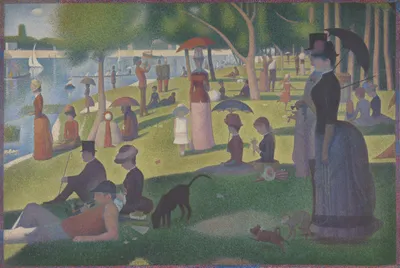
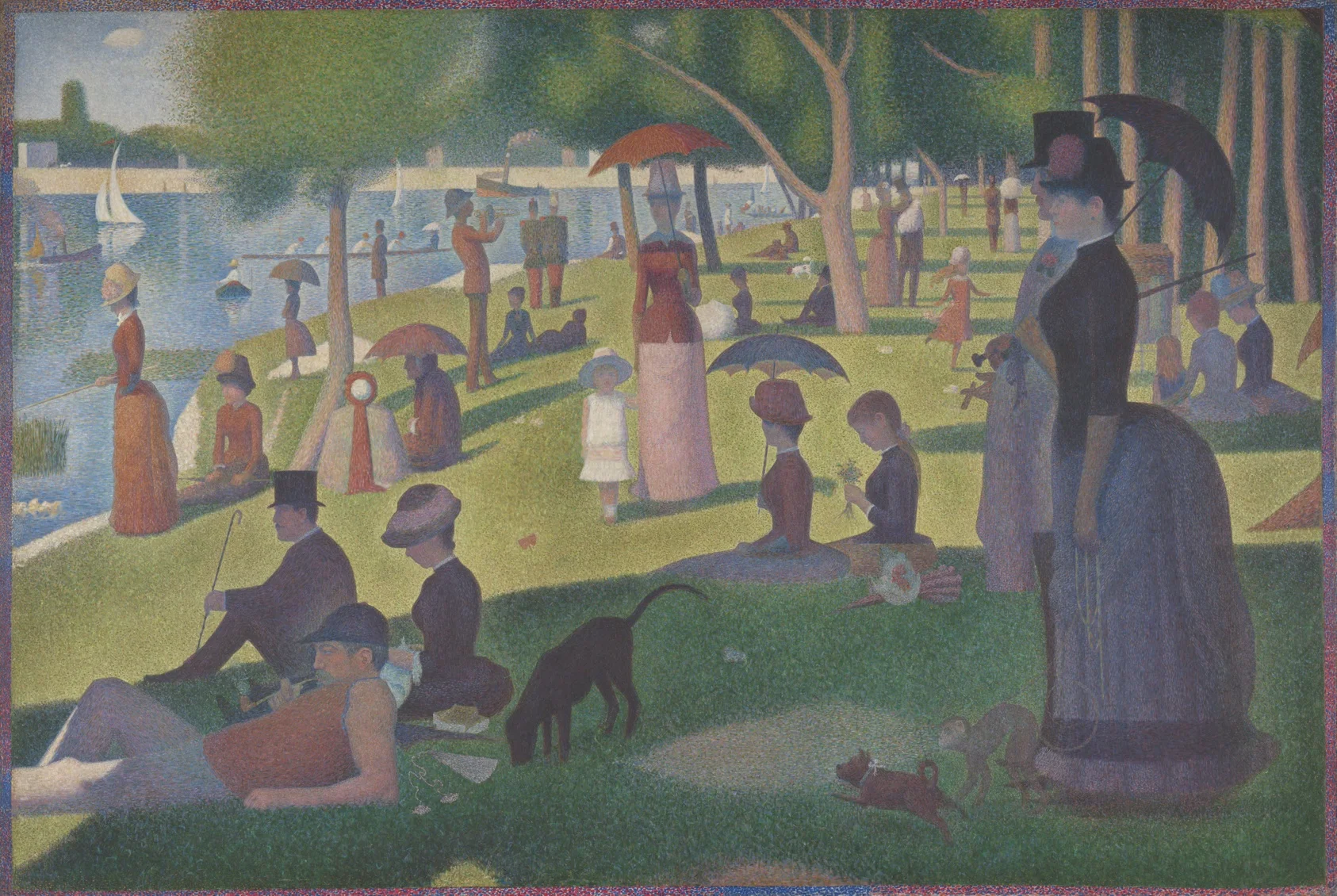
A Sunday on La Grande Jatte — 1884, 1884–86, border added 1888–89. Georges Seurat. Art Institute of Chicago.
Look closer
7 things to notice
 1
01
The only one who sees you
Near the middle, a small girl in a white dress and bonnet stands in full sun, her eyes turned straight out of the picture at us. Everyone around her faces the river, or each other, or nothing at all. It is as if she alone has noticed that someone is watching.
02
Dressed to be seen
At the right, a woman in a dark jacket and a great bustle holds a black parasol beside a man in a top hat, both in strict profile, facing left. In the 1950s the Marxist philosopher Ernst Bloch read social and political meaning into the painting's stiff, mechanical figures, and these two seem the stiffest of all. They look less like people taking a walk than like people taking part in one.
03
A little wildness on a leash
In front of her skirt, a small brown monkey with a long curled tail is on the end of her leash. A small reddish pug runs across the grass towards it, and that dog seems to be the only thing in the whole picture in a hurry. The monkey seems ready to make the one scene this Sunday will allow.
04
A rod with a second meaning
At the water's edge, a woman in an orange-brown dress and a yellow hat holds a long thin rod out over the river. Her fishing rod has been read as a likely reference to prostitution, which the area was known for. Even on a respectable Sunday, the park seems to keep a second life.
05
At attention on their day off
In the middle distance, two small figures in dark jackets and red trousers stand side by side. They are soldiers standing at attention, in a park, on a Sunday, as if no one had told them they could rest. Their red is one of the few hot notes in all that shade.
06
The only ones going anywhere
At the upper left, white sails and a small rowing boat are out on the blue river, with the far bank behind them. Everyone on the grass has come to stay; only the boats seem to be going anywhere. The way out of the picture is the river.
07
He came back to frame it
A narrow band of red, orange and blue dots runs all the way around the edge. The painting was first shown in an unusual white frame; later, Seurat stretched the canvas again and painted this border onto it himself. It is as if, years after it was finished, he still couldn't leave it alone.
Our take
A Sunday on La Grande Jatte is Georges Seurat's largest and best-known painting: Parisians at leisure in a park on the Seine, strolling, lounging, sailing and fishing, built from tiny dabs of color meant to merge in the eye. Almost nothing in it moves. A crowd has come out for the sun, and nearly every one of them sits in the shade. Everyone is together, and each of them seems alone.
Seurat seems to have wanted it that way. As William Everdell reports, he told the critic Gustave Kahn that his model was the Panathenaic procession on the Parthenon frieze: modern people filing past in their essential form. So he gave one Sunday afternoon the stillness of carved stone, and spent two years making it last.
The painter's moment
French, 1859–1891Neo-Impressionism
Georges Seurat was about 25 when he began it, in 1884. Earlier that year the Paris Salon had rejected Bathers at Asnières, so in May he showed it with the Indépendants instead. For the new picture he spent much of the next two years sketching in the park itself, and about 60 studies survive, among them a complete oil study. He painted the big canvas in two campaigns, May 1884 to March 1885 and October 1885 to May 1886. At first he was still blending several pigments together and reaching for muted earth colors, ochre and burnt sienna among them. The even, near-identical dots came only in the second year, drawing on the color theories of Michel Eugène Chevreul and Ogden Rood. He called the method Divisionism; it is now known as Pointillism. The painting was first shown in May 1886, at the eighth and last Impressionist exhibition. In August it dominated the second Salon of the Société des Artistes Indépendants, which he had helped found in 1884, and it made him the recognized leader of Neo-Impressionism.
He wasn't finished with it. In 1888–89 he came back and added the painted border. In 1889 the model Madeleine Knobloch moved into his studio on the Boulevard de Clichy, and their son, Pierre-Georges, was born on 16 February 1890. Seurat died at his parents' home in Paris on 29 March 1891, aged 31, and his mother, Ernestine, owned the painting until 1899. It came to Chicago through the collection of Frederic Bartlett and Helen Birch Bartlett, bought in 1924 on the advice of the Art Institute's curators. It has been lent out only once, to MoMA in 1958, when a fire there forced its emergency evacuation.
In its time
A Sunday on La Grande Jatte — 1884 was painted in 1884–86, border added 1888–89, when Seurat was 25. Where it stands on Art Through Time:
Its colors
Elsewhere in the world
- 1881Pogroms sweep the empireSome two million Jews leave for America and beyond by 1914.
- 1884The Berlin ConferenceEurope's powers divide Africa among themselves.
- 1885Leopold II takes the CongoHis forced-labor regime costs millions of lives.
- 1885The Indian National Congress is foundedThe movement for self-rule takes shape.
- 1887French Indochina is formedFrance rules Vietnam and Cambodia, and later Laos.
In the museum's words
For his largest and best-known painting, Georges Seurat depicted Parisians enjoying all sorts of leisurely activities—strolling, lounging, sailing, and fishing—in the park called La Grande Jatte on the River Seine. He used an innovative technique called Pointillism that was inspired by optical and color theory, applying tiny dabs of different colored paint that viewers would see as a single, and Seurat believed, more brilliant hue.
Art Institute of Chicago · CC BY 4.0
The facts
- Title
- A Sunday on La Grande Jatte — 1884
- Artist
- Georges Seurat (French, 1859–1891)
- Date
- 1884–86, border added 1888–89
- Original medium
- Oil on canvas
- Style
- Neo-Impressionism
- Made in
- France
- Collection
- Art Institute of Chicago
Living with it
The mood
Unhurried and shaded, like the long middle of a summer afternoon. It gives a room the quiet of people who have nowhere they need to be. Nothing in it asks for attention; it simply holds still.
The palette
Seen whole, it is the soft grey-green of shade on a summer lawn, which is where nearly everyone in it sits. Part of that softness is time: the bright zinc yellow Seurat used for the sunlit grass has turned brown over the years, and it was already turning while he lived. The color comes in small notes against it: an orange-brown dress, red trousers, a girl in white, the sails.
Who it finds
- Anyone who has spent a whole Sunday doing nothing on purpose, and remembers it as one of the good days.
- People who watch strangers in a park and quietly invent a life for each of them.
- Anyone who has worked on one thing for years, called it finished, and still gone back to it one more time.
See it in a room
Your photo is never uploaded, and it's gone when you leave.
From across a room it reads as broad bands: dark shade in front, a strip of sunlit lawn, the blue of the river, with the figures standing in profile like a frieze. Come close and it breaks into dots, and into the small things: the monkey, the running pug, the soldiers, the sails, the border of colored dots.
The painting itself is about 2 metres high and 3 metres wide, a long, wide view. It belongs on a long wall where people gather and linger: over a sofa, along a dining room, at the end of a hallway. Give it width, enough that the two soldiers and the monkey can be read from where you sit.
How we make it
- True to the original
- Each file is color-matched to the museum original. If the color isn't right, we print it again, with our compliments.
- On canvas
- Fine-art canvas hand-stretched over a ¾″ solid-wood frame, with mirrored edges so nothing is lost.
- In our floating frame
- Our stretched canvas set in a slim floating frame, with a shadow gap so the painting seems to hover.
- As a framed print
- Archival pigment print on museum-grade cotton paper, in a solid-wood frame with UV-protective glazing.
- Ready to hang on arrival
- It arrives with the hanging hardware attached. No framer, no guesswork.
- Perfect on arrival
- If anything arrives damaged or not as you ordered, send us a photo within 7 days of delivery and we'll make it again, with our compliments.
Seurat spent two years on one Sunday afternoon by the Seine, and it still hasn't ended. Give it a long wall and let it go on.