The story · 4 min read
The bird is running out of air, and the man at the pump is looking at you.
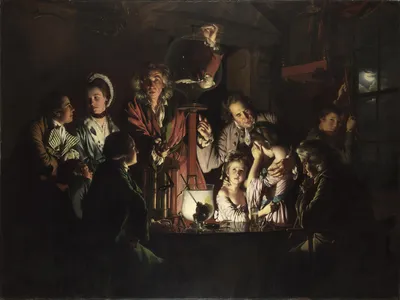
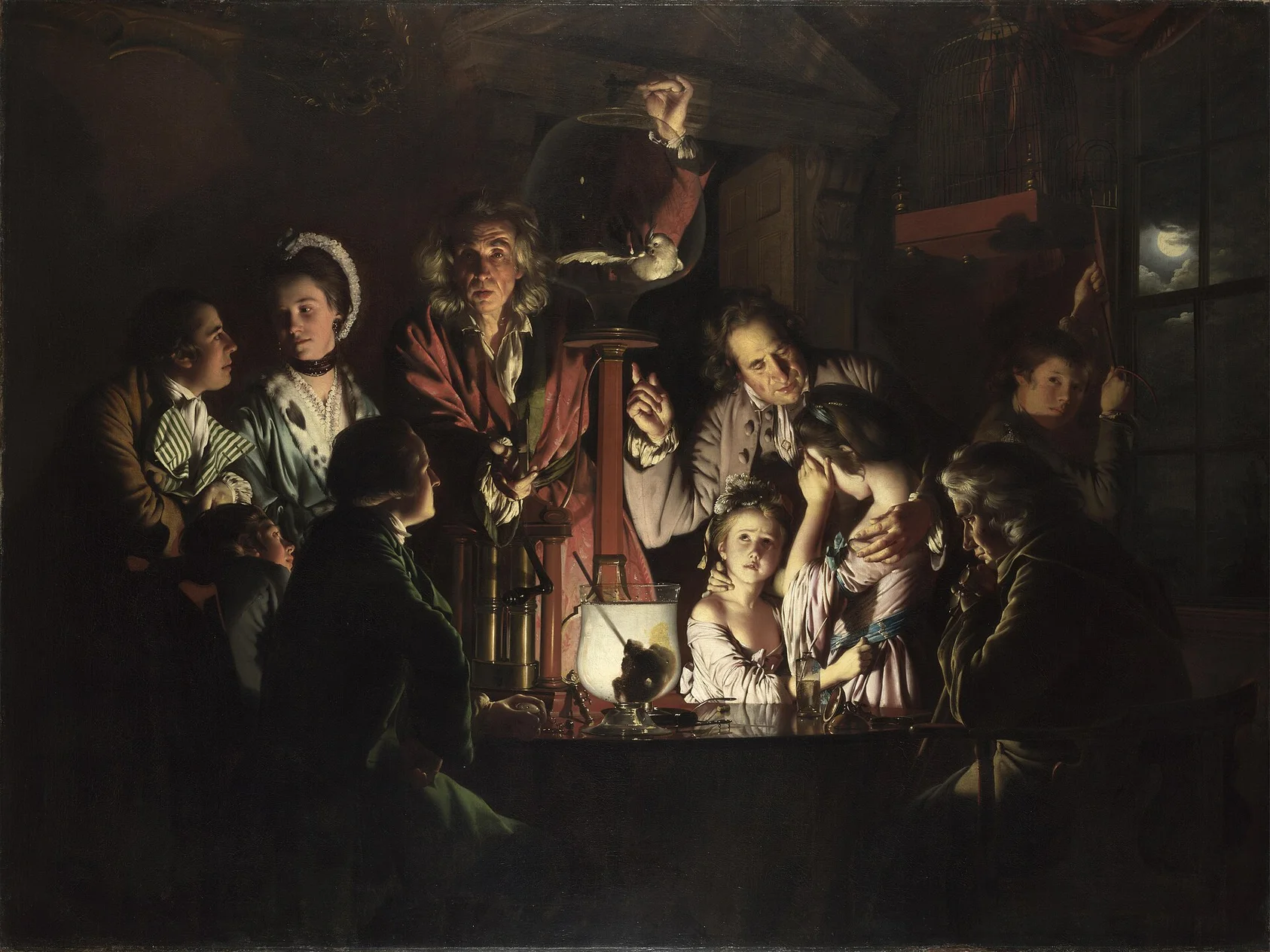
An Experiment on a Bird in the Air Pump, 1768. Joseph Wright of Derby. National Gallery, London.
Look closer
7 things to notice
 1
01
A bird too precious to lose
At the bottom of the glass a grey cockatiel lies sprawled with its wings spread, panicking as the air is drawn out. In 1768 a cockatiel was a rare bird, far too valuable to risk in a real experiment like this one, which makes it look like a deliberate choice. Writers have compared the bird and the two nearest figures to Early Netherlandish pictures of the Trinity, where a dove stands for the Holy Spirit.
02
The question is for you
With his wild grey hair and red robe, the philosopher seems to be the only one in the room looking out of the picture. His eyes are on us, as if asking us to decide whether he should keep pumping. Every other face is turned toward the glass or away from it; his is turned toward the one person who can't answer.
03
One can't look, one can't look away
The older girl covers her face and turns from the glass, while her small sister stares up at the bird, wide-eyed. Their father leans over them with a hand on the older girl's shoulder, comforting her. In an early study found on the back of a self-portrait, the philosopher comforts the girls and the bird clearly survives; in this one, nobody can be sure.
04
An empty cage, rising or falling
At the back on the right, a boy holds the cord of the empty cage that hangs near the ceiling. We can't tell if he is lowering it for the bird's return or raising it because the bird will die. The biographer Jenny Uglow sees him as an echo of a figure in the last print of Hogarth's series The Four Stages of Cruelty.
05
A full moon for the philosophers
Through the window on the right, a full moon shines among dark clouds. It has been read as a nod to the Lunar Society, whose monthly meetings were held at full moon. It is the only light Wright lets you see whole; the candle that lights every face is hidden.
06
Lit by a reminder of death
A glass bowl of liquid glows from the candle hidden behind it, and something dark and roughly round sits in the water. William Schupbach reads it as what may be a human skull, and the skull together with the candle as a vanitas: two reminders of death. It is as if the whole room were lit by the very thing the bird is facing.
07
The only two not watching
On the left, a young man in a striped waistcoat and a young woman in a white lace cap pay attention only to each other. Some have suggested that Thomas Coltman and Mary Barlow, friends of Wright, were the models, though Wright himself never named anyone in the picture. They seem to be the only ones in the room who haven't noticed the bird.
Our take
Look first at the glass. A grey cockatiel lies at the bottom with its wings spread as the air is pumped out around it, and the man with his hand on the valve is looking at you, not at the bird. Joseph Wright of Derby painted this natural philosopher repeating one of Robert Boyle's experiments in 1768, and turned it into a question. Everyone in the room is waiting on one hand, and the hand seems to be waiting on you.
Then count the faces, because each one is a different way of watching. A small girl can't look away, her sister can't look at all, a man times it, two lovers notice only each other, and an old man bows his head over his thoughts. The historian David Solkin argues that these onlookers feel little sympathy for the bird itself; we read the picture as asking which of them we would have been.
The painter's moment
1734–1797Painted it at 34Rococo
Joseph Wright of Derby was about 34 and still unmarried. His mother had died in 1764, and his father, an attorney and town clerk of Derby, died in 1767, the year before this painting. That same year Wright first saw Erasmus Darwin about his health and stayed a week with the Darwin family. He had painted the first of his candlelit scenes, Three Persons Viewing the Gladiator by Candlelight, in 1765, and A Philosopher Lecturing on the Orrery, now in Derby Museum and Art Gallery, in 1766. He showed the Air Pump at the Society of Artists exhibition in 1768, and that September King Christian VII of Denmark was shown it. From 1768 to 1771 he worked in Liverpool, painting portraits.
Dr Benjamin Bates, who already owned the Gladiator picture, bought it; Wright's account book records only £30 received from him in part payment. John Boydell published Valentine Green's mezzotint of it on 24 June 1769, at 15 shillings. Wright's next science painting was The Alchemist Discovering Phosphorus in 1771. The Air Pump failed to sell at Christie's in 1854, and Edward Tyrell gave it to the National Gallery, London in 1863. It was on loan to Derby Museum and Art Gallery from 1912 to 1947, moved to the Tate in 1929, and went back to the National Gallery in 1986, which in 2025 gave it its own exhibition, Wright of Derby: From the Shadows.
In its time
An Experiment on a Bird in the Air Pump was painted in 1768, when Derby was 34. Where it stands on Art Through Time:
Its colors
Elsewhere in the world
- 1767Ayutthaya fallsBurmese armies destroy the Thai capital; Bangkok rises in 1782.
- 1770The Bengal famineMillions die under East India Company rule.
- 1770Cook charts Australia's east coastEuropean contact in the Pacific.
The facts
- Title
- An Experiment on a Bird in the Air Pump
- Artist
- Joseph Wright of Derby (1734–1797)
- Date
- 1768
- Original medium
- Oil on canvas
- Style
- Rococo
- Made in
- United Kingdom
- Collection
- National Gallery, London
Living with it
The mood
Hushed and wide awake. It doesn't darken a room so much as gather it around one light, the way a story told by candlelight makes everyone lean in. A painting that starts conversations and doesn't quite let them end.
The palette
Nearly all of it is the brown and black of a room after dark: lamp soot and old wood. One hidden candle breaks it, falling on the faces, the glass globe and the philosopher's red robe, and from across a room that glow is what you see.
Who it finds
- Anyone who has asked a question and then feared the answer. The man at the pump is still waiting for one.
- People who have stood in a crowd watching something they couldn't stop, and wondered afterwards which face was theirs.
- Those who need to know how things work, and have learned at least once what finding out can cost.
See it in a room
Your photo is never uploaded, and it's gone when you leave.
From across a room it reads at once: a ring of lit faces around a glowing globe, with the night all around them. Up close it becomes a game of looking: the cage on its cord, the moon in the window, the dark thing in the bowl, and each face's different answer to the same question.
It belongs where people talk and think: a study, a library, a dining room where guests stay late. Give it size. Wright painted it about 183 by 244 cm, and the small things that carry its meaning need room to be read from a chair.
How we make it
- True to the original
- Each file is color-matched to the museum original. If the color isn't right, we print it again, with our compliments.
- On canvas
- Fine-art canvas hand-stretched over a ¾″ solid-wood frame, with mirrored edges so nothing is lost.
- In our floating frame
- Our stretched canvas set in a slim floating frame, with a shadow gap so the painting seems to hover.
- As a framed print
- Archival pigment print on museum-grade cotton paper, in a solid-wood frame with UV-protective glazing.
- Ready to hang on arrival
- It arrives with the hanging hardware attached. No framer, no guesswork.
- Perfect on arrival
- If anything arrives damaged or not as you ordered, send us a photo within 7 days of delivery and we'll make it again, with our compliments.
Wright posed the question in 1768, and the man at the pump is still waiting for an answer. Give him a wall where he can ask it.


.jpg&w=200)