The story · 4 min read
The room gives us evidence. It keeps the occasion to itself.
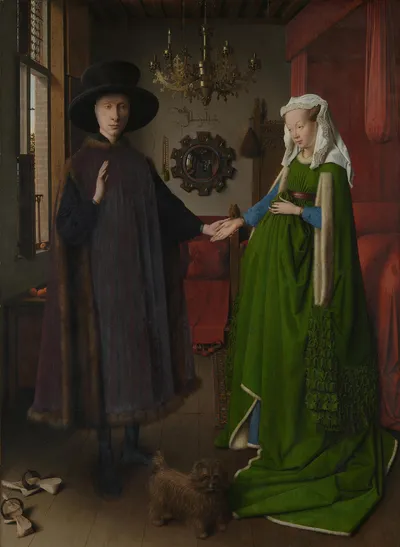
Arnolfini Portrait, 1434. Jan van Eyck. The National Gallery, London.
Look closer
7 things to notice
 1
01
The visitors enter through a reflection
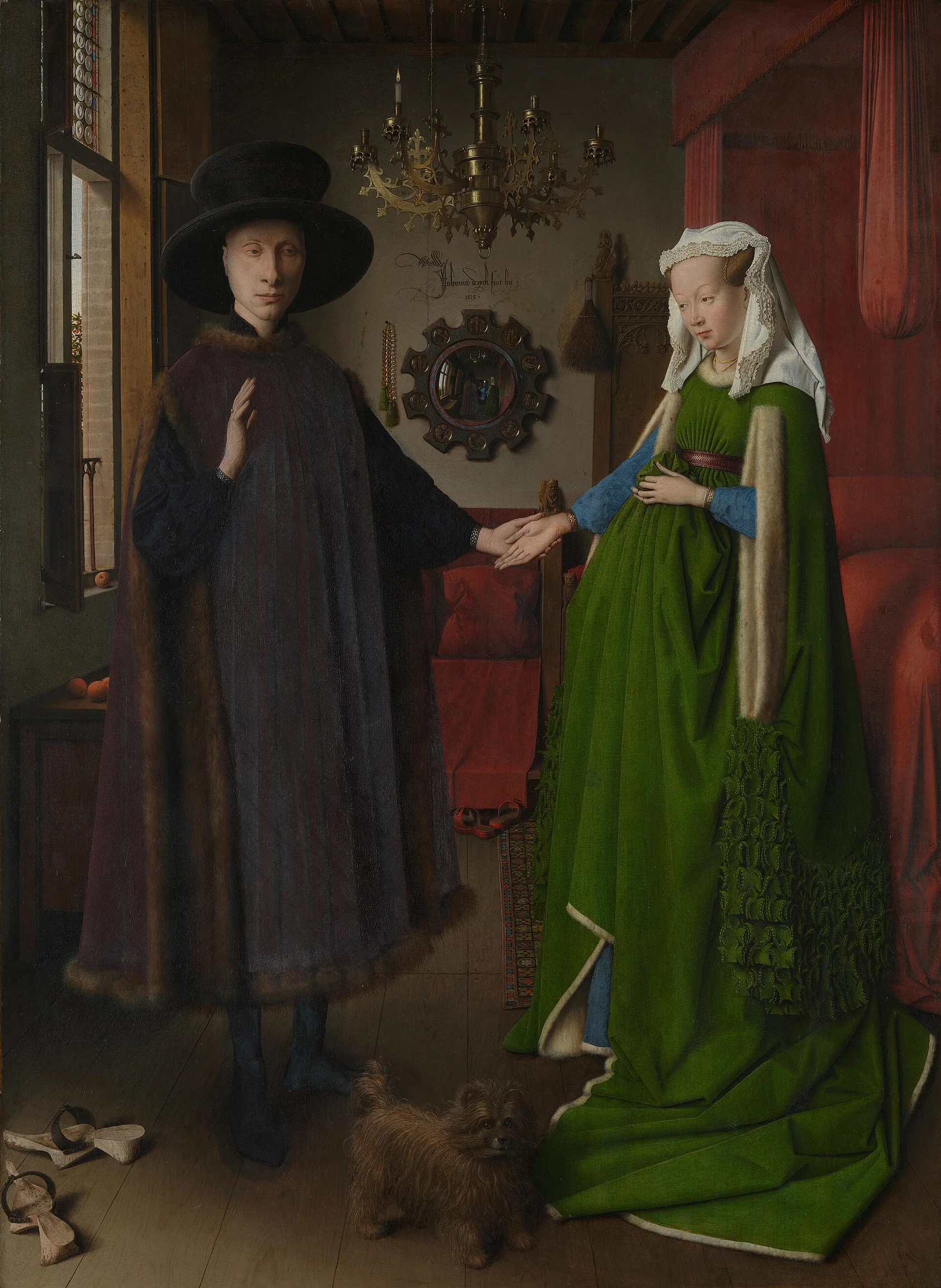
The convex mirror contains the couple's backs and two small figures in a doorway. The National Gallery suggests that one visitor could be van Eyck, whose dated inscription is just above. It remains a possibility, not an identified self-portrait. The glass gives the room an entrance behind our own position.
02
The dog came later
A small brown dog stands between the couple, its coat built from fine pale strokes. Rachel Billinge and Lorne Campbell's infrared study found that the dog was added without an underdrawing. The image did not emerge from one fixed plan. Van Eyck found room for this little animal while painting.
03
A gesture changed its meaning
Their hands meet near the center, her palm supported by his fingers. Billinge and Campbell found changes in the man's raised hand elsewhere in the design and proposed a more welcoming final gesture. That evidence complicates a fixed wedding ritual. The hands belong to a composition the painter kept adjusting.
04
The cloth explains the shape
Green fabric gathers under the woman's hand and falls in deep folds. The National Gallery cautions that the apparent pregnancy is an effect of fashionable, bulky dress, not evidence that she was expecting a child. Fur lining adds still more volume. Her hand is carrying a substantial amount of cloth.
05
The fruit cost something
Oranges sit on the chest under the window, small warm circles in the shadow. Ayla Lepine at the National Gallery explains that they were expensive in Northern Europe and advertise the household's wealth. A familiar fruit had a different status here. These oranges could impress a visitor before anyone offered one.
06
One flame leaves a question
A single candle burns in the brass chandelier despite the daylight. Panofsky connected it with the sacred character of a marriage, but that reading depends on his disputed account of the scene. Billinge and Campbell found the chandelier among the late additions. The flame cannot establish a wedding by itself.
07
The street stops at the floor
Wooden pattens lie at lower left, their pale soles separate from the man's stockinged feet. Lorne Campbell draws attention to the carefully painted mud on them. Such an ordinary mark can make the whole room seem observed from life. Van Eyck included the dirt along with the expensive furnishings.
Our take
The mirror admits two more people than the room first seems to contain. They stand in the doorway behind us, tiny figures reflected beyond the couple's backs. Above them, van Eyck has written that he was here in 1434. Everything feels like evidence of a particular visit. Yet the painting does not tell us exactly what happened during it.
Erwin Panofsky read the scene as a marriage record, with the painter acting as a witness. The National Gallery now treats that famous explanation cautiously: even the woman's identity remains uncertain. What we can say is that the room is expensive, the clothes are elaborate, and the couple present themselves to an audience. The dog looks directly out while the man keeps his hand raised.
The painter's moment
1390–1441Painted it at 44Early Netherlandish painting
In 1434, Jan van Eyck was established in Bruges, a trading city in what is now Belgium, and employed by Philip the Good, Duke of Burgundy. His work had already taken him abroad on the duke's business, including a journey to Portugal in 1428 connected with a proposed marriage. Portraiture belonged to diplomacy as well as private life. The Ghent Altarpiece had been completed in 1432; around those years he also married Margaret and set up a household. Their first child was born in 1434. The double portrait therefore comes from a period when court service, major commissions and family life overlapped.
The exact arrangement with the Arnolfini household is lost. The National Gallery favors Giovanni di Nicolao Arnolfini as the man, with an unidentified wife. That gap matters: the small oak panel gives us a remarkably specific interior without a surviving account of the visit or occasion. Infrared examination shows van Eyck changing figures and adding objects as he worked, a practical process behind the room's apparent completeness. The painting entered the National Gallery in 1842. By then van Eyck's name and date were still readable on the wall, but the people and event had to be reconstructed through records and competing interpretations.
In its time
Arnolfini Portrait was painted in 1434, when Van Eyck was 44. Where it stands on Art Through Time:
Its colors
Elsewhere in the world
- 1438The Inca expand under PachacutiAn empire along the Andes.
The facts
- Title
- Arnolfini Portrait
- Artist
- Jan van Eyck (1390–1441)
- Date
- 1434
- Original medium
- Oil on oak panel
- Style
- Early Netherlandish painting
- Made in
- Belgium
- Collection
- The National Gallery, London
Living with it
The mood
A furnished room opens inside the room around it. Green cloth and red bed hangings occupy opposite sides of a brown interior; a little mirror promises another view. The figures stand close enough for their small possessions to matter.
The palette
Walnut and bark color the wooden floor and furniture; ebony gathers in the man's clothing. Olive belongs to the deep green dress, flax to the lit wood and fur. The stronger green and red blocks carry across a room before the mirror or fruit becomes clear.
Who it finds
- For someone who has studied a family photograph for clues about an occasion; this room supplies objects without a complete explanation.
- For someone who remembers the best clothes brought out for visitors; the heavy fabric makes that care visible.
- For someone whose dog always reached the doorway first; the smallest figure here is already looking directly at us.
See it in a room
Your photo is never uploaded, and it's gone when you leave.
From a few steps away, the two figures and the red-and-green division establish the room. Closer, the mirror, beads and dog demand another scale of attention. The picture rewards a position where someone can move forward without having to step around a sofa or a low table.
A study, hall landing or space near a reading chair suits that double encounter. A medium or larger upright print helps the tiny reflected visitors remain legible. Keep the area around it relatively simple; the painted room already contains enough furniture and objects to occupy a long look.
How we make it
- True to the original
- Each file is color-matched to the museum original. If the color isn't right, we print it again, with our compliments.
- On canvas
- Fine-art canvas hand-stretched over a ¾″ solid-wood frame, with mirrored edges so nothing is lost.
- In our floating frame
- Our stretched canvas set in a slim floating frame, with a shadow gap so the painting seems to hover.
- As a framed print
- Archival pigment print on museum-grade cotton paper, in a solid-wood frame with UV-protective glazing.
- Ready to hang on arrival
- It arrives with the hanging hardware attached. No framer, no guesswork.
- Perfect on arrival
- If anything arrives damaged or not as you ordered, send us a photo within 7 days of delivery and we'll make it again, with our compliments.
Van Eyck dated this encounter 1434. Give its mirror and small possessions a place where a closer look is easy to take.