The story · 4 min read
The sitter lost patience before the coat was finished.
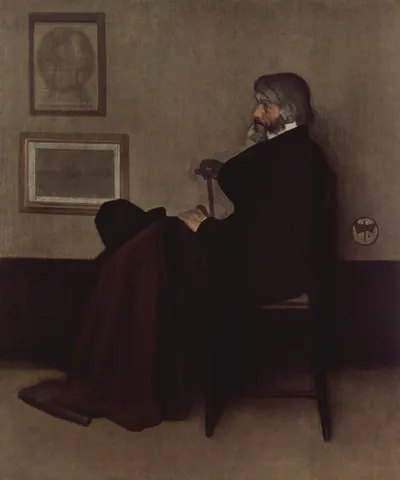
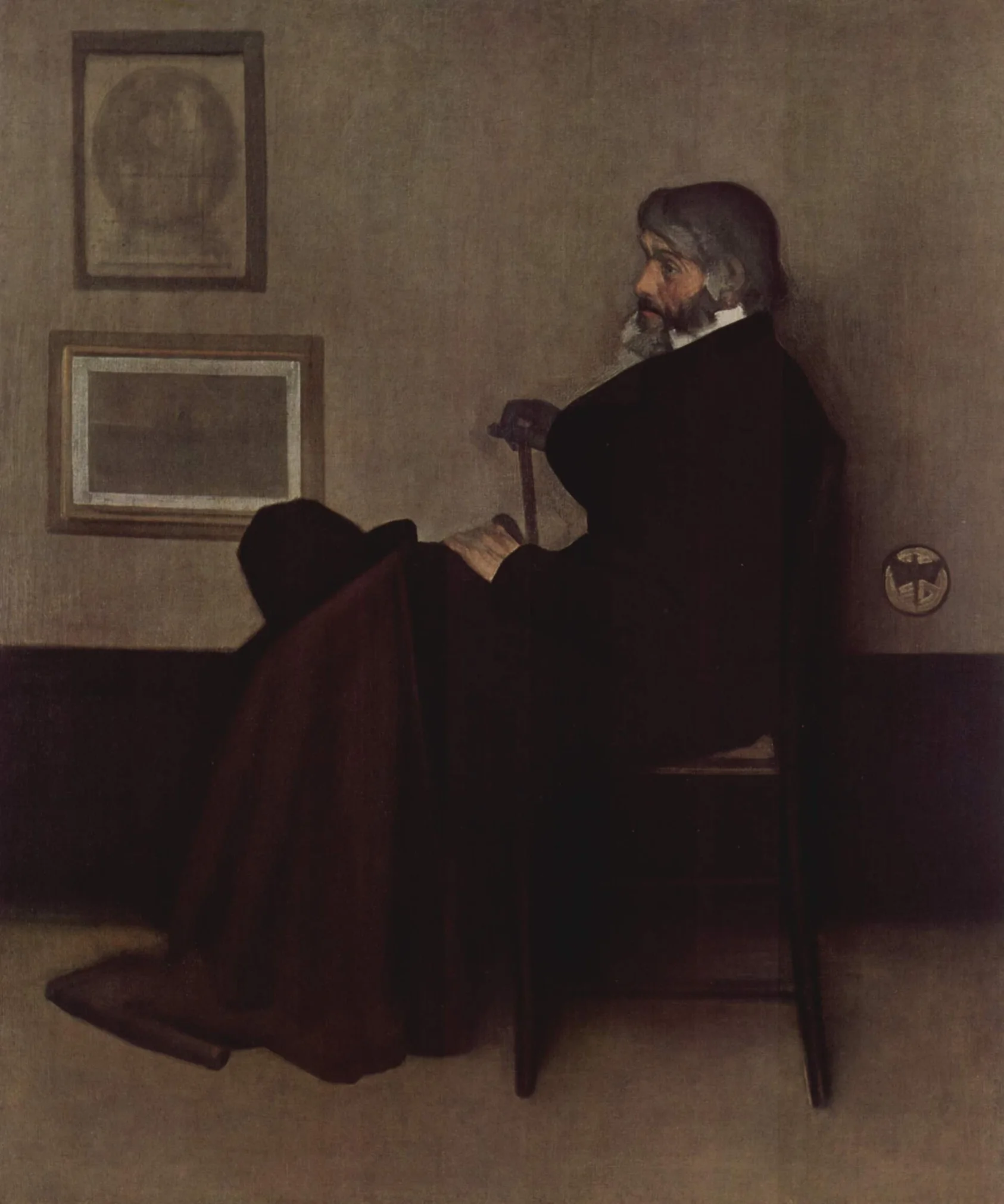
Arrangement in Grey and Black, No. 2: Portrait of Thomas Carlyle, c. 1873. James McNeill Whistler. Glasgow Museums, Kelvingrove Art Gallery and Museum, Glasgow.
Look closer
7 things to notice
 1
01
A little paint makes a face
The cheek and beard emerge from thin brown and gray passages at upper right. The University of Glasgow's technical catalog records a lightly painted head, in contrast with thicker work at the collar and shoulders. That difference gives the face a delicate surface above the greatcoat. A few pale marks make the beard readable.
02
Someone else wore the coat
Dark cloth covers the knees in a broad, nearly unbroken area. Allingham reported Carlyle's impatience with the repeated work on it; the Pennells later recorded a substitute sitter for the coat. The catalog leaves that person's exact identity uncertain. Even an empty-looking fold could require another appointment.
03
One hand keeps its glove
A dark gloved hand closes around the walking stick in front of the chest. The Glasgow catalog identifies this as Carlyle's right hand, a small distinction within the near-black clothing. The glove makes the visitor's outdoor equipment part of the pose. Its fingers are almost absorbed by the coat.
04
The writer arrives without books
A black felt hat balances on the knee, its rounded crown outlined against the wall. Glasgow Museums identifies Carlyle as the author of major histories, including The French Revolution. Whistler supplies no desk or open book to announce that work. The hat belongs to someone who has come to sit.
05
The studio stays in view
The lower framed picture hangs against the gray wall at left, its subject indistinct in this copy. The Glasgow catalog places the sitting in Whistler's second-floor back studio at 2 Lindsey Row, with gray walls above a black lower section. The setting belongs to the painter. Carlyle has entered another man's working room.
06
The chair changed direction
The chair's dark legs stand beneath the coat at lower right. Technical examination recorded traces of earlier legs between and beside the final ones, consistent with a chair once set at a greater angle. The finished pose was adjusted during painting. What looks settled took more than one arrangement.
07
The painter adds his own mark
A butterfly sits inside a small round field on the wall at right. It is Whistler's signature, identified in the catalog, rather than a decorative insect in Carlyle's room. The same broad brush used for the hair also defined this emblem. The painter gives himself a compact place beside the sitter.
Our take
The coat takes up more space than the famous man inside it. Thomas Carlyle sits sideways, his hat on his knees, his face high against a nearly bare wall. Whistler lets the great dark shape occupy most of the picture. A historian known for forceful writing has become a man waiting in a chair.
The waiting was real. Whistler asked for a few sittings, then kept Carlyle coming back into the following year. William Allingham recorded the sitter's complaint that the painter cared excessively about getting the coat right. Another model eventually posed for it, according to the account preserved in the University of Glasgow catalog. The face was recognizable enough for Carlyle to approve it. The troublesome coat remained spread across his knees.
The painter's moment
1834–1903Painted it at 39Aestheticism
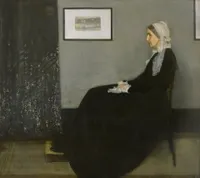
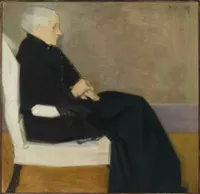
In 1872, James McNeill Whistler had recently painted his mother in a seated profile against a gray wall. The Royal Academy had nearly rejected that portrait. Carlyle's response was more encouraging: after seeing it in the studio with their mutual friend Emilie Venturi, he agreed to sit. They were neighbors in Chelsea, the London district beside the Thames, so the journey was short. The process was not. Sittings continued into July 1873, and Carlyle grew tired of a painter who seemed endlessly occupied with the clothing. His niece Mary nevertheless reported that he was beginning to admire the likeness.
Whistler made studies and revised the chair before arriving at the final structure. He exhibited the painting in his first solo show in 1874, supported by his patron Frederick Leyland. A sale did not follow promptly. By 1878 the portrait was serving as security for a loan, part of the financial trouble that complicates its ownership history. Glasgow bought it in 1891 after local artists supported the acquisition; it became the first Whistler painting in a public collection. That recognition came almost twenty years after the sittings. The city now also addresses Carlyle's racist defense of slavery, refusing to let the dignity of the portrait stand as a complete account of the man.
In its time
Arrangement in Grey and Black, No. 2: Portrait of Thomas Carlyle was painted around 1873, when Whistler was 39. Where it stands on Art Through Time:
Its colors
Elsewhere in the world
- 1869The transcontinental railroadThe West opens to painters and tourists.
- 1870The Wanderers break awayRealist painters leave the Academy to paint ordinary life.
- 1874The first Impressionist exhibitionArtists show on their own terms in Paris.
- 1875Fort Marion ledger drawingsImprisoned Plains artists draw their world.
- 1876Centennial Exhibition, PhiladelphiaAmerica measures its art against the world.
The facts
- Title
- Arrangement in Grey and Black, No. 2: Portrait of Thomas Carlyle
- Artist
- James McNeill Whistler (1834–1903)
- Date
- c. 1873
- Original medium
- Oil on canvas
- Style
- Aestheticism
- Made in
- United States
- Collection
- Glasgow Museums, Kelvingrove Art Gallery and Museum, Glasgow
Living with it
The mood
A seated figure gives the room a large dark shape with a small, sharply lit face. The wall inside the painting is mostly empty. Hat, stick and coat make the stillness feel temporary, as though a visitor has kept his outdoor things.
The palette
Ebony and clove occupy the coat and lower wall; walnut, bark and bronze name the warmer grays in this reproduction's background and floor. The narrow white collar is the strongest small contrast. From farther away, the silhouette matters more than any individual color.
Who it finds
- For someone who has waited through another person's exacting work; the coat took longer than its owner wanted.
- For someone who remembers a visitor keeping hat and gloves close by; Carlyle has brought both into the sitting.
- For someone whose opinion of a writer has changed with more reading; the face can remain compelling while the history becomes harder.
See it in a room
Your photo is never uploaded, and it's gone when you leave.
Across a room, the head sits above a single broad area of darkness. At close range, the glove, butterfly and fine changes in the face become legible. The picture benefits from even light; a dim corner would lose much of what separates the coat from the chair.
A study, library or spacious hall gives the upright figure enough distance and room to approach. Choose a medium or large print if the small signature matters. Simple nearby furniture can echo the chair without competing with it, while a pale mat can clarify the edges of this particularly dark reproduction.
How we make it
- True to the original
- Each file is color-matched to the museum original. If the color isn't right, we print it again, with our compliments.
- On canvas
- Fine-art canvas hand-stretched over a ¾″ solid-wood frame, with mirrored edges so nothing is lost.
- In our floating frame
- Our stretched canvas set in a slim floating frame, with a shadow gap so the painting seems to hover.
- As a framed print
- Archival pigment print on museum-grade cotton paper, in a solid-wood frame with UV-protective glazing.
- Ready to hang on arrival
- It arrives with the hanging hardware attached. No framer, no guesswork.
- Perfect on arrival
- If anything arrives damaged or not as you ordered, send us a photo within 7 days of delivery and we'll make it again, with our compliments.
Painted in 1872–73, Carlyle's patient-looking pose concealed difficult sittings. Give the dark coat enough light for its small distinctions to remain visible.