The story · 4 min read
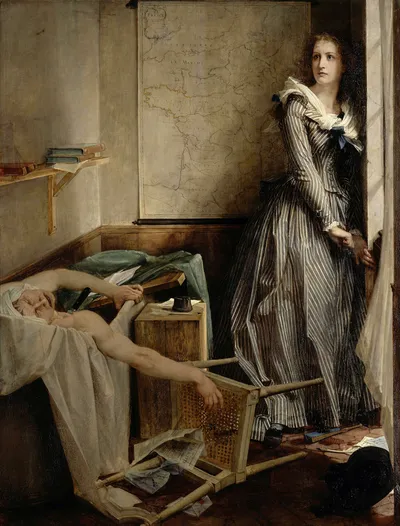
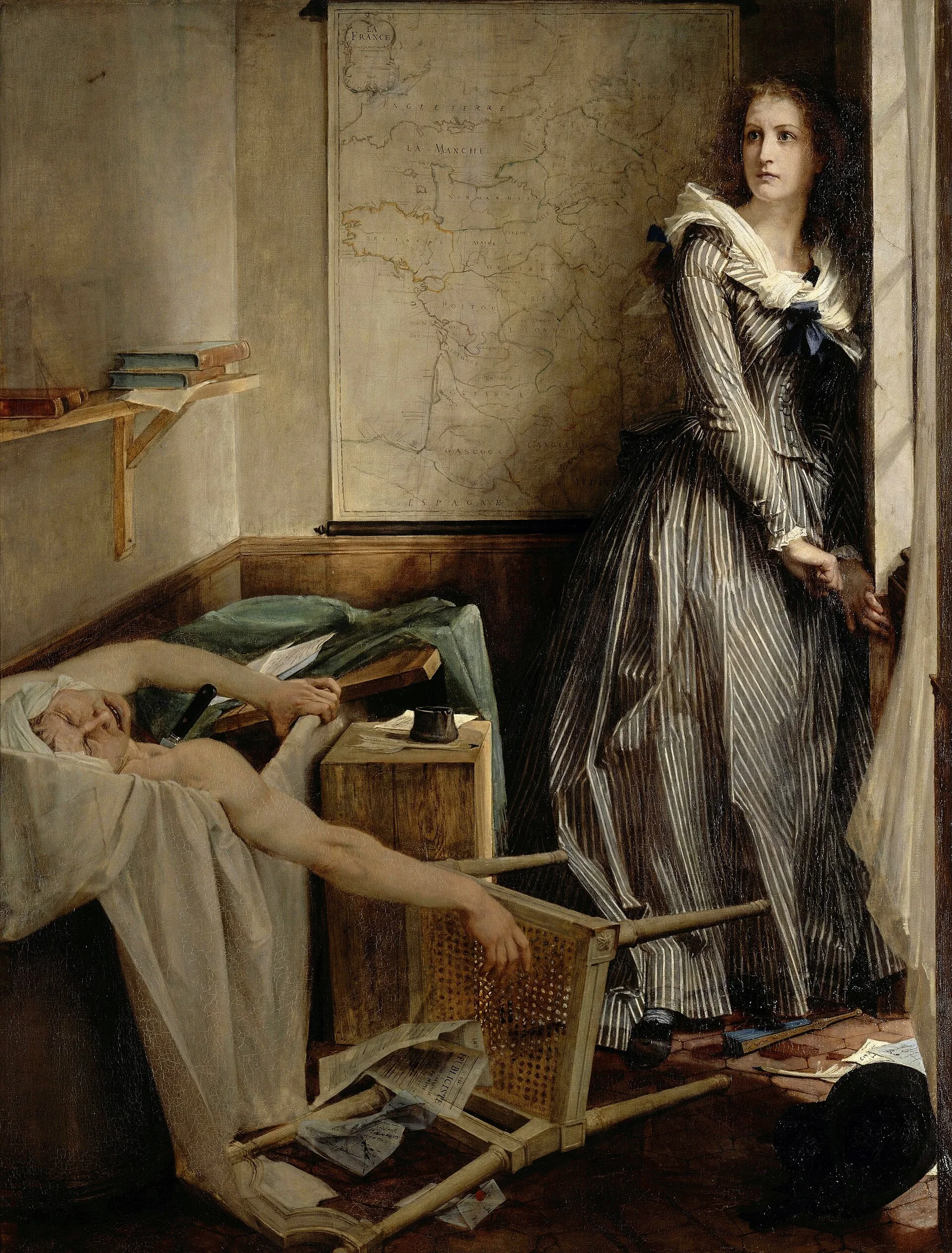
The killing is over; the room has not yet settled around it.
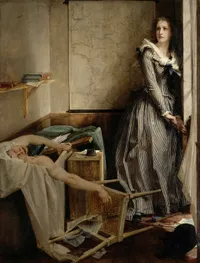
Charlotte Corday, 1860. Paul-Jacques-Aimé Baudry. Musée d'arts de Nantes.
Look closer
7 things to notice
 1
01
The face will not explain itself
Corday's eyes look past the bath beneath loose brown hair. The Nantes museum describes her as fixed in place after the murder and notes that critics questioned her resemblance to earlier portraits. Baudry's Charlotte Corday offers a visible expression without settling its meaning. Light follows the edge of her cheek.
02
A country fits behind her
A map of France fills the wall behind Corday. The Musée historique de l'environnement urbain proposes a reading of her as a wounded France, while allowing a less heroic interpretation. The map does not settle that disagreement. Normandy and the Channel remain printed above the figure's shadow.
03
The hands have nothing left
Both hands hang near the window edge, clear of the weapon. Nantes identifies this as the moment after Corday has stabbed Marat. The pose leaves the completed act elsewhere in the room while her hands remain in the light. Her fingers stop just short of the pale curtain.
04
The furniture remembers the movement
Marat's arm extends over a chair lying on its side. The Musée historique de l'environnement urbain describes Baudry's scene as the same death approached from a different angle than David's. That changed view exposes more of the room's disruption. The dead hand hangs over the woven chair back.
05
The work was close to hand
A dark inkwell sits on a wooden box beside the bath. The Musée historique de l'environnement urbain identifies this improvised table among the furnishings shared with David's account. Marat's working space remains within arm's length of the water. The small black vessel stands upright above the scattered papers.
06
The dress met an objection
Narrow stripes follow the bodice beneath a white collar and dark bow. According to Nantes, Salon critics compared this clothing with accounts of Corday wearing white on the day of the murder. A researched scene could still provoke disagreement over a dress. The dark bow interrupts the pale stripes.
07
These books stay on the shelf
A few closed books remain on a narrow shelf above the bath. Baudry consulted historical writing, including Michelet's account, while constructing this room; the museum does not identify these particular volumes. They belong to the visible furnishings without supplying a hidden message. Two green edges lie one above the other.
Our take
The chair is still on its side. Charlotte Corday stands against the wall while Marat lies dead in the bath, one arm across the overturned furniture. Baudry painted the aftermath of the assassination on 13 July 1793. The space is narrow enough to put us between the two people. The act has ended, but its disorder occupies the floor.
Baudry studied accounts of the murder and drew on earlier portraits, yet viewers at the 1861 Salon challenged his accuracy. The Nantes museum records objections to Corday's appearance and striped dress. Historical research had not produced an agreed likeness. Above the bath, a large map places France in the same small room as the killer and her victim. Its borders remain intact behind her shoulder.
The painter's moment
1828–1886Painted it at 32Academic history painting
In 1860, Paul-Jacques-Aimé Baudry was ten years beyond his Prix de Rome. Italian painting had become central to his training, and mythological subjects had occupied much of his early career. For this picture he entered a smaller, more recent world: a Paris room after a political murder. The Nantes museum traces his sources to David's Marat, Jean-Jacques Hauer's portrait of Corday and Jules Michelet's writing about women in the French Revolution. He also consulted contemporary reports. The standing woman and the dead man came from a process of looking backward through images and words, nearly seventy years after the event.
The result met criticism at the Paris Salon in 1861. Some viewers found it too dependent on David; others challenged Corday's likeness. Nantes bought the canvas that year at its own Salon. The work's life-size figure and tightly bounded room make those disputes about appearance unusually immediate: a dress, a face, a hand beside a window. Baudry subsequently devoted years to a far larger decorative undertaking, painting the Paris Opera's grand foyer between 1864 and 1874. Here, before those expansive mythological ceilings, his attention stays within a few steps of a bath. The painting remains in the Musée d'arts de Nantes, with Corday upright at its edge.
In its time
Charlotte Corday was painted in 1860, when Baudry was 32. Its French title is L'Assassinat de Marat / Charlotte Corday. Where it stands on Art Through Time:
Its colors
Elsewhere in the world
- 1857The Uprising of 1857Indian soldiers and rulers rise against the Company; the Mughal court ends.
- 1861The American Civil WarFour years of war, some 620,000 dead, and the end of slavery.
- 1861Russia frees its serfsSome 23 million people are released from bondage.
- 1864The Circassians are expelledRussia's conquest of the Caucasus ends in mass killing and deportation.
- 1864The Long Walk and Sand CreekNavajo are marched into exile; Cheyenne and Arapaho are massacred at Sand Creek.
The facts
- Title
- Charlotte Corday
- Artist
- Paul-Jacques-Aimé Baudry (1828–1886)
- Date
- 1860
- Original medium
- Oil on canvas
- Style
- Academic history painting
- Made in
- France
- Collection
- Musée d'arts de Nantes
Living with it
The mood
A tall striped figure occupies the right edge while a pale arm crosses the lower half. The map gives the upper wall a broad brown field. The image makes a room feel closely observed, with ordinary furniture carrying the evidence of a violent event.
The palette
Bronze and khaki belong to the map, wood and surrounding wall. Walnut and ebony deepen the bath's lower edge and Corday's dress. Sand lightens skin, paper and collar; across a room, these small pale areas interrupt a largely brown interior.
Who it finds
- For someone who has entered a room just after an argument; furniture can retain the action after people stop.
- For someone who has found conflicting accounts of one event; Baudry's careful research still produced a disputed face.
- For someone who notices the objects left undisturbed in a crisis; the inkwell and shelf remain in place.
See it in a room
Your photo is never uploaded, and it's gone when you leave.
Across a room, the standing figure and the long pale arm establish two separate directions. Close up, the inkwell, striped sleeve and map lettering make the setting more particular. Keep the bottom edge visible: the overturned chair gives the scene a physical disturbance that the upper wall alone would conceal.
A study or reading room allows the narrow interior to be examined without competing images nearby. Choose a height that keeps Corday's face readable from the usual seat, with enough space below for the chair and papers. A clear approach from one side makes the small shelf and map available for a closer look.
How we make it
- True to the original
- Each file is color-matched to the museum original. If the color isn't right, we print it again, with our compliments.
- On canvas
- Fine-art canvas hand-stretched over a ¾″ solid-wood frame, with mirrored edges so nothing is lost.
- In our floating frame
- Our stretched canvas set in a slim floating frame, with a shadow gap so the painting seems to hover.
- As a framed print
- Archival pigment print on museum-grade cotton paper, in a solid-wood frame with UV-protective glazing.
- Ready to hang on arrival
- It arrives with the hanging hardware attached. No framer, no guesswork.
- Perfect on arrival
- If anything arrives damaged or not as you ordered, send us a photo within 7 days of delivery and we'll make it again, with our compliments.
Baudry's 1860 room contains the aftermath of one irreversible act. Give its full height space, from Corday's face to the overturned chair.