The story · 4 min read
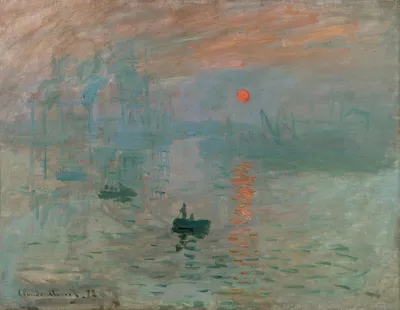
A harbor waking in the mist, under a sun no brighter than the sky.
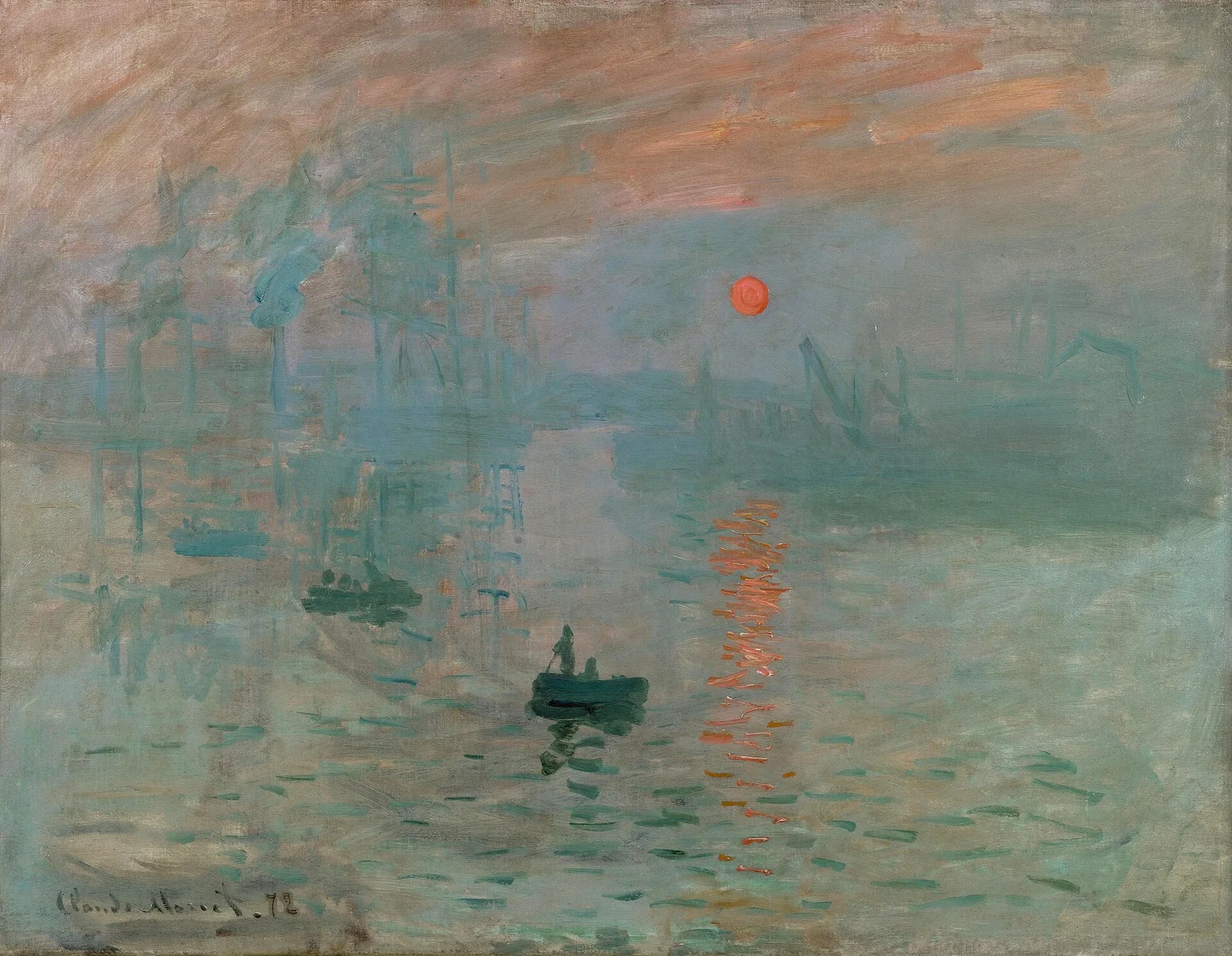
Impression, Sunrise, 1872. Claude Monet. Musée Marmottan Monet.
Look closer
7 things to notice
 1
01
A sun that burns without light
A small, flat orange disc hangs in the grey-blue haze, with a curl of paint inside it. Measured with a photometer, it is no brighter than the sky around it, and the Harvard neurobiologist Margaret Livingstone says it almost disappears in a black-and-white copy. It seems to burn by color alone.
02
A path of light across the water
Below the sun, a broken column of short orange dashes runs down the water, thinning and scattering as it comes toward us. Each one is a single stroke, put down and left alone. Monet said he painted the scene from his window at Le Havre, and the path seems to lead straight to it.
03
Someone is already at work
The nearest rowboat is almost black. A figure stands working an oar, a smaller one sits behind, and their dark reflection hangs below them. This boat and the one behind it are, with the sun, the first things the eye finds. The oarsman has no face, only a posture: upright, steady, as if rowing into the light.
04
Fading into the mist
Further back on the left, a second boat holds a few figures made of quick dark blobs. Monet gives them less and less as they go further away, as if the mist were taking them one stroke at a time.
05
A forest of masts
Left of center, thin blue-green lines with crossbars rise into the pink sky: the masts and yards of clipper ships. Monet remembered exactly this when he described the picture later: sunlight in the mist, with masts in the foreground. It is as if these tall ships were what is left of the old harbor, nearly gone into the dawn.
06
The trees are steamships
The pale tufts at the far left look like trees at first. They are steamship smokestacks and their smoke, and Monet dropped the houses that actually lined that side of the jetty, clearing the view so this industrial backdrop shows through. The art historian Paul Tucker reads the busy port as a tribute to France recovering after its defeat in the Franco-Prussian War.
07
Seven thirty-five, one November morning
In the bottom left corner, 'Claude Monet .72' is written in dark paint across the water itself. In 2014 the astronomer Donald Olson and colleagues worked out the moment the signature leaves out: the morning of 13 November 1872, at about 7:35.
Our take
Impression, Sunrise is Claude Monet's view of the port of Le Havre, the town where he grew up, as the sun comes up through the mist in 1872. He later said he painted it from his window: sunlight in the mist, with masts in the foreground. There is an orange sun, an oarsman standing in a rowboat, and ships and smoke turning grey. And the picture has a secret: measured with a photometer, the sun is no brighter than the sky around it, as if it burned by color alone.
The title came last, and almost by chance. Monet said that when he was asked for a title for the catalogue, he called it an impression, because the picture could not really pass as a view of Le Havre. That is the honest word for it: not the port itself, but one minute of light over it, caught before it changed. Nothing in it is finished, and nothing is missing.
The painter's moment
1840–1926Painted it at 32Impressionism
Claude Monet was about 32. His family had moved to Le Havre in 1845, when he was a small child, and it was there, around 1858, that Eugène Boudin taught him to paint outdoors. He married Camille Doncieux on 28 June 1870, just before the Franco-Prussian War broke out. During the war he was in London, where he admired how Turner painted light, especially fog on the Thames, and where he met Paul Durand-Ruel, who became his first and main dealer. His father died in 1871, the year the family settled in Argenteuil, near Paris. By 1872 his inheritance and sales of his paintings meant the Monets could afford two servants and a gardener. That year he painted the port of Le Havre on six canvases. He painted the studies from his hotel room, on canvases primed with greys of varying tone.
He showed it in April 1874 at the first Impressionist exhibition, alongside The Luncheon and Boulevard des Capucines, and asked 1,000 francs. It did not sell, and few critics noticed it: it earned just five passing mentions across all the exhibition's reviews. One of those reviews was Louis Leroy's mocking piece, which listed it as number 98, said wallpaper in its earliest stage was more finished than this seascape, and made the word Impressionism from it. Ernest Hoschedé owned it from 1876 and Georges de Bellio from 1878, and it has been at the Musée Marmottan Monet in Paris since 1938. It was stolen in 1985, recovered in 1990, and back on display in 1991.
In its time
Impression, Sunrise was painted in 1872, when Monet was 32. Its French title is Impression, soleil levant. Where it stands on Art Through Time:
Its colors
Elsewhere in the world
- 1869The transcontinental railroadThe West opens to painters and tourists.
- 1870The Wanderers break awayRealist painters leave the Academy to paint ordinary life.
- 1874The first Impressionist exhibitionIndependent artists show on their own terms.
- 1875Fort Marion ledger drawingsImprisoned Plains artists draw their world.
- 1876Centennial Exhibition, PhiladelphiaAmerica measures its art against the world.
The facts
- Title
- Impression, Sunrise
- Artist
- Claude Monet (1840–1926)
- Date
- 1872
- Original medium
- Oil on canvas
- Style
- Impressionism
- Made in
- France
- Collection
- Musée Marmottan Monet
Living with it
The mood
Cool and unhurried, with one point of warmth at its center. It brings the first minutes of a day into a room: grey water, quiet boats, and a small orange sun the eye keeps going back to. It makes a room feel like early morning at an open window.
The palette
Almost all of it is the grey-green of mist over water, with a dusty fawn where the sky warms toward the sun. The sun itself is too small to count among the main colors, and that is the point: from across a room, it is the one warm spark in a cool field.
Who it finds
- Anyone who grew up by a harbor and still wakes to it in their head. Monet painted the port of the town where he grew up.
- People who love the hour before the world gets loud: the first light, the first boat out, nobody else awake yet.
- Anyone starting again after a hard stretch. The art historian Paul Tucker reads this busy port as France getting back to work after defeat, with one small sun coming up regardless.
See it in a room
Your photo is never uploaded, and it's gone when you leave.
From across a room it reads as weather: a soft grey-green field with a single orange point, the sun and its broken path on the water. Come close and the harbor appears: the oarsman standing in his boat, the masts, the smoke on the left, the signature written across the water, every stroke left as it fell.
The canvas is small, 48 by 63 cm, and it was painted at a window, so it belongs near the start of a day: a hallway, a breakfast table, a desk, a bedroom that faces east. At or a little above its own size it keeps its closeness. Larger, the brushstrokes become the subject, which suits a long wall with room to step back.
How we make it
- True to the original
- Each file is color-matched to the museum original. If the color isn't right, we print it again, with our compliments.
- On canvas
- Fine-art canvas hand-stretched over a ¾″ solid-wood frame, with mirrored edges so nothing is lost.
- In our floating frame
- Our stretched canvas set in a slim floating frame, with a shadow gap so the painting seems to hover.
- As a framed print
- Archival pigment print on museum-grade cotton paper, in a solid-wood frame with UV-protective glazing.
- Ready to hang on arrival
- It arrives with the hanging hardware attached. No framer, no guesswork.
- Perfect on arrival
- If anything arrives damaged or not as you ordered, send us a photo within 7 days of delivery and we'll make it again, with our compliments.
Monet caught this minute of light over Le Havre in 1872, and the sun has been rising in it ever since. Let it rise somewhere you will see it each morning.