The story · 4 min read
Liberty moves forward. The people paying for it remain underfoot.
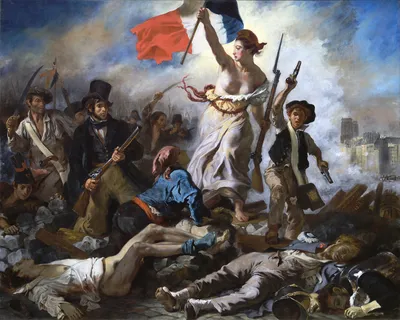
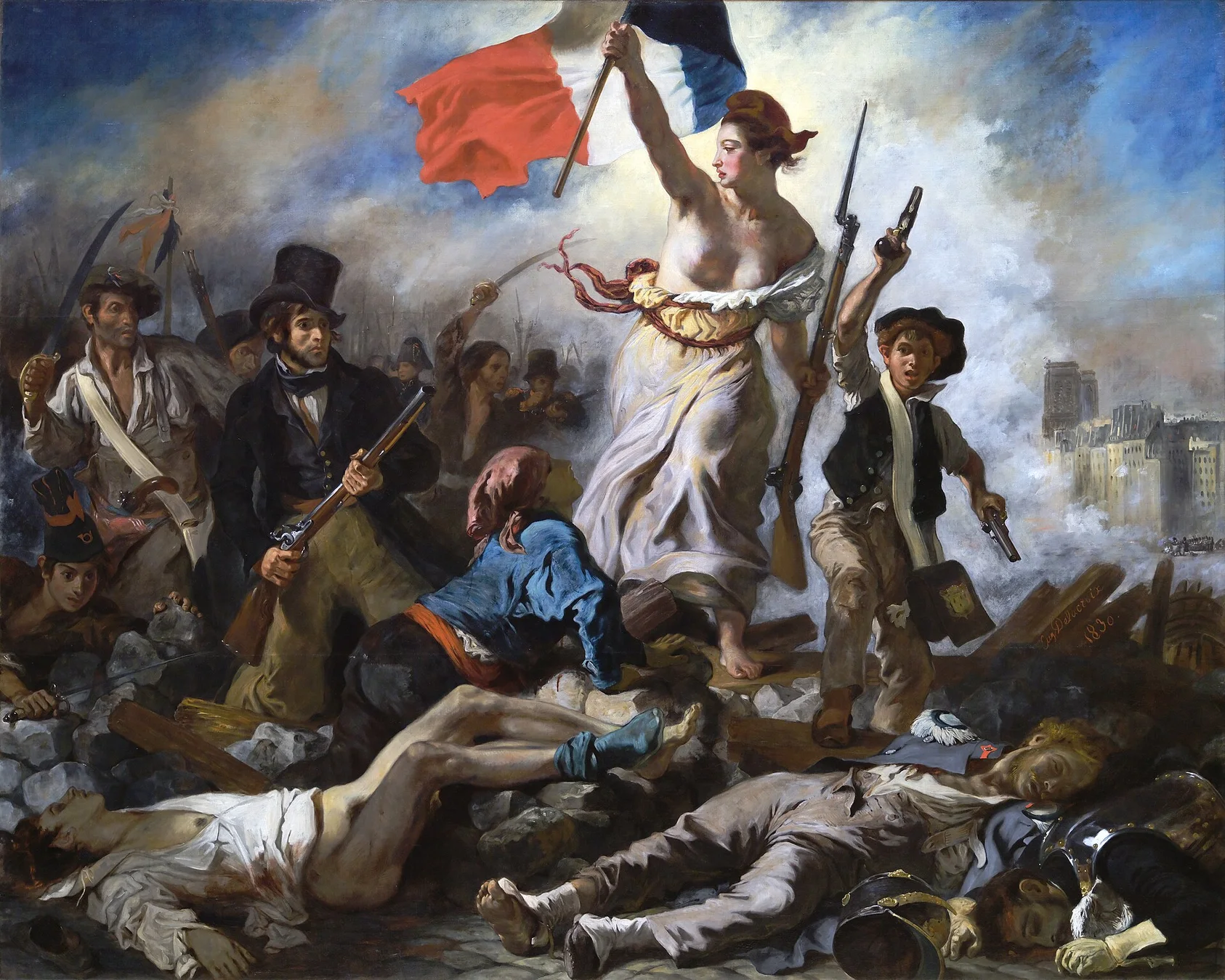
Liberty Leading the People, 1830. Eugène Delacroix. Musée du Louvre, Department of Paintings, Paris.
Look closer
7 things to notice
 1
01
An idea takes the lead
Liberty's red cap sits above her face, beside the raised arm and flagstaff. The Louvre identifies her as both a woman of the people and a figure drawn from classical tradition. Her Phrygian cap makes freedom legible as a symbol. The face beneath it still looks back toward the crowd.
02
The yellow came afterward
Yellow marks interrupt the pale dress around Liberty's waist and knees. Conservators Bénédicte Trémolières and Laurence Mugniot found that Delacroix first painted the dress gray, then added yellow in differing densities. The 2024 cleaning clarified those separate stages. Her moving leg remains visible through a dress made from several decisions.
03
He is already ahead
The boy's open mouth and raised pistol occupy the right side of the advance. The Louvre's restoration report stresses that he runs ahead of Liberty, rather than beside her. Often called Gavroche, he predates Victor Hugo's character. The open mouth sits just below the raised weapon.
04
A hat does not settle class
A tall black hat stands out above the armed man at left. Although he is often described as middle class, the Louvre's teaching guide identifies his clothing with a craftsman or artisan. The difference matters in a crowd claimed for many social groups. His working hands grip a hunting gun.
05
The flag comes down to earth
The man below Liberty wears a blue shirt, pale fabric and a red sash. The Louvre points out repeated groups of the national colors throughout the painting. Here the flag's colors belong to a person low on the barricade. His head is raised toward the woman passing him.
06
Paris is still identifiable
The towers of Notre-Dame emerge through smoke at the right. Beth Harris and Steven Zucker identify the cathedral and the tiny tricolor on it, a revolutionary flag above a building associated with the monarchy. The city has a precise landmark even in this confusion. Its two towers remain upright behind the fighting.
07
Uniforms offer no protection
A fallen man in military clothing lies across the lower right, his pale shirt visible beneath the coat. Bryan Zygmont identifies the shoulder decoration as evidence of a soldier among the dead. The barricade has casualties on different sides. His body occupies the ground the advancing figures must cross.
Our take
The flag rises above a street no one can cross without stepping over the dead. Delacroix gives the advance a clear direction and an appalling obstacle. Liberty leads, a woman with bare feet, a weapon and a red cap; the people around her have the clothes and faces of a city in revolt. The fallen remain closest to us.
This is Paris in July 1830, when three days of fighting removed Charles X from the throne. It is not the revolution of 1789. Delacroix told his brother that painting could be his contribution to his country, although he had not fought. He made the image in the months afterward, when the outcome was already known. Within the picture, the boy still runs with a pistol raised and his mouth open.
The painter's moment
1798–1863Painted it at 32Romanticism
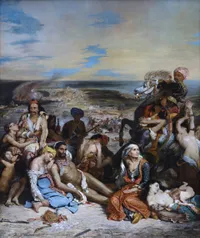
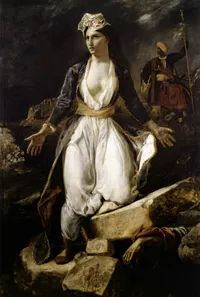
The fighting came to Eugène Delacroix in his own city. During the July Revolution of 1830, Parisian streets became places where a passerby could be hit along with the combatants. Delacroix described that danger to his nephew. His earlier large paintings had treated violence elsewhere, including The Massacre at Chios, made in 1824 in response to the Greek struggle against Ottoman rule. Now he had to give a form to an upheaval nearby. In an October letter to his brother, he explained that the barricade picture had restored his spirits: he could serve his country by painting when he had not served it by fighting.
He completed the canvas in December 1830 and exhibited it at the Salon the next year, when the French state bought it. The new king, Louis-Philippe, had gained his throne through the uprising, but an armed population remained an uncomfortable subject for official display. The painting's public life was interrupted before it finally entered the Louvre in 1874. Delacroix had meanwhile found another major source of work: in 1832 he traveled with a diplomatic mission to Morocco, making drawings that fed later paintings. His next change of scene came through travel and official connections, not another Paris barricade.
In its time
Liberty Leading the People was painted in 1830, when Delacroix was 32. Its French title is Le 28 juillet 1830. La Liberté guidant le peuple. Where it stands on Art Through Time:
Its colors
Elsewhere in the world
- 1824The Battle of AyacuchoSucre's victory all but ends Spanish rule in South America.
- 1825Thomas Cole paints the CatskillsThe Hudson River School begins as the Erie Canal opens.
- 1830The Indian Removal ActForced removals from ancestral lands.
The facts
- Title
- Liberty Leading the People
- Artist
- Eugène Delacroix (1798–1863)
- Date
- 1830
- Original medium
- Oil on canvas
- Style
- Romanticism
- Made in
- France
- Collection
- Musée du Louvre, Department of Paintings, Paris
Living with it
The mood
Smoke and bodies occupy a broad, unsettled space, with the flag above them as the clearest color signal. The image gives a room a public event to confront. Its forward movement keeps the foreground casualties in view.
The palette
Flint and walnut gather in clothing, rubble and shadow; slate, clay and chalk belong to smoke, stone and the pale dress. These sampled neutrals carry much of the surface. The smaller blue and red passages cut across them, especially in the flag.
Who it finds
- For someone who has joined a crowd without knowing its outcome; the forward motion here contains that unfinished knowledge.
- For someone who has inherited a family's account of political upheaval; the painting gives public history individual clothes and faces.
- For someone who distrusts victory pictures that omit the cost; the dead occupy the nearest part of this one.
See it in a room
Your photo is never uploaded, and it's gone when you leave.
The full crowd needs viewing distance: from across a room, the flag and central figure establish the advance. A closer position reveals the different hats, weapons and bodies. The image asks for enough scale that the foreground people remain people, rather than an indistinct strip beneath the action.
A large study or a substantial living-room wall can accommodate that broad composition and its difficult subject. Leave room to approach from the front, since the small cathedral is easily lost from an angle. Nearby decoration can be restrained in color; a row of other busy pictures would compete with the crowd and smoke.
How we make it
- True to the original
- Each file is color-matched to the museum original. If the color isn't right, we print it again, with our compliments.
- On canvas
- Fine-art canvas hand-stretched over a ¾″ solid-wood frame, with mirrored edges so nothing is lost.
- In our floating frame
- Our stretched canvas set in a slim floating frame, with a shadow gap so the painting seems to hover.
- As a framed print
- Archival pigment print on museum-grade cotton paper, in a solid-wood frame with UV-protective glazing.
- Ready to hang on arrival
- It arrives with the hanging hardware attached. No framer, no guesswork.
- Perfect on arrival
- If anything arrives damaged or not as you ordered, send us a photo within 7 days of delivery and we'll make it again, with our compliments.
Painted after the July fighting of 1830, this advance needs space for its casualties too. Give the full barricade an uninterrupted view.