The story · 4 min read
The strap was put back. The portrait could never be taken back.
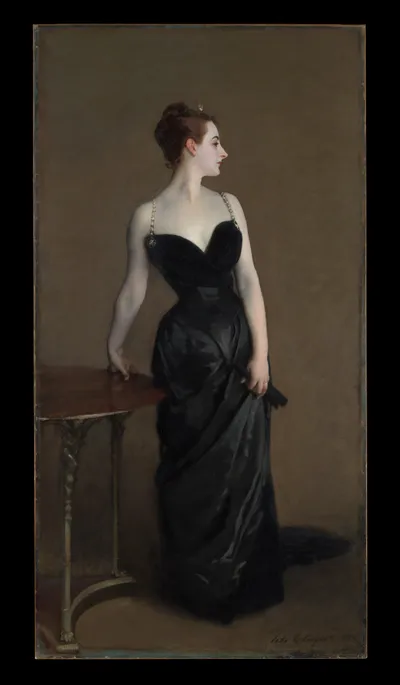
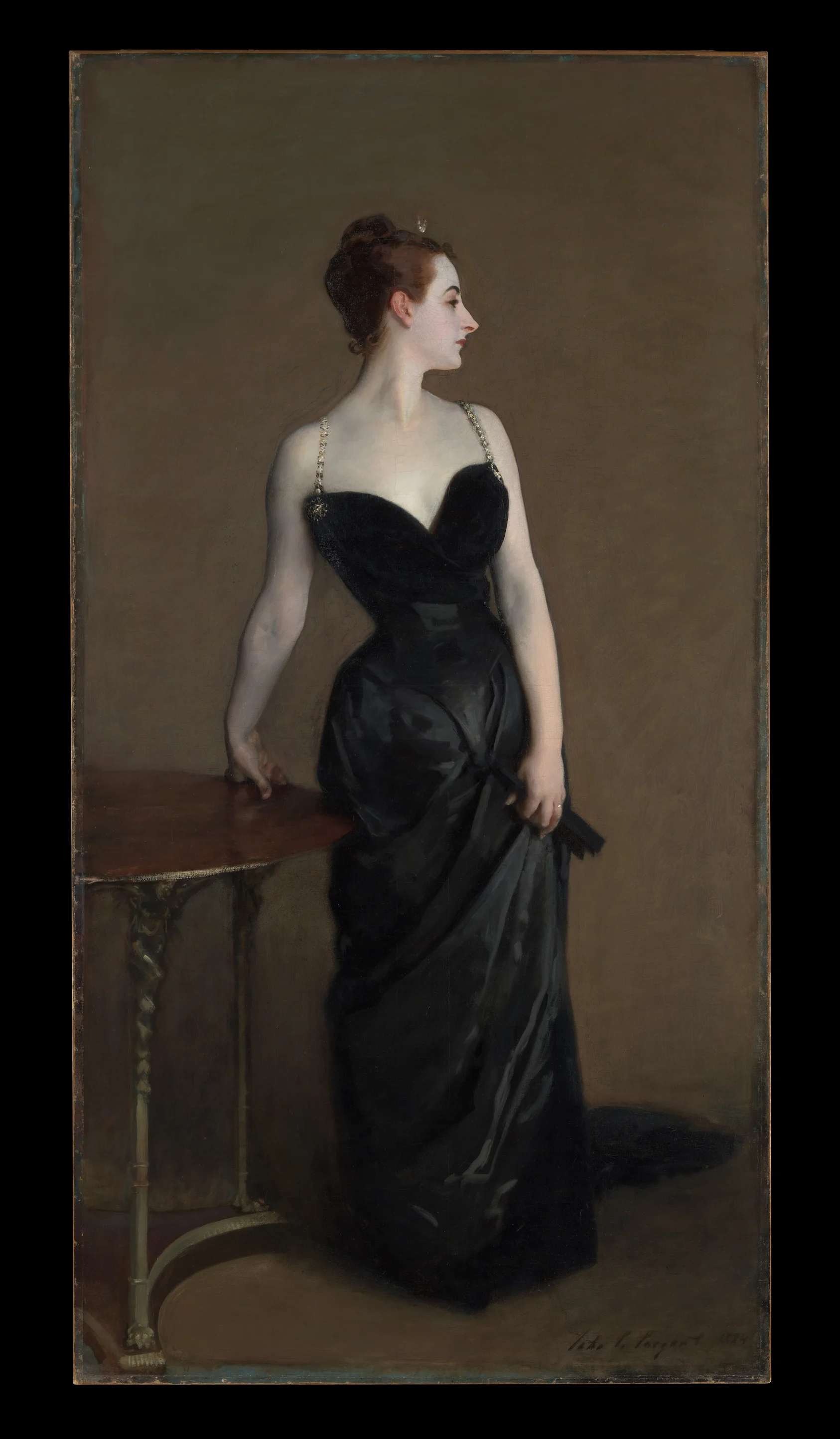
Madame X (Virginie Amélie Avegno Gautreau), 1883–84. John Singer Sargent. The Metropolitan Museum of Art, New York.
Look closer
7 things to notice
 1
01
She chooses a different audience
Her face points right, pale cheek edged by nose and dark red lips, a pink ear behind it. The Met identifies the coloured ear as part of Gautreau's use of cosmetics. The colour belongs to her chosen appearance; it gives us no evidence of a blush. Behind the later X was a woman with a name and a particular face.
02
One small line was changed
The jewelled strap runs down her right shoulder, at the left of the picture, joining pale skin to black fabric. This is Sargent's revision after the 1884 Salon: in the exhibited version, the strap had fallen. We see the correction rather than the offending detail. A narrow line of paint had acquired a public life.
03
The pose needs somewhere to end
Her right fingertips meet the brown tabletop, the wrist bent above them, the arm coming down from behind. Stephanie Herdrich describes Sargent testing different poses in his preparatory drawings. Here, the final arrangement seems effortful when we look close. All that poise arrives at a few fingers on wood.
04
A little claim to the sky
A bright crescent sits above her dark hair, small enough to miss beside the sweep of the head. Fashion historian Justine De Young suggests an association with Diana, goddess of the hunt. The proposed allusion gives this tiny ornament a large ambition. A piece of the moon fits in her hair.
05
Black has more than one answer
The dress narrows at her waist, its dark upper part giving way to broad grey reflections below. De Young identifies velvet above and satin in the skirt. Sargent lets the two fabrics take light differently, so the outline stays clear without a bright colour. Even the black has been chosen twice.
06
Someone else carries the weight
A carved figure appears below the table's near edge, its small head between curled, wing-like forms. Far below Gautreau's hand, this ornament gives the furniture a body of its own. As a visual echo, it seems to share the work of maintaining the pose. The tabletop has another figure beneath it.
07
His name stayed on it
Sargent's signature crosses the brown floor at lower right, below the trailing edge of the dress. When he sold the painting, he asked the museum to leave the sitter's name out of its title. His own remains visible in the paint. The two names had different places to stand.
Our take
The scandal has already been painted over. Both jewelled straps sit on her shoulders now, two fine lines above a black dress. At the Paris Salon in 1884, the right one hung down her arm; Sargent raised it after the exhibition closed. Yet the altered portrait gives us no easier welcome. Her face turns away, the pale profile outlined against brown, her body directed towards us. She offers one view of herself.
In 1916, writing from London, Sargent offered the portrait to the Metropolitan Museum of Art and asked that Gautreau's name be withheld. The X carries the history of that request. As we read it, the picture makes public attention feel difficult to control, even for the person who made it. Her profile remains high above his signature on the floor.
The painter's moment
American, Florence 1856–1925 LondonRealism
The portrait began with a painter's ambition: to be noticed in Paris. Virginie Avegno Gautreau had come from Louisiana and married a French banker; her appearance was already a subject of public attention. John Singer Sargent undertook her portrait without a commission, hoping it would advance his standing as a painter. Stephanie Herdrich says he made more studies for this work than for any other portrait. He tried different arrangements of the body while returning to the profile. The finished figure makes that work hard to see from a distance. Up close, the angle of the wrist gives some of it back.
The 1884 Salon supplied the attention, with a response neither sitter nor painter had sought. Gautreau and her mother asked Sargent to remove the canvas; he refused. He later kept it for more than thirty years. Its size and the stark division between skin and dress continued to belong to his working surroundings, long after that first public encounter. The Metropolitan Museum of Art in New York acquired the painting in 1916, with Sargent asking that the title conceal Gautreau's identity. Today the museum gives her name alongside Madame X. The woman in the picture still looks past anyone who comes to read it.
In its time
Madame X (Virginie Amélie Avegno Gautreau) was painted in 1883–84, when Sargent was 27. Where it stands on Art Through Time:
Its colors
Elsewhere in the world
- 1881Pogroms sweep the empireSome two million Jews leave for America and beyond by 1914.
- 1884The Berlin ConferenceEurope's powers divide Africa among themselves.
- 1885Leopold II takes the CongoHis forced-labor regime costs millions of lives.
- 1885The Indian National Congress is foundedThe movement for self-rule takes shape.
- 1887French Indochina is formedFrance rules Vietnam and Cambodia, and later Laos.
The facts
- Title
- Madame X (Virginie Amélie Avegno Gautreau)
- Artist
- John Singer Sargent (American, Florence 1856–1925 London)
- Date
- 1883–84
- Original medium
- Oil on canvas
- Style
- Realism
- Made in
- American
- Collection
- The Metropolitan Museum of Art, New York
Living with it
The mood
A tall black dress gives the room a strong upright, with pale shoulders and a profile near its top. Brown surrounds the figure on every side. Across the room, that small area of skin carries an unusual share of the light.
The palette
Bark and walnut belong to the brown setting and table; ink and ebony gather in the dress. Flax picks up the warmer grey around the figure. The pale skin, brighter than these five sampled colours, reaches across a room first, with the black silhouette immediately below it.
Who it finds
- For someone who has rehearsed how to enter a room; the studied pose keeps its effort close to the surface.
- For someone who has had a photograph tell a story they never agreed to; this portrait carries a long public afterlife.
- For someone who has dressed carefully for an occasion and still felt exposed; the small straps bear more attention than their size suggests.
See it in a room
Your photo is never uploaded, and it's gone when you leave.
From a doorway, the portrait reads as a pale upper body above a long black shape. Come nearer for the jewelled straps, the crescent and the grey light on satin. The fingers against the table make the pose less effortless at close range. Leave enough room in front of the print to make that approach.
A tall space beside a low cabinet or along a hall suits the figure's proportions. A larger print keeps the hand and small ornaments legible without losing the brown around her. Give the full dress room beneath the face; a narrow gap crowded by shelves would break up the long view.
How we make it
- True to the original
- Each file is color-matched to the museum original. If the color isn't right, we print it again, with our compliments.
- On canvas
- Fine-art canvas hand-stretched over a ¾″ solid-wood frame, with mirrored edges so nothing is lost.
- In our floating frame
- Our stretched canvas set in a slim floating frame, with a shadow gap so the painting seems to hover.
- As a framed print
- Archival pigment print on museum-grade cotton paper, in a solid-wood frame with UV-protective glazing.
- Ready to hang on arrival
- It arrives with the hanging hardware attached. No framer, no guesswork.
- Perfect on arrival
- If anything arrives damaged or not as you ordered, send us a photo within 7 days of delivery and we'll make it again, with our compliments.
Sargent's portrait of 1883–84 keeps its pale profile above a long black dress. Give the full figure a tall space and a little distance.