The story · 4 min read
The queen kept her pose; the public required another dress.
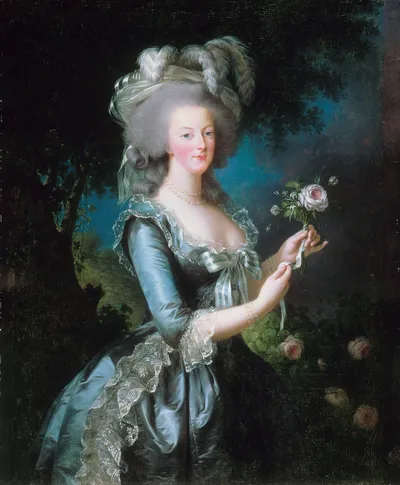
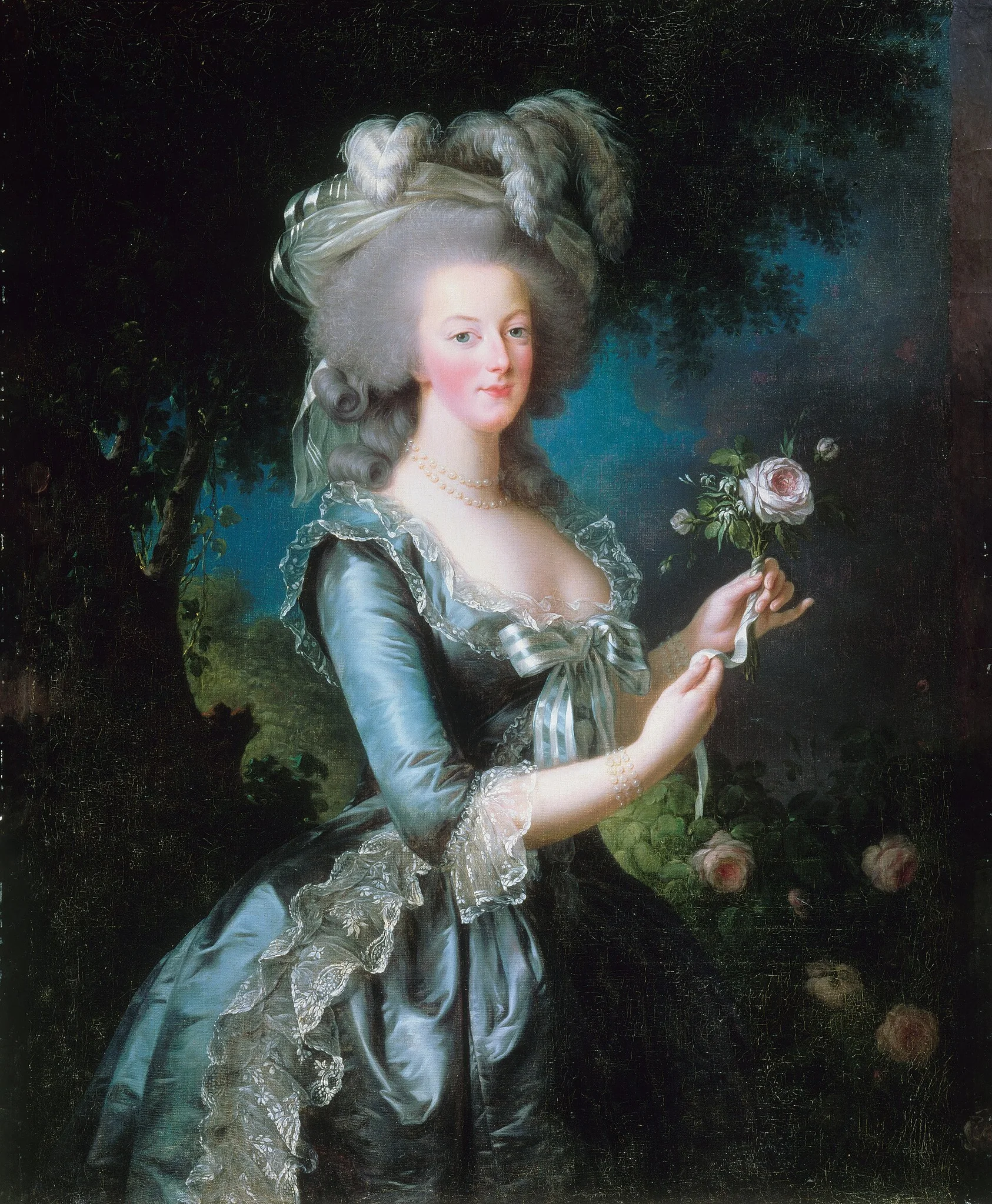
Marie Antoinette with a Rose, 1783. Élisabeth Louise Vigée Le Brun. Musée national des châteaux de Versailles et de Trianon, Versailles.
Look closer
7 things to notice
 1
01
The same face survived the scandal
The queen looks outward beneath powdered hair, her cheeks pink against the dark leaves. In this Marie Antoinette painting, the pose follows the rejected muslin portrait. Versailles reads the new silk dress as an implied endorsement of Lyon's weavers. The revised public image still begins with the same face.
02
She has a small task
A pink rose opens among pale flowers, just above the fingers at right. Joseph Baillio identifies the bouquet as a cabbage rose with jasmine, tied with white ribbon. That account describes the composition shared by the surviving versions. The queen's occupation fits into a few stems.
03
Rank arrives bead by bead
Two strings of pearls cross the neck above the gown. Historian Caroline Weber reads the replacement portrait's silk and jewelry as signs of royal status and French identity. Vigée Le Brun had already painted the queen's official portrait in 1778. Here that position is expressed in small pale beads against skin.
04
Even the sleeve needed an audience
White lace hangs from the sleeve beside the bare forearm, its floral pattern visible against blue silk. Fashion historian Rebecca Herrera identifies these sleeve ruffles as engageantes. Their loose edges add another kind of labor to the portrait, one recorded through holes, threads and small points of white paint.
05
Light feathers carried a cost
Large pale plumes rise above striped, translucent headwear. Herrera identifies the feathers as probably ostrich, an imported material associated with expensive dress. That identification remains qualified; the image alone cannot establish the bird. Their curved tips stand above the heavier mass of powdered hair.
06
Formality tied in a bow
A striped bow sits at the front of the bodice, with long ends descending over the skirt. Herrera identifies the gown as a robe à la française, formal aristocratic clothing with a matching underskirt. The bow adds a clear knot to the many smaller lace patterns. Its pale stripes cross the dark blue fabric.
07
A garden already had precedents
Dark branches and trailing leaves border the queen at left, opening onto patches of blue sky. Baillio compares this garden setting with François Boucher's portraits of Madame de Pompadour. It belongs to an established way of giving a court figure an outdoor setting. Leaves make a shadowed edge beside the silk.
Our take
The flower was acceptable. The dress had to change. This Marie Antoinette painting repeats the pose of a portrait withdrawn from the Salon of 1783, where the queen's informal muslin clothing had offended viewers. Now blue-gray silk, pearls and lace accompany the rose. She still seems to be gathering flowers in a garden. Even that small private occupation needed the right public clothes.
Vigée Le Brun knew how much the queen's support mattered. Marie Antoinette had helped secure her admission to the Royal Academy that year, overcoming objections connected to her husband's work as an art dealer. Patron and painter both faced rules about who could appear where, and in what role. The replacement keeps their arrangement intact. A white ribbon passes between the queen's hands.
The painter's moment
1755–1842Painted it at 28French painting, 18th century
In 1783, Élisabeth Louise Vigée Le Brun gained a place in the institution that could bring her portraits before the Salon public. She was twenty-eight. Marie Antoinette's intervention helped overcome the objection that her husband's work as an art dealer disqualified her; on May 31 she entered the Royal Academy alongside Adélaïde Labille-Guiard. The queen had been a regular patron since the successful official portrait of 1778. Now the painter had to manage a public objection to that patron's clothes. Her professional advance and the disputed portrait belonged to the same year.
The muslin portrait came down, and the composition with silk took its place. Versailles identifies its own canvas as a replica of the successful replacement. Baillio argues that the version now in the Resnick collection was probably the one exhibited at the Salon; the distinction prevents us from giving every surviving version the same history. The Versailles painting entered the palace collection during Louis-Philippe's reign. The earlier scandal had not ended the artist's court commissions, but the French Revolution changed the conditions around them. On October 6, 1789, she left Paris with her daughter and governess, bound for Italy. Royal connections that had helped her enter the Academy now accompanied her into exile.
In its time
Marie Antoinette with a Rose was painted in 1783, when Brun was 28. Its French title is Marie-Antoinette dit « à la Rose ». Where it stands on Art Through Time:
Its colors
Elsewhere in the world
- 1780The rebellion of Túpac Amaru IIAn Andean uprising against colonial abuse is crushed; its leader is executed.
- 1781Academy of San Carlos foundedAcademic training arrives in Mexico City.
- 1788Colonization of Australia beginsConvicts, Australia's first Jews among them, land on Gadigal country; Aboriginal nations face devastation.
- 1789The French RevolutionPainters take sides; history painting turns political.
The facts
- Title
- Marie Antoinette with a Rose
- Artist
- Élisabeth Louise Vigée Le Brun (1755–1842)
- Date
- 1783
- Original medium
- Oil on canvas
- Style
- French painting, 18th century
- Made in
- France
- Collection
- Musée national des châteaux de Versailles et de Trianon, Versailles
Living with it
The mood
Pale skin and blue silk rise through a dark garden. The flower gives the upright figure a small point of activity, while the shaded leaves keep the surrounding space deep. In a room, the face arrives before the clothing's many details.
The palette
Ebony and pine fill the garden's darkest parts; slate and sage run through the silk and shaded leaves. Silver belongs to lace, pearls and plumes. The small pinks in the face and rose interrupt that cool range without changing its overall weight.
Who it finds
- For someone who has changed clothes to be taken seriously; the queen's revised portrait keeps the pose and changes its public reception.
- For someone whose work depended on another person's support; painter and patron helped each other enter rooms with rules.
- For someone who remembers a person through the way they arranged flowers; a few stems give this formal portrait a private task.
See it in a room
Your photo is never uploaded, and it's gone when you leave.
A distant view reduces the painting to a pale face above a column of blue. Move closer and the clothing separates into lace holes, pearl beads and striped ribbon. The rose is small enough to reward an approach; it should remain a flower rather than a pale dot at the side.
A bedroom, dressing area or study suits the portrait's vertical shape and detailed fabric. Hang it where the upper half can meet the eye directly, with enough room below for the gown. A moderate print keeps the encounter personal; greater height asks for a clear view of the whole figure.
How we make it
- True to the original
- Each file is color-matched to the museum original. If the color isn't right, we print it again, with our compliments.
- On canvas
- Fine-art canvas hand-stretched over a ¾″ solid-wood frame, with mirrored edges so nothing is lost.
- In our floating frame
- Our stretched canvas set in a slim floating frame, with a shadow gap so the painting seems to hover.
- As a framed print
- Archival pigment print on museum-grade cotton paper, in a solid-wood frame with UV-protective glazing.
- Ready to hang on arrival
- It arrives with the hanging hardware attached. No framer, no guesswork.
- Perfect on arrival
- If anything arrives damaged or not as you ordered, send us a photo within 7 days of delivery and we'll make it again, with our compliments.
In this 1783 portrait, a rose survives a change of royal clothing. Give the blue silk room, and the small flower a closer look.