The story · 4 min read
Still singing, still afloat, for a little while longer.
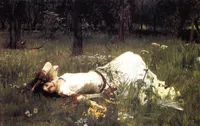
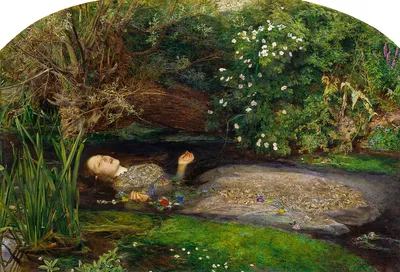
Ophelia, 1851. John Everett Millais. Tate Britain.
Look closer
7 things to notice
 1
01
Singing to the end
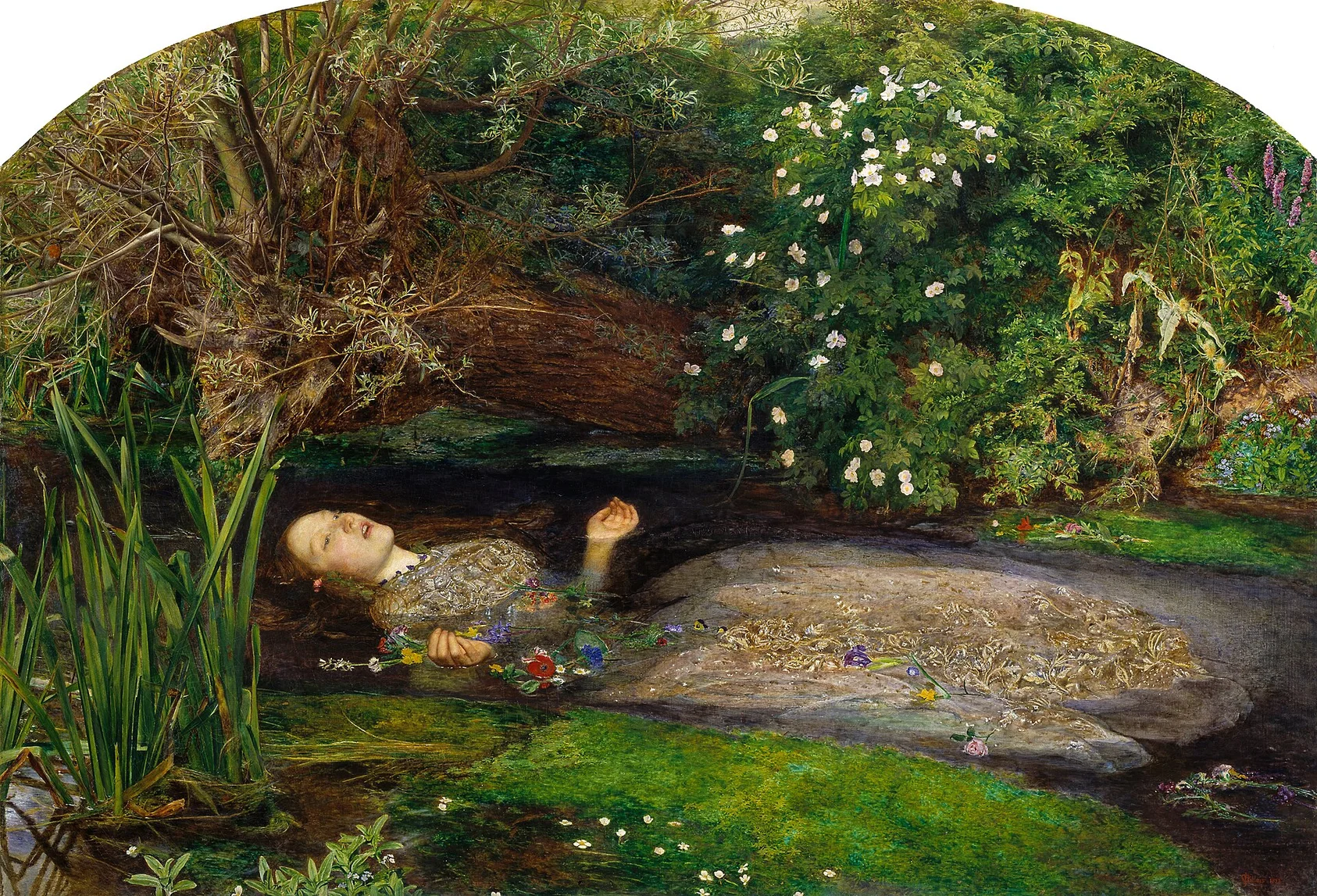
Her head is tilted back at the surface, her lips parted and her eyes turned up past the willow. She is singing while the stream carries her, with only moments left before she goes under. The face is Elizabeth Siddal's, and she was 22 when she lay for it.
02
Open to whatever comes
Her left forearm rises from the dark water, the palm open and turned up. Her open arms and upturned gaze have been read as recalling paintings of saints and martyrs, and by some as erotic instead. She seems neither to reach for the bank nor to fight the stream.
03
The garland coming apart
Her right hand still holds a few loose flowers, and the rest are drifting away around it. The floating flowers have been read as following Shakespeare's description of her garland, and as drawing on the Victorian 'language of flowers', which gave every bloom its own meaning. What she was making is coming undone in the water.
04
The flower Shakespeare never named
Just below her hand, one bright red poppy floats among the blue and white. Shakespeare does not mention a poppy, and it has been read as a sign of sleep and death. Among so much blue and white, the eye finds it at once.
05
The dress that holds her, for now
Her silvery gown, embroidered all over, spreads flat across the water. In the story the dress fills with air and keeps her afloat for a while, until the soaked cloth pulls her under. To paint it, Siddal lay fully dressed in a full bathtub in Millais's studio; the lamps warming the water went out, and she caught a bad cold.
06
The branch that broke
Above her, a gnarled willow leans out over the brook. In Gertrude's telling, Ophelia was climbing out along a willow above the stream to hang up her garlands when a branch snapped beneath her. Willow is among the plants identified in the picture, and it is as if the tree that let her fall were still there, in full leaf.
07
A face in the leaves
Look for a while at the right bank and a pale, rounded patch among the leaves starts to look like a face, or a skull. Once you have seen it, it is hard to stop seeing it.
Our take
In Millais's Ophelia, Shakespeare's Ophelia is still singing as the brook carries her, only moments from drowning. Her dress has spread out and filled with air, and for now it holds her up. The flowers she was carrying drift out of her hand. She is still afloat, and she is already lost.
What breaks the heart is everything around her. In Hamlet this moment happens offstage, told by Queen Gertrude in Act 4, Scene 7. Millais gives it a real place, a riverbank in Surrey painted outdoors over five months, and fills it with life: wild roses, purple loosestrife, a robin on the willow. The world seems not to have noticed what is happening in it.
The painter's moment
1829–1896Painted it at 22Pre-Raphaelite
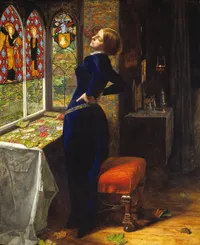
John Everett Millais was 22. At eleven he had become the youngest student ever admitted to the Royal Academy Schools, and in September 1847 he, Hunt and Rossetti had founded the Pre-Raphaelite Brotherhood at his family's home on Gower Street. Just before Ophelia he painted Mariana, also from Shakespeare. Over five months in 1851 he painted the bank of the Hogsmill River in Surrey, near Tolworth, outdoors, up to 11 hours a day and six days a week, while his friend William Holman Hunt worked close by. In a letter to a friend he complained that the Surrey flies were especially fierce biters. He was threatened with a summons for trespassing and damaging the hay. When wind and snow came in November, he had a straw-covered hut built from four hurdles to paint in, and said it made him feel like Robinson Crusoe.
Only after the landscape did he paint Ophelia herself, at his studio at 7 Gower Street. He had painted a water vole swimming beside her and then painted it out; when Hunt's uncle saw the unfinished picture in December 1851, he guessed it was a hare. That month, on 10 December, the dealer Henry Farrer bought the painting for 300 guineas. At the Royal Academy in 1852 a critic in The Times attacked it for putting Ophelia in a weedy ditch, and John Ruskin, who supported Millais, called the technique exquisite but questioned the choice of a Surrey landscape. Its dense natural detail has since been called a kind of 'pictorial eco-system'. Laurence Olivier based Ophelia's death in his 1948 film of Hamlet on it, and it hangs in Tate Britain.
In its time
Ophelia was painted in 1851, when Millais was 22. Where it stands on Art Through Time:
Its colors
Elsewhere in the world
- 1846The Mexican–American WarMexico loses about half its territory to the United States.
- 1848Revolutions across EuropeRealists paint workers and the poor.
- 1848The Seneca Falls ConventionThe first women's rights convention demands the vote.
- 1850The Taiping RebellionSome 20 million die in China's civil war.
- 1853Japan opens to the WestJapanese prints astonish European painters.
The facts
- Title
- Ophelia
- Artist
- John Everett Millais (1829–1896)
- Date
- 1851
- Original medium
- Oil on canvas
- Style
- Pre-Raphaelite
- Made in
- United Kingdom
- Collection
- Tate Britain
Living with it
The mood
Lush and quiet, with grief at its center. It first fills a room with the deep green of a summer riverbank, and only slowly with what is happening there. A painting that speaks softly, and keeps going long after you've looked away.
The palette
Almost all of it is the green of a riverbank in high summer: olive and moss, going down to peat in the shadow over the water, with driftwood in the stems and trunk. Against it lies the pearl of her face and dress, and one small red, the poppy, which the eye finds again and again.
Who it finds
- Anyone who has noticed how beautiful a day can be on the worst day of their life.
- Anyone who has loved someone they could not save, and still remembers them singing.
- Readers who know Hamlet well, and have always wanted to see the scene the play only tells.
See it in a room
Your photo is never uploaded, and it's gone when you leave.
From across a room it reads as one shape: a pale figure lying across dark water, closed in by green. Up close it opens into the plants one by one, the daisies, the wild roses, the loosestrife, the poppy beside her hand, and the longer you look, the more you find.
It belongs where people sit and stay: a bedroom, a library, a reading corner, a quiet landing. Hang it big enough that the separate flowers can be told apart from where you sit, because so much of the story is in them.
How we make it
- True to the original
- Each file is color-matched to the museum original. If the color isn't right, we print it again, with our compliments.
- On canvas
- Fine-art canvas hand-stretched over a ¾″ solid-wood frame, with mirrored edges so nothing is lost.
- In our floating frame
- Our stretched canvas set in a slim floating frame, with a shadow gap so the painting seems to hover.
- As a framed print
- Archival pigment print on museum-grade cotton paper, in a solid-wood frame with UV-protective glazing.
- Ready to hang on arrival
- It arrives with the hanging hardware attached. No framer, no guesswork.
- Perfect on arrival
- If anything arrives damaged or not as you ordered, send us a photo within 7 days of delivery and we'll make it again, with our compliments.
Millais spent five months of 1851 on her riverbank, and she has been singing there ever since. If she stays with you, give her a quiet wall.