The story · 4 min read
She has already eaten the seeds.
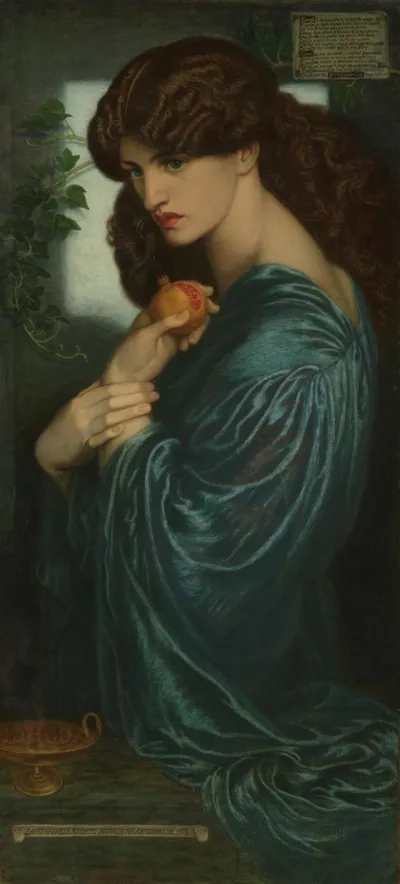
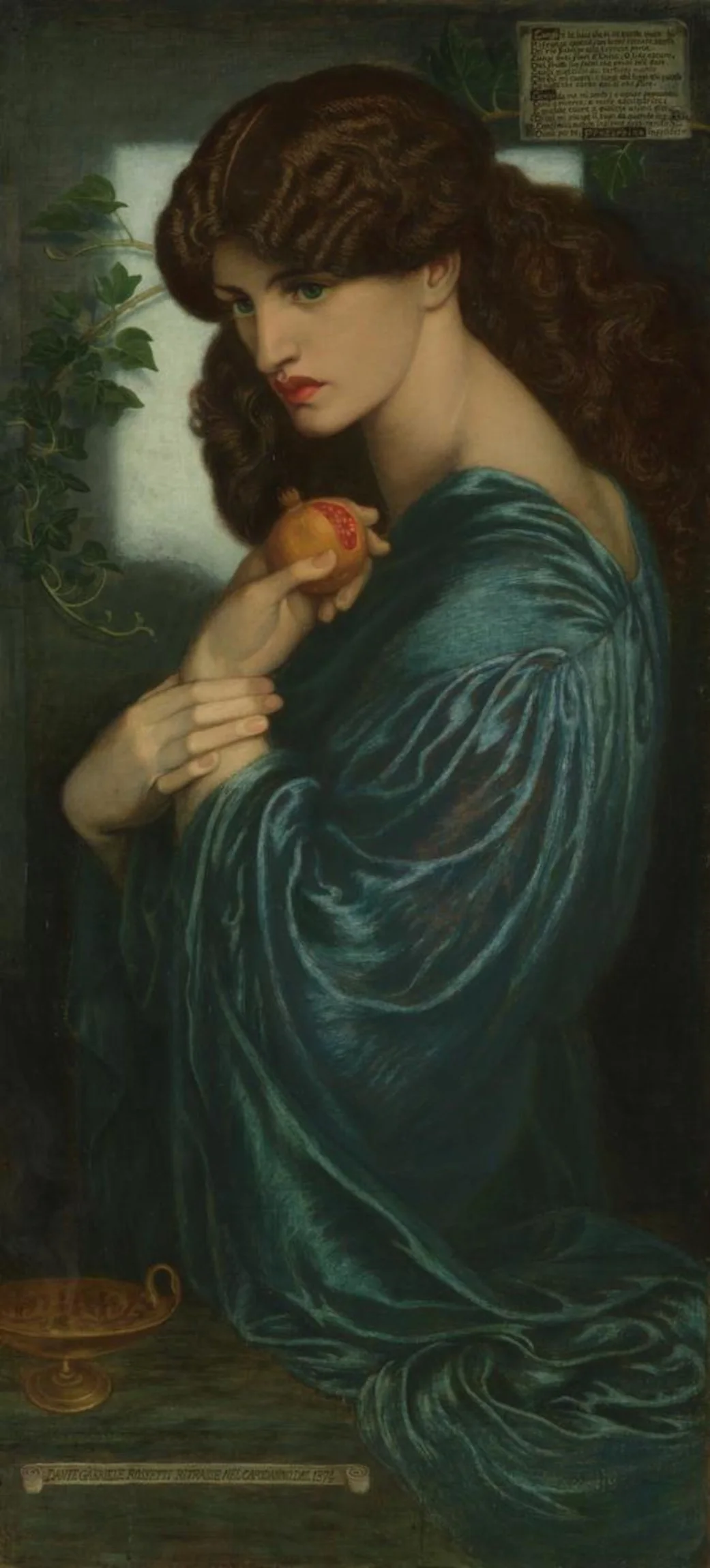
Proserpine, 1874. Dante Gabriel Rossetti. Tate Britain.
Look closer
7 things to notice
 1
01
She won't look at the fruit
Her pale green-grey eyes slide away from the pomegranate in her hand, toward something past the edge of the canvas. Rossetti described her standing in a dark corridor of her palace, holding the fruit that seals her fate. Whatever she's looking at, it isn't the thing that decided it.
02
The same red as her mouth
One side of the golden pomegranate is broken open, with the red seeds packed inside. The fruit's flesh is the same deep coral as her lips just above, as if it had already left its mark on her. In the myth, six of those seeds cost her six months of every year.
03
One hand holding the other back
Her right hand holds the fruit at her chest, and the long fingers of her left hand grip that wrist below. It looks like a woman stopping herself, or trying to, after it's too late. The whole myth seems to be in those two hands.
04
Daylight, for a moment
Behind her head, a pale rectangle of cold light falls on the dark wall. Rossetti described it as light coming through a sudden opening, a brief view of the world above. The light and shadow on the wall have been read as her two worlds: the shadow is her months below, and the light is her glimpse of earth.
05
The ivy remembers
On the left, a trailing branch of ivy climbs the dark wall, its pale tendrils curling. Rossetti said it can be read as a symbol of memory that clings. Down in the corridor, it seems to be all she has kept of the world she left.
06
Still a goddess, even here
A shallow gold vessel stands on the ledge at the lower left, with a faint thread of smoke rising from it into the dark. Rossetti said the incense burner marks her as a goddess. A few seeds have made her a prisoner, yet she is still the daughter of Jupiter and Ceres.
07
He wrote her a sonnet and painted it in
In the top right corner, on a pale panel wreathed in ivy, Rossetti wrote "Proserpina" and, under it, his own sonnet in Italian. The same sonnet runs in English on the frame he designed himself, which has roundels that look like a cut pomegranate. The sonnet ends in grief for her, as if the painter were mourning her himself.
Our take
Rossetti's Proserpine isn't the story of a girl being carried off. It shows what comes after: the goddess alone in a dark corridor of her palace, with the pomegranate in her hand already broken open. In the myth, six seeds were enough to bind her to the underworld for six months of every year, and she has eaten them. Behind her a square of daylight falls on the wall, and she looks at neither the light nor the fruit. The fruit is open, and it can't be closed again.
It's also a picture of longing. The face is Jane Morris's, and Rossetti painted it when his love for her had become an obsession. Her summers with him at Kelmscott and her winters with her husband have been read as Proserpine's own divided year. Her mouth is the same red as the seeds. Her eyes go somewhere the picture never shows, as if the story she's thinking of were happening out of frame.
“Woe me for thee, unhappy Proserpine.”
Dante Gabriel Rossetti, the sonnet on the frame of Proserpine
The painter's moment
1828–1882Painted it at 46Pre-Raphaelite
Dante Gabriel Rossetti was in his mid-forties, and the three years before had nearly broken him. In October 1871 the critic Robert Buchanan went after his poetry and his morals together in The Contemporary Review. In June 1872 Rossetti had a breakdown and tried to take his own life with an overdose of laudanum, the drug that had killed his wife, Elizabeth Siddal, ten years before. Afterwards, back at Kelmscott Manor, the Oxfordshire house he and William Morris had rented as a summer house in 1869, he spent his days dulled by chloral and whisky. Morris travelled to Iceland in 1871 and again in 1873. By the summer of 1873 Rossetti's health was better, and Jane Morris and Alexa Wilding sat for him at Kelmscott for a series of dreamlike portraits. He had first painted Jane Burden for the Oxford Union murals, before she married Morris in 1859. By now his love for her had become an obsession.
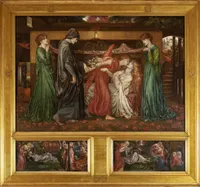
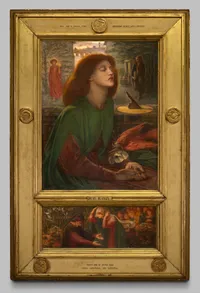
On a scroll at the lower left he signed this canvas and dated it, in Italian, to the beginning of 1874. It is the seventh version of a picture he painted at least eight times between 1871 and his death in 1882. The early versions had been promised to Charles Augustus Howell, but this one was commissioned by Frederick Richards Leyland, who ordered 18 paintings from Rossetti and grouped Proserpine with Mnemosyne and The Blessed Damozel as a triptych. That same year Morris restructured his decorative arts firm without him, and in July Rossetti left Kelmscott, abruptly and for good. The painting is in the collection of Tate Britain, and another version, very close to this one, is in Birmingham Museum and Art Gallery.
In its time
Proserpine was painted in 1874, when Rossetti was 46. Where it stands on Art Through Time:
Its colors
Elsewhere in the world
- 1874The first Impressionist exhibitionIndependent artists show on their own terms.
- 1875Fort Marion ledger drawingsImprisoned Plains artists draw their world.
- 1876Centennial Exhibition, PhiladelphiaAmerica measures its art against the world.
- 1876Russia bans books in UkrainianThe Ems Decree suppresses the Ukrainian language in print.
- 1876Battle of the Little BighornRecorded by Lakota and Cheyenne artists.
The facts
- Title
- Proserpine
- Artist
- Dante Gabriel Rossetti (1828–1882)
- Date
- 1874
- Original medium
- Oil on canvas
- Style
- Pre-Raphaelite
- Made in
- United Kingdom
- Collection
- Tate Britain
Living with it
The mood
Hushed and heavy-lidded, with a slow pull to it. It doesn't darken a room so much as deepen it: a corner of dusk with one square of daylight in it, and a woman who has decided something. It rewards the second look more than the first.
The palette
Almost all of it is the green-black of a shadowed corridor, with the ivy and the blue-green silk sinking into the dark. Light breaks through in three places, the pale light on the wall, her face and the gold of the fruit and the burner, and those carry across a room. The two small reds, her lips and the seeds, are there for when you come closer.
Who it finds
- Anyone who has loved someone they could have only part of the year, or part of a life.
- People who made a choice that can't be unmade, and have learned to stand inside it with their heads up.
- Anyone who lives between two places and carries the light of one into the other.
See it in a room
Your photo is never uploaded, and it's gone when you leave.
From across a room it reads as a tall column of dark with a pale face, a square of light near the top and a glow of gold at her chest. Up close it gives you the small things: the packed seeds, the fingers tight on her wrist, the thread of smoke and the lines of the sonnet in the corner.
The canvas is 125.1 by 61 cm, about twice as tall as it is wide, so it belongs where the wall is narrow too: between two windows, beside a doorway, at the end of a hall, on a stair. It suits rooms where the light is low and people linger, like a bedroom or a study. Give it height, enough that the seeds and her grip can be read from where you stand.
How we make it
- True to the original
- Each file is color-matched to the museum original. If the color isn't right, we print it again, with our compliments.
- On canvas
- Fine-art canvas hand-stretched over a ¾″ solid-wood frame, with mirrored edges so nothing is lost.
- In our floating frame
- Our stretched canvas set in a slim floating frame, with a shadow gap so the painting seems to hover.
- As a framed print
- Archival pigment print on museum-grade cotton paper, in a solid-wood frame with UV-protective glazing.
- Ready to hang on arrival
- It arrives with the hanging hardware attached. No framer, no guesswork.
- Perfect on arrival
- If anything arrives damaged or not as you ordered, send us a photo within 7 days of delivery and we'll make it again, with our compliments.
Rossetti came back to her for the rest of his life, and she is still holding the fruit. Give her a wall where the light can find her.