The story · 4 min read
The creditors counted his possessions; the portrait gives them nothing to count.
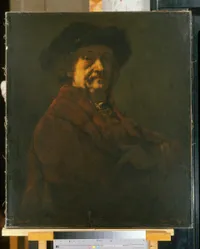
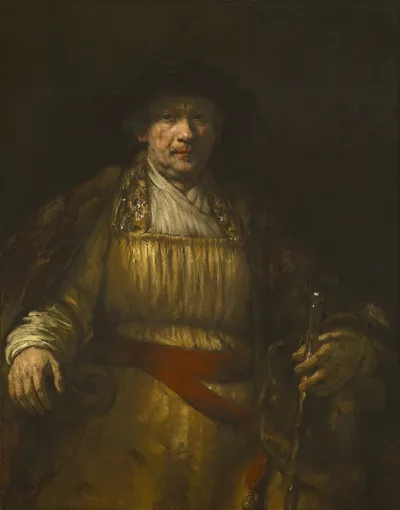
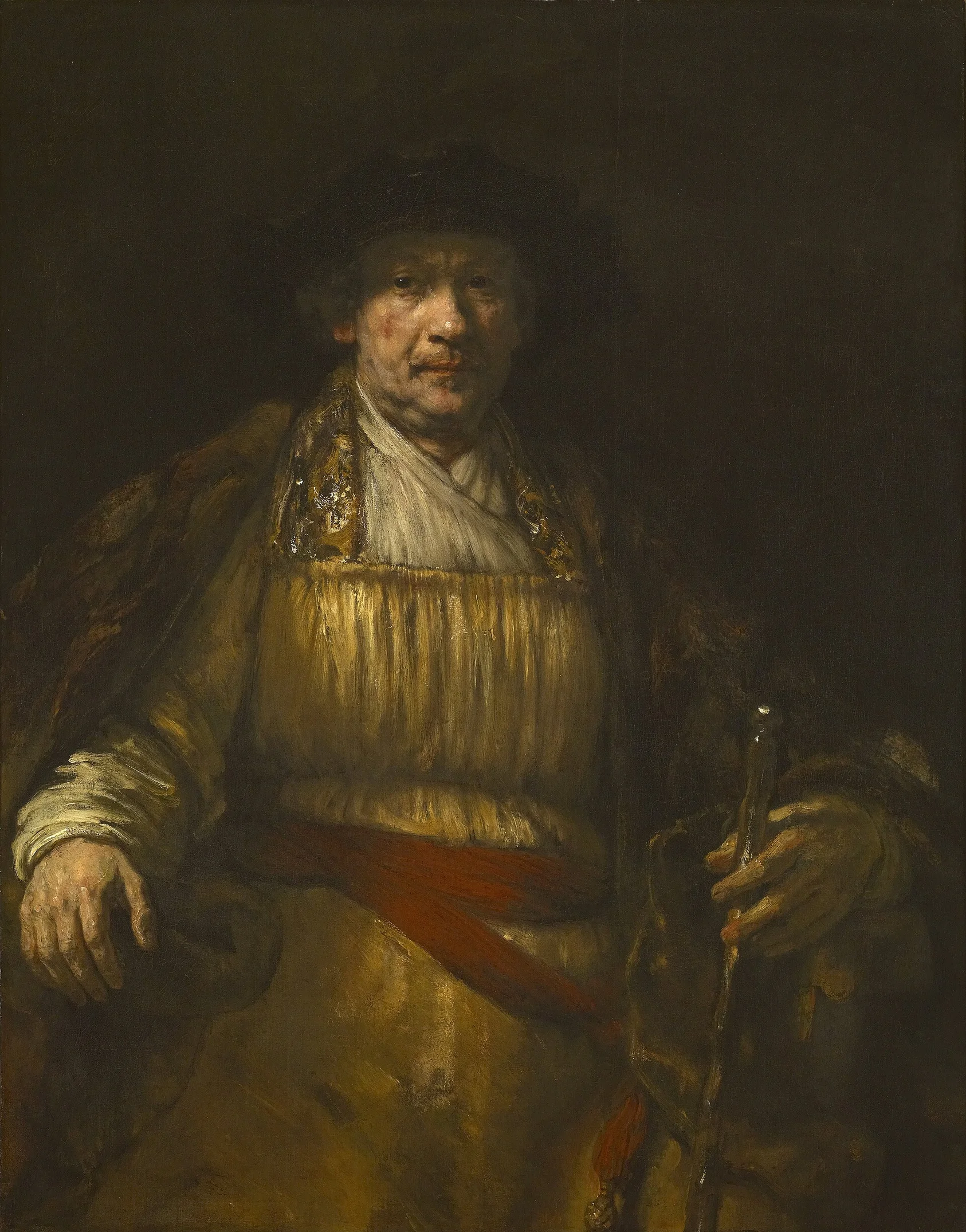
Self Portrait, 1658. Rembrandt. The Frick Collection, New York.
Look closer
7 things to notice
 1
01
Fifty-two, with no borrowed face
Light crosses the forehead and the uneven skin beneath the eyes. Rembrandt was fifty-two when he signed and dated this portrait. The Frick's account emphasizes the difference between his actual age and the older-looking face. He gives the viewer a specific man, with a shadow beneath each eye.
02
Dressed for an earlier century
The broad black beret makes a dark shelf above his forehead. The Frick identifies it as an artist's velvet cap, part of a costume that looks back to earlier painters. This is a chosen professional identity, not a record of an ordinary day's clothes. The cap extends beyond both temples.
03
Gold that could stay with him
Yellow pleats run down the front of the broad jerkin. The Frick dates this style of dress to the sixteenth century, well before Rembrandt's own lifetime. Its richness cannot establish what he could afford in 1658. The wealth we can verify here is the yellow oil paint across the cloth.
04
A collar with a past
A patterned neck cloth emerges beside the white linen at his chest. The Frick's exhibition essay connects this elaborate dress and pose to older portraits of distinguished artists, including Van Dyck's engraved series. Those images helped claim painting's place among the learned arts. Here that argument arrives in embroidered fabric.
05
The work depended on this hand
His bare right hand lies below a broad white cuff at the left edge. The Frick reads the prominent hands as a reminder that his livelihood depended on them. Amsterdam's surviving inventory offers a practical counterpart: professional tools were protected from creditors. His brush was absent from their list.
06
An object with two identities
His left hand grips a thin shaft with a bright tip above it. Frick accounts differ: an older description calls it a painter's stick, while the 2011 exhibition identifies a jointed rattan cane capped with silver. Neither reading makes it a royal scepter. The narrow shaft passes between his fingers.
07
Rough paint took careful work
The red sash crosses the yellow garment in broad, uneven passages. The Frick's technical account describes layered paint, broken surfaces and glazes throughout the portrait. What looks loosely handled was carefully built. At this distance, the red band is both a piece of clothing and a succession of painted marks.
Our take
He occupies the chair as though no one could ask him to leave. The dark coat opens around a broad gold garment, a red sash crosses his waist, and one hand closes around a cane. His face receives less light than the clothes. The eyes meet ours without explaining the costume.
In 1658, the year of this portrait, Rembrandt lost the Amsterdam house that had contained his family, studio and collection. The financial ruin is documented; the expression is harder to settle. The Frick describes his clothing as historical dress, associated with artists of the Northern Renaissance. He could choose how to appear even when he could no longer keep his possessions. Gold paint fills the space across his knees.
The painter's moment
1606–1669Painted it at 52Dutch Golden Age; Baroque
By 1656, Rembrandt could no longer manage his debts. He applied for a protected surrender of his property, and officials inventoried the Amsterdam house where he worked and lived. The document filled nineteen pages. It records paintings, prints, sculptures and the clothes and weapons he collected as studio material. Professional tools were exempt from seizure, but much of the collection went to auction. In 1658 the house itself was sold. He moved to rented rooms on the Rozengracht, an Amsterdam canal, with his partner Hendrickje Stoffels, his son Titus and their daughter Cornelia. The address changed; he continued painting.
This self-portrait belongs to that year of removal. Rembrandt dressed himself in clothing from an earlier artistic tradition and worked the oil paint into thick, varied layers. The picture gives no inventory of his losses. In 1660, Hendrickje and Titus established an art business that employed him, helping protect his earnings from creditors. The people in his household became the legal structure around his continuing work. Much later, in 1906, Henry Clay Frick acquired the portrait for his collection. It remains at The Frick Collection in New York. The painting survived the dispersal of one household to become a central possession in another.
In its time
Self Portrait was painted in 1658, when Rembrandt was 52. Its Dutch title is Zelfportret. Where it stands on Art Through Time:
Its colors
Elsewhere in the world
- 1654Jewish refugees reach New AmsterdamTwenty-three Jews from Recife found North America's first Jewish community.
The facts
- Title
- Self Portrait
- Artist
- Rembrandt (1606–1669)
- Date
- 1658
- Original medium
- Oil on canvas
- Style
- Dutch Golden Age; Baroque
- Made in
- Netherlands
- Collection
- The Frick Collection, New York
Living with it
The mood
The broad yellow garment brings a low warmth into a room, while the dark coat and background contain it. From a distance the seated body has weight; nearby, the face and two hands interrupt the large areas of cloth.
The palette
Charcoal and bark belong to the cap, coat and background. Walnut and bronze run through the shadowed folds, with ochre nearest the brighter garment. Across a room, the broad gold area registers first; the face appears within a much smaller patch of light.
Who it finds
- For someone who has moved after a financial loss; the man in this chair chose his appearance after losing his house.
- For someone whose hands have earned the household's living; the two bare hands remain prominent beneath the elaborate clothes.
- For someone who has kept working while family reorganized everything around them; Rembrandt's later business depended on Hendrickje and Titus.
See it in a room
Your photo is never uploaded, and it's gone when you leave.
Across a room, the wide gold shape and black cap establish the seated figure before the face becomes clear. Nearer, the red sash, patterned neck cloth and uneven paint give it more particular detail. Leave enough viewing distance for both encounters, rather than placing it where only the face is visible.
A study or a sitting room with plain upholstery gives the dark outer areas room to remain legible. A larger print helps the hands retain their separate shapes without making the head the only subject. Warm wood suits the brown passages; a simple frame keeps attention on the broad garment and the narrow bright cane.
How we make it
- True to the original
- Each file is color-matched to the museum original. If the color isn't right, we print it again, with our compliments.
- On canvas
- Fine-art canvas hand-stretched over a ¾″ solid-wood frame, with mirrored edges so nothing is lost.
- In our floating frame
- Our stretched canvas set in a slim floating frame, with a shadow gap so the painting seems to hover.
- As a framed print
- Archival pigment print on museum-grade cotton paper, in a solid-wood frame with UV-protective glazing.
- Ready to hang on arrival
- It arrives with the hanging hardware attached. No framer, no guesswork.
- Perfect on arrival
- If anything arrives damaged or not as you ordered, send us a photo within 7 days of delivery and we'll make it again, with our compliments.
Rembrandt's 1658 self-portrait sets a red sash against gold and black. Hang it where the broad figure and the worked face can both register.