The story · 4 min read
The child is safe in her arms, with suffering still ahead.
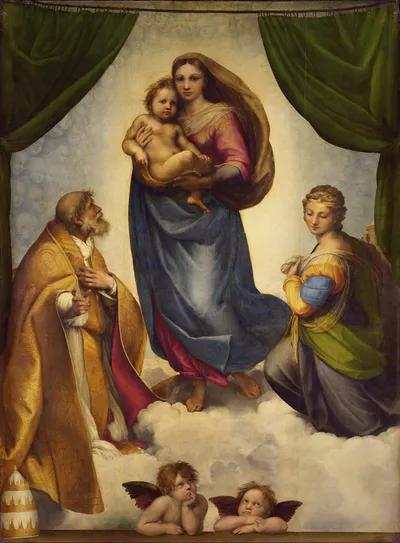
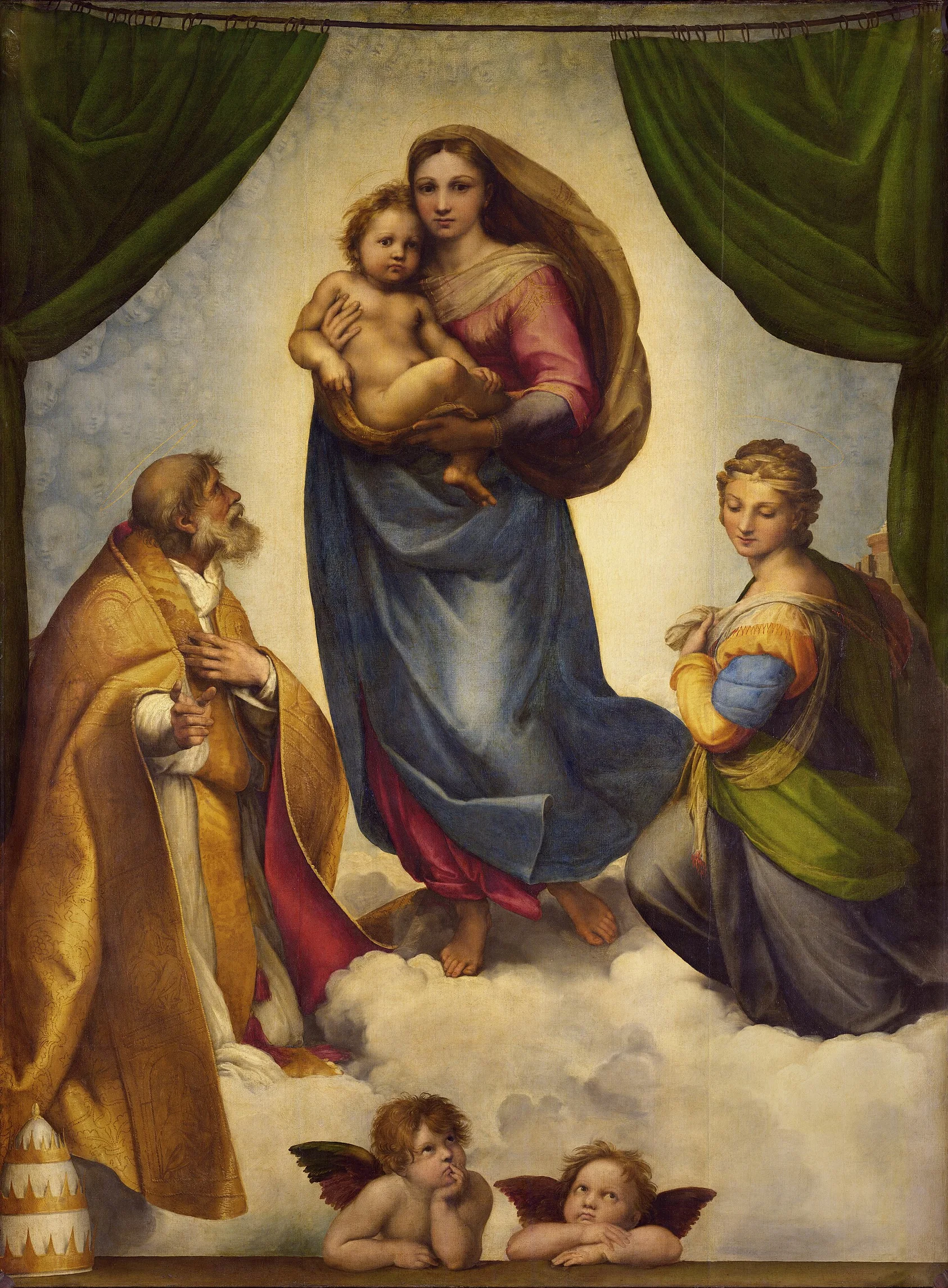
Sistine Madonna, c. 1512. Raphael. Gemäldegalerie Alte Meister, Staatliche Kunstsammlungen Dresden.
Look closer
7 things to notice
 1
01
She knows what lies ahead
Mary's face sits just above the child's, close enough for us to compare their wide eyes. Dresden's museum connects her seriousness with foreknowledge of the Passion, Christ's future suffering and death. The child she carries is still small. The painting gives that knowledge to a mother's young face.
02
A saint speaks for the congregation
The older saint on the left looks up while his hand points out of the painting. He is Saint Sixtus, patron of the church for which the work was made. Curator Mary Elizabeth Podles reads the gesture as intercession for the people below. His fingers direct attention beyond the painted clouds.
03
Her place has a local reason
The young saint on the right lowers her eyes beneath a carefully arranged veil. She is Saint Barbara, whose relics were housed at San Sisto. Her presence connected this heavenly gathering to the particular church that received it. The lowered gaze makes her face different from Sixtus's upward appeal.
04
The crown stays below him
A jeweled papal crown occupies the ledge at the lower left. It belongs to the identity of Sixtus as a pope, although he appears here bareheaded before Mary. The museum names him among the saints honored at San Sisto's high altar. His rank is visible in an object set aside.
05
The sky has more faces
Faint heads emerge from the pale clouds beside Mary's upper body. Podles identifies this background as a heavenly choir of cherubs, distinct from the two larger angels below. What initially looks like empty atmosphere is inhabited. Small eyes and noses become visible as the cloud loses its blankness.
06
A church window becomes an opening
The green curtain gathers at the upper right, leaving the central light exposed. The Saxon State Archives describes green-curtained windows beside the painting's original position in San Sisto. Painted cloth belonged to a setting with real cloth nearby. Here its heavy edge borders the pale heads in the clouds.
07
The famous pair arrived late
Two winged children look upward from the bottom ledge. According to Dresden's museum, Raphael added them near the end of painting the work. Their separate fame now extends to museum merchandise bearing their images. Their elbows stay on the ledge at the bottom of the picture.
Our take
Mary carries the child toward us, but neither face offers the reassurance we might expect. Her eyes look ahead; his seem fixed on something beyond the frame. Below them, two small angels watch from a ledge. The green curtains make the opening look almost domestic. What appears through it belongs to heaven.
Dresden's museum reads the mother's grave expression as knowledge of Christ's coming Passion. That changes the familiar image of a mother protecting her child: within this Christian vision, she cannot prevent what is to come. Raphael painted the work for a church altar, where the congregation would look upward toward the figures. The saints attend to Mary and to the space below her. At the bottom, the two angels have their own patient faces.
The painter's moment
1483–1520Painted it at 29High Renaissance
By 1512, Raphael had become one of the painters on whom Pope Julius II depended. He had arrived in Rome in 1508, with connections that included the architect Donato Bramante, and had gained responsibility for major Vatican rooms. The new commission sent his work toward Piacenza, a city southeast of Milan, rather than another room in the pope's palace. Julius ordered an altarpiece for the Benedictine church of San Sisto in the summer of 1512. The museum dates the resulting canvas to 1512–13. A painter already busy with large public projects had to make an image that would answer a congregation looking up from below.
Julius died in 1513, but Raphael's place in papal Rome survived the change of patron. Under Leo X, his interests and responsibilities extended further into architecture; around 1514 he paid the scholar Fabio Calvo to translate Vitruvius into Italian so he could study the ancient architectural treatise closely. The Madonna remained at San Sisto long after the men who commissioned and painted it had died. In 1754, after nearly two years of negotiations, Augustus III acquired it for Dresden. The work now belongs to the Gemäldegalerie Alte Meister. For its five-hundredth anniversary in 2012, the museum fitted it with new protective glass and a newly designed frame.
In its time
Sistine Madonna was painted around 1512, when Raphael was 29. Its German title is Sixtinische Madonna. Where it stands on Art Through Time:
Its colors
Elsewhere in the world
- 1508Michelangelo paints the Sistine ceilingRome becomes the capital of the High Renaissance.
- 1511Portugal takes MalaccaEuropean empires arrive in the spice trade.
- 1516Venice creates the first ghettoThe city confines its Jews to a walled quarter; the word spreads.
- 1517The Reformation beginsEurope divides over images and faith.
- 1517Luther's 95 ThesesProtestant lands turn away from religious images.
The facts
- Title
- Sistine Madonna
- Artist
- Raphael (1483–1520)
- Date
- c. 1512
- Original medium
- Oil on canvas
- Style
- High Renaissance
- Made in
- Italy
- Collection
- Gemäldegalerie Alte Meister, Staatliche Kunstsammlungen Dresden
Living with it
The mood
A tall central figure occupies a pale opening between dark green curtains. The upward and downward glances keep attention moving through the vertical image. At a distance, the gold clothing and small light faces remain distinct against the darker edges.
The palette
Bronze and flax pick out the gold vestments and the warm light in the clouds. Olive, walnut and bark belong to the curtain shadows, ledge and darker cloth. The supplied colors emphasize the painting's browned warmth; Mary's blue garment adds a separate, cooler center.
Who it finds
- For someone who has carried a child while worrying about what comes next; Mary's forward gaze gives that experience a visible form.
- For someone who knew the two small angels before knowing their painting; the full image restores the people above them.
- For someone who remembers looking upward from a church pew; the saints' gestures still address the space below the altar.
See it in a room
Your photo is never uploaded, and it's gone when you leave.
Across a room, the figure of Mary and the pale opening around her establish the picture's height. Nearer, faces emerge from the clouds and the small angels regain their place in the larger scene. A medium or large vertical print allows both distances of looking without reducing those faces to dots.
A study, living room or place used for prayer can give the image an unhurried setting. Leave enough wall above nearby furniture for the upper curtain to remain visible from a seated position. Warm wood and a narrow border suit the golds without adding another elaborate frame inside the room.
How we make it
- True to the original
- Each file is color-matched to the museum original. If the color isn't right, we print it again, with our compliments.
- On canvas
- Fine-art canvas hand-stretched over a ¾″ solid-wood frame, with mirrored edges so nothing is lost.
- In our floating frame
- Our stretched canvas set in a slim floating frame, with a shadow gap so the painting seems to hover.
- As a framed print
- Archival pigment print on museum-grade cotton paper, in a solid-wood frame with UV-protective glazing.
- Ready to hang on arrival
- It arrives with the hanging hardware attached. No framer, no guesswork.
- Perfect on arrival
- If anything arrives damaged or not as you ordered, send us a photo within 7 days of delivery and we'll make it again, with our compliments.
Raphael's Madonna of 1512–13 carries her child through a curtained opening. Give the full vertical image room above the two familiar angels.