The story · 4 min read
Dying flowers, painted in a rare season of hope.
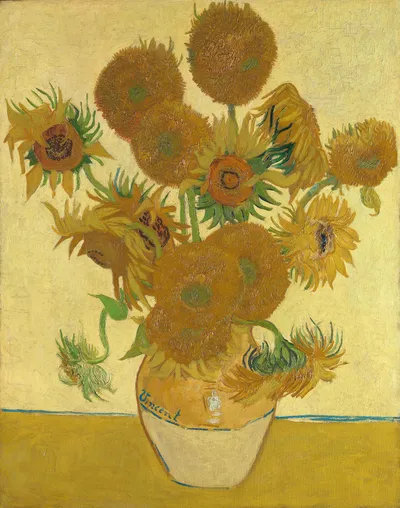
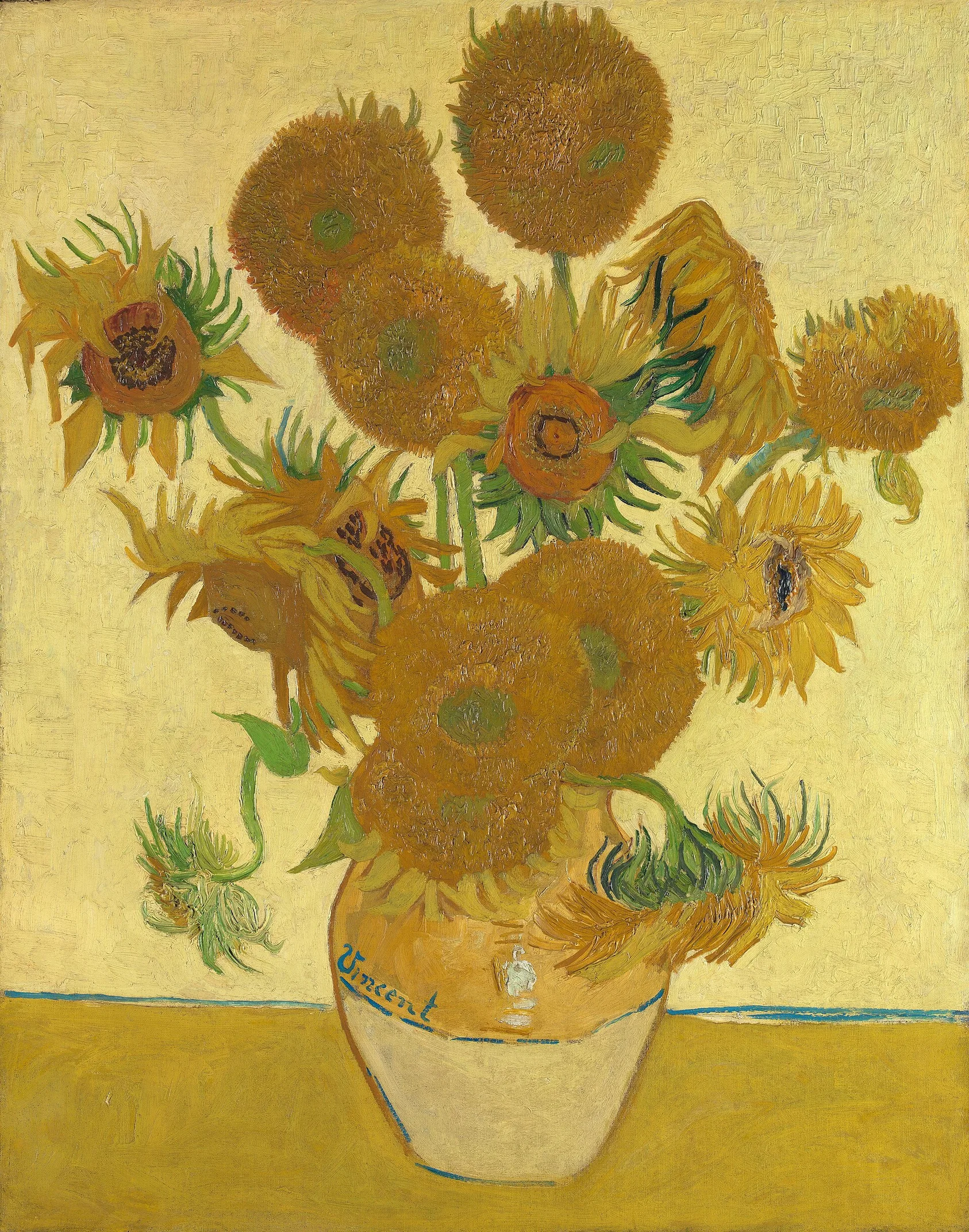
Sunflowers, 1888. Vincent van Gogh. National Gallery, London.
Look closer
7 things to notice
 1
01
A small sun at the heart of it
In the middle of the bouquet, a flower with a bright orange-red disc and dark rings at its heart sits in a ruff of yellow petals and spiky green sepals. It seems the hottest note in the picture, and the eye tends to land there first. For Van Gogh, yellow stood for sunlight, life and God, and here it burns at the very centre.
02
Paint that became the seeds
The highest flower shows no petals at all, only a big shaggy head of dense, raised orange-brown strokes around a small green centre. The National Gallery in London says the thick layers of paint call up the texture of the seed-heads. It is as if the paint stopped describing the seeds and turned into them.
03
Heavy with what comes next
On the left, a heavy head hangs face-down with its ragged yellow petals splayed and rows of dark seeds showing on its brown back. Both of his sunflower series show dying flowers, and this one is plainly past its best. Nothing about it looks mournful, though. It reads like a flower that has given everything it had.
04
The wilting he was racing
On the right, a wilted head droops over the edge of the vase, its dark green sepals curling and its dry orange petals trailing down like a fringe. He painted every morning from sunrise because the flowers wilted fast, and this is exactly what he was racing. He let it into the picture anyway.
05
Bright, and already worn
A fresher flower on the right bursts with lemon-yellow petals, but its small pale centre looks worn, with a dark gash across it. Even the brightest head in the vase has begun to turn. His flower paintings use a symbolism he made up himself rather than the traditional Christian one, and here it seems to say that the light and the ending arrive together.
06
One blue line holds it all
A thin blue line runs across the canvas where the pale yellow wall meets the darker ochre table. He called the scheme he planned for these canvases a symphony in blue and yellow, and this line seems to be the blue: one quiet stroke, as if it were there to keep all that yellow from melting into itself.
07
A name like a card in a bouquet
His name is painted in blue across the upper part of the vase, just above the band where its two colours meet: Vincent. He told Theo he wanted to decorate the studio he hoped to share with Gauguin with nothing but large sunflowers. The name sits there like a card tucked into flowers for a guest.
Our take
Van Gogh painted this vase of sunflowers in Arles in August 1888, in early morning light. It is one of four versions he made in a single week, to get ready for Gauguin's arrival. He started every morning at sunrise because the flowers wilted fast, and you can see that race on the canvas: a few heads still blazing, the rest drooping, shrivelling, going to seed. Every flower in it is dying, and the whole picture seems glad.
The gladness is his: he made it in a rare season of optimism. For Van Gogh, yellow stood for sunlight, life and God, and here he gives it almost the whole canvas: yellow flowers on a yellow wall above a yellow table, held together by a few thin lines of blue. The series has also been read as a show of his skill for Gauguin more than a vehicle for feeling, and its yellow has been read as sickly as well. To us it reads as a morning held still: the light at its fullest, the flowers already turning, and a man who for once believed the room would soon be full.
The painter's moment
1853–1890Painted it at 35Post-Impressionism
Van Gogh was about 35. He had come to Arles on 21 February 1888, and on 1 May he rented four rooms at 2 Place Lamartine, the Yellow House. His younger brother Theo supported him with money. That summer, while he waited for Gauguin, he painted four versions of Sunflowers in a single week, and in an August letter he compared his eagerness to paint big sunflowers to a man from Marseille eating bouillabaisse. In Arles he made 200 paintings and more than 100 drawings and watercolours.
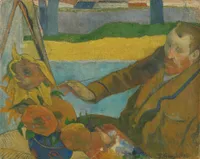
He first slept in the Yellow House on 17 September, when it still had little furniture. Gauguin arrived on 23 October and painted him at work in The Painter of Sunflowers. On the evening of 23 December, after a quarrel, Van Gogh cut off all or part of his left ear with a razor. After Gauguin left, he pictured the two main sunflower versions as the side panels of a triptych around La Berceuse. In May 1889 he wrote that he wanted to do something with cypresses like his sunflower canvases. He died on 29 July 1890 in Auvers-sur-Oise. By 1912 this canvas belonged to Johanna van Gogh-Bonger, Theo's widow, and the National Gallery in London has held it since 1924.
In its time
Sunflowers was painted in 1888, when Van Gogh was 35. Its Dutch title is Zonnebloemen. Where it stands on Art Through Time:
Its colors
Elsewhere in the world
- 1884The Berlin ConferenceEurope's powers divide Africa among themselves.
- 1887French Indochina is formedFrance rules Vietnam and Cambodia, and later Laos.
- 1888Brazil abolishes slaveryThe Golden Law makes Brazil the last country in the Americas to end it.
- 1890Wounded KneeU.S. soldiers kill some 250 Lakota men, women and children.
- 1894The Dreyfus AffairA Jewish officer is falsely convicted of treason; France, and its painters, split in two.
The facts
- Title
- Sunflowers
- Artist
- Vincent van Gogh (1853–1890)
- Date
- 1888
- Original medium
- Oil on canvas
- Style
- Post-Impressionism
- Made in
- Netherlands
- Collection
- National Gallery, London
Living with it
The mood
Warm and awake, like a room just after the curtains are opened. It doesn't shout. It glows, all gold and morning, with a faint sense underneath of a summer already turning.
The palette
Almost all of it is yellow, from the primrose of the wall to the ochre and tobacco of the seed-heads. The only real contrast comes from the green stems and a few thin lines of blue, so from across a room it reads as one warm glow.
Who it finds
- Anyone who has got a room ready for someone they longed to see. He painted these for a guest who had not yet arrived.
- People who know that the best seasons don't last, and love them more for it. Half these flowers are already going to seed.
- Anyone who has got up at sunrise to make something before the day could take it away.
See it in a room
Your photo is never uploaded, and it's gone when you leave.
It works from two distances. From across the room you see a single shape of light: a round vase and a crown of gold against a pale wall. Come close and it turns into a story of ripening and wilting, flower by flower, with the brushwork of the seed-heads and the blue name on the vase.
It belongs in a room that is used in the morning, such as a kitchen, a breakfast table, a sunny hallway or a dining room where people linger. Give it size, near the canvas's own 92 by 73 cm, so that the drooping heads and the woven strokes of the wall can be read from the table.
How we make it
- True to the original
- Each file is color-matched to the museum original. If the color isn't right, we print it again, with our compliments.
- On canvas
- Fine-art canvas hand-stretched over a ¾″ solid-wood frame, with mirrored edges so nothing is lost.
- In our floating frame
- Our stretched canvas set in a slim floating frame, with a shadow gap so the painting seems to hover.
- As a framed print
- Archival pigment print on museum-grade cotton paper, in a solid-wood frame with UV-protective glazing.
- Ready to hang on arrival
- It arrives with the hanging hardware attached. No framer, no guesswork.
- Perfect on arrival
- If anything arrives damaged or not as you ordered, send us a photo within 7 days of delivery and we'll make it again, with our compliments.
Van Gogh painted them at sunrise in August 1888, before they could wilt, to fill a room for a friend. Let them fill a room again.