The story · 3 min read
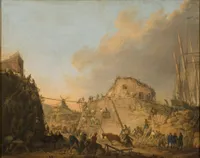
The walls still dwarf the people who are taking them apart.
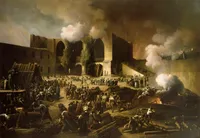
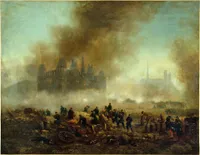
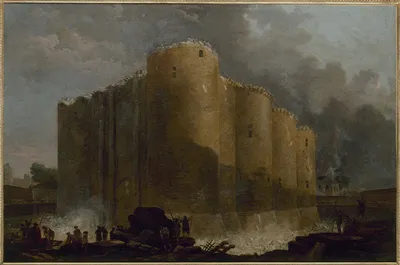
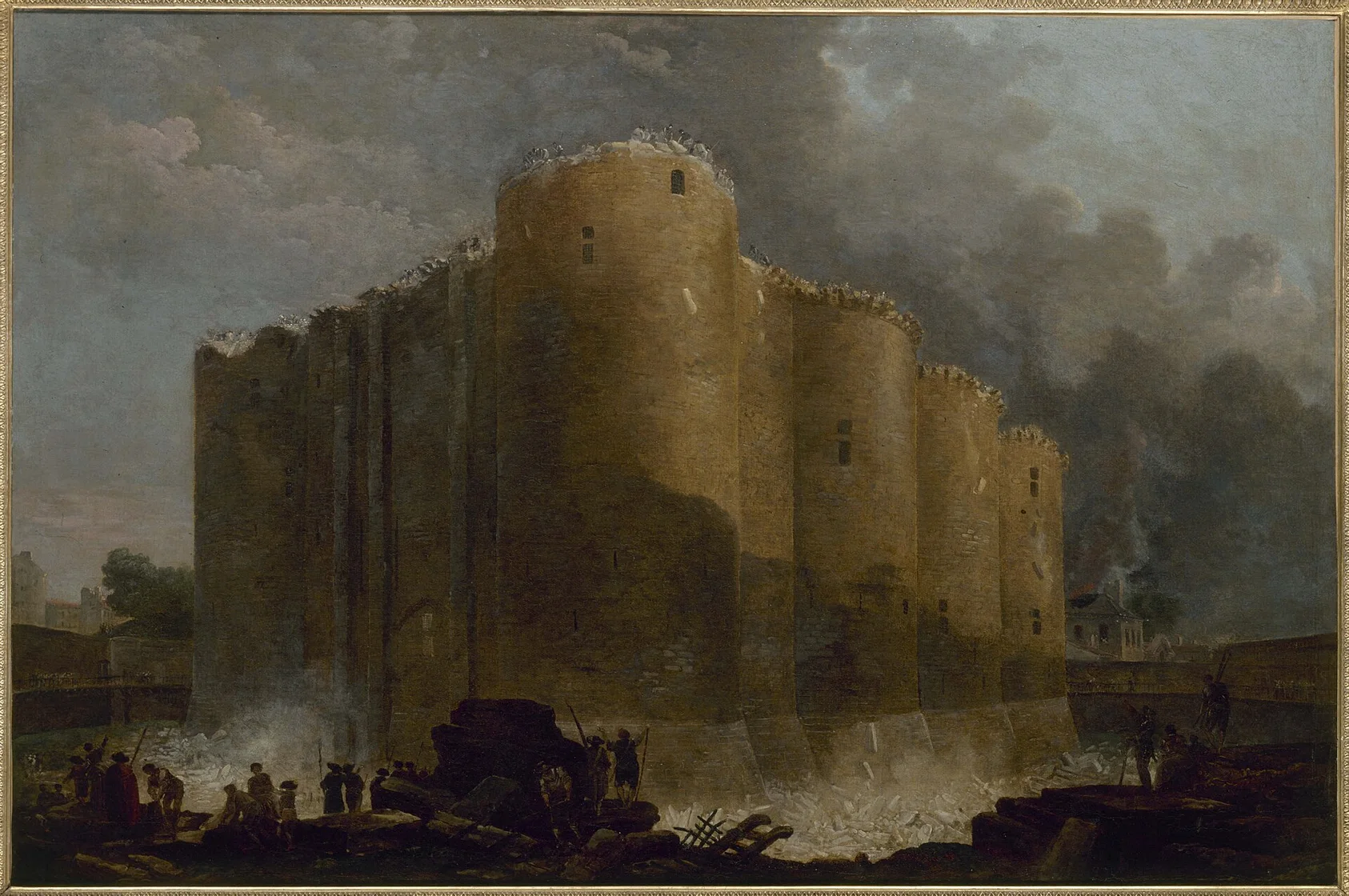
The Bastille in the Early Days of Its Demolition, 1789. Hubert Robert. Musée Carnavalet – Histoire de Paris.
Look closer
7 things to notice
 1
01
The smallest figures change the skyline
Workers line the broken crown of the central tower, their bodies little more than dark marks. Stéphane Blond identifies the activity as the removal of the towers' battlements. The building loses its outline a few stones at a time. One small figure stands against the gray sky.
02
Its size is part of the story
A broad yellow-brown tower occupies the center, with tiny windows across its curved wall. Blond identifies it as the Tour du Puits. Carnavalet notes that Robert enlarged the fortress beyond realistic proportions. The remaining masonry overwhelms the small openings cut through it.
03
Stone becomes a falling object
Pale blocks descend beside the lower towers toward a cloud of dust. Blond describes the masonry falling into the former dry moat during demolition. These are pieces of the building already separated from its walls. Their light edges appear briefly against the darker stone behind.
04
The smoke comes from another loss
Dark smoke rises at the right beyond the fortress wall. Blond connects it to the former governor's residence, still burning after the storming. Robert's Bastille painting puts two kinds of destruction in one view: dismantling stone and fire below. A small roof appears beneath the smoke.
05
Some watch while others work
Small figures gather among rubble in the left foreground, several seen from behind. Blond identifies both onlookers and people sorting debris. The painting gives them a close view without making them larger than the task. A light-colored coat separates from the dark group.
06
The city continues beyond the wall
Low buildings appear beyond the left edge of the fortress, under the gray-blue sky. Robert had returned from Rome in 1765 and repeatedly painted Paris as it changed. This demolition belonged to that continuing attention. A small roofline remains visible beside the much taller prison.
07
Six days fit on a stone
A dark foreground stone carries the painting's date and signature at lower right. The inscription gives 20 July 1789, only six days after the storming. Robert fixes a stage in a structure's disappearance. The small lettering stays close to the rubble it records.
Our take
Look along the skyline: the fortress has people on its roof. Robert's Bastille painting records the first days of demolition after the storming on 14 July 1789. Tiny workers break up the towers while blocks fall toward the ditch. From below, the building still appears almost too large to touch. Its destruction begins at the edge of the sky.
Robert had made a career from ruins, often combining observed buildings with imagined ones. Here a Paris prison was becoming a ruin in front of him. Carnavalet says he enlarged its dimensions to give the structure greater symbolic weight. The picture is dated 20 July, six days after the assault. A dark line of spectators watches pale dust gather beneath the remaining walls.
The painter's moment
1733–1808Painted it at 56Architectural history painting
Ruins were familiar work for Hubert Robert by July 1789. He had spent years in Italy, returning to Paris in 1765 with drawings that supplied subjects throughout his career. He entered the Royal Academy the next year and worked for patrons close to the court. Paris also gave him buildings in the process of changing, including houses being removed from its bridges. The Bastille brought that interest into the opening weeks of the French Revolution. He visited the demolition early, although the exact day is uncertain, and dated his picture 20 July. The old prison was already becoming material on the ground.
The canvas appeared at the Salon later that summer. Its later owners included Lafayette; the reported story that Robert gave it to him during the exhibition remains less certain than the ownership itself. The museum's friends acquired it for Carnavalet in 1929. Between making this view and its eventual museum life, Robert experienced confinement himself. Arrested in October 1793, he spent months in Sainte-Pélagie and Saint-Lazare, making images of prison life before his release after Robespierre's fall. The painter who watched one prison disappear survived inside others. His Bastille remains at the point where the walls still stand and the workmen have begun to remove their upper edge.
In its time
The Bastille in the Early Days of Its Demolition was painted in 1789, when Robert was 56. Its French title is La Bastille, dans les premiers jours de sa démolition. Where it stands on Art Through Time:
Its colors
Elsewhere in the world
- 1788Colonization of Australia beginsConvicts, Australia's first Jews among them, land on Gadigal country; Aboriginal nations face devastation.
- 1789The French RevolutionPainters take sides; history painting turns political.
- 1791France makes its Jews full citizensThe first country in Europe to grant Jews equal rights.
- 1791The Pale of SettlementRussia confines its Jews to its western borderlands.
- 1795Poland is erased from the mapRussia, Prussia and Austria complete the partitions.
The facts
- Title
- The Bastille in the Early Days of Its Demolition
- Artist
- Hubert Robert (1733–1808)
- Date
- 1789
- Original medium
- Oil on canvas
- Style
- Architectural history painting
- Made in
- France
- Collection
- Musée Carnavalet – Histoire de Paris
Living with it
The mood
The fortress makes a broad brown mass under a gray sky, with people confined to a thin band below. Pale dust marks its base. The image gives a room a large architectural presence while keeping the human activity small and discoverable.
The palette
Bark and walnut shape the broad towers; ebony occupies the rubble and foreground figures. Stone and ash lighten smoke, dust and the upper sky. From across a room, the warm central tower separates from the cooler air around its broken crown.
Who it finds
- For someone who has watched a familiar building come down; the skyline changes before the whole structure disappears.
- For someone who remembers visiting a place at the end of its use; small workers occupy the former defenses.
- For someone who notices the people in a large landscape; the smallest marks here perform the largest change.
See it in a room
Your photo is never uploaded, and it's gone when you leave.
At a distance, the fortress appears almost intact. Closer, the figures at the top and the individual falling blocks reveal how much is changing. Leave a clear approach to the image so that the tiny workers can become visible after the first broad impression of walls and sky.
A wide study wall or a living room with low furniture suits the long outline. Choose enough width to keep the roofline workers distinct at close range. The dark foreground needs room above any furniture; covering that strip would remove the people whose scale makes the remaining fortress seem so large.
How we make it
- True to the original
- Each file is color-matched to the museum original. If the color isn't right, we print it again, with our compliments.
- On canvas
- Fine-art canvas hand-stretched over a ¾″ solid-wood frame, with mirrored edges so nothing is lost.
- In our floating frame
- Our stretched canvas set in a slim floating frame, with a shadow gap so the painting seems to hover.
- As a framed print
- Archival pigment print on museum-grade cotton paper, in a solid-wood frame with UV-protective glazing.
- Ready to hang on arrival
- It arrives with the hanging hardware attached. No framer, no guesswork.
- Perfect on arrival
- If anything arrives damaged or not as you ordered, send us a photo within 7 days of delivery and we'll make it again, with our compliments.
Dated 20 July 1789, Robert's fortress is already coming apart. Give its skyline enough width for the workers to emerge from the stone.