The story · 4 min read
The great ship has survived the battle. A little tug decides where she ends.
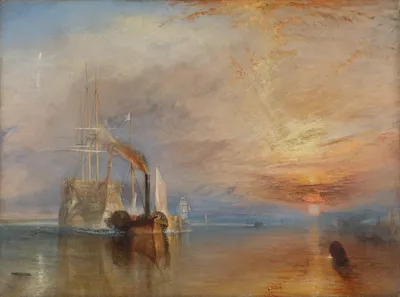
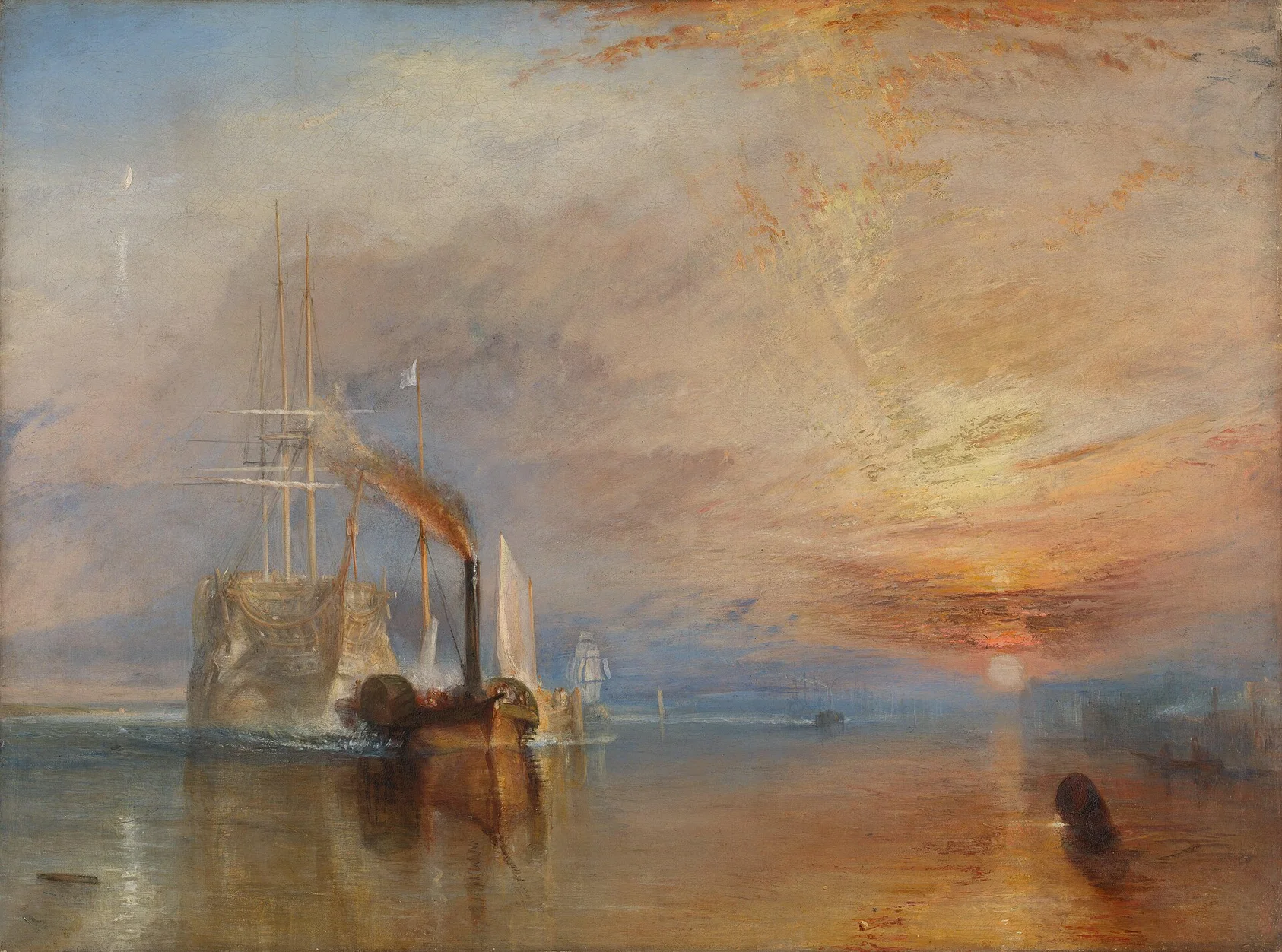
The Fighting Temeraire, 1839. J. M. W. Turner. The National Gallery, London.
Look closer
7 things to notice
 1
01
She is losing her weight
The ship's hull glows pale at left, gold around its curved sides, dark marks picking out the rows above the water. Turner replaced the vessel's black-and-yellow paintwork with white and gold, the National Gallery explains. Her last passage seems to be making her less solid. The water meets a hull already full of light.
02
He gave her back her masts
Three masts rise into the blue-grey sky, narrow uprights crossed by spars and fine rigging. The real ship had been stripped of her masts before the tow. Judy Egerton reads Turner's restoration of them as a way of preserving the vessel's dignity. She can stand tall for this last stretch of river.
03
The smaller boat decides
The tug pushes forward below its black funnel, brown smoke trailing across the sky, white ripples at its sides. Two steam tugs did the actual towing; Turner makes this one the picture's working centre. It seems indifferent to the ceremony gathering around it. The little hull has a job to finish.
04
Daylight has company already
A white crescent hangs high at left, a small curved mark in the pale blue above the river. The sun elsewhere in the picture has not yet disappeared. As we read it, the moon gives the farewell a second light, cooler and harder to notice. It needs so little paint to stay.
05
The sky spends its last gold
The sun sinks towards the right-hand horizon, its pale disc below a bank of red and copper cloud. The National Gallery connects this sunset to the end of the vessel's working life. Light occupies more space here than any hull. The sky gives a whole evening to one ship.
06
Others still have somewhere to go
A cream sail appears beyond the tug, with a smaller square-rigged ship farther back, both pale against blue haze. These other craft keep the river in use around the final tow. The painting leaves their destinations outside the frame. Someone else's passage continues under those sails.
07
Something stays behind
A dark buoy tips out of the water at lower right, its rounded top above a brown reflection. Its size against the distant boats places it close to us. In this crop the river's orange light meets an ordinary object along the route. The farewell passes a buoy.
Our take
The smaller boat decides where they go. Brown smoke leaves its funnel, pale water breaks beside its hull, and the tall ship follows with her sails closed. Turner painted this final journey in 1839, a year after the Temeraire was towed to a breaker's yard in London. The National Gallery reads the passage from sail to steam in the two vessels and the setting sun. The river is wide; the destination is fixed.
Turner would not sell this picture of a parting. He called it his darling and intended to leave it to the nation. Knowing that makes the painted passage feel more personal without turning the ship into a portrait of him. He kept the old vessel near, pale above the water, while the small working boat brought her towards the edge of the canvas.
The painter's moment
1775–1851Painted it at 64Romanticism
The news concerned a ship J. M. W. Turner could place in Britain's history. Temeraire had fought at Trafalgar in 1805; in 1838 she was taken from Sheerness in Kent, at the Thames estuary, to be dismantled at Rotherhithe in south-east London. Her masts were already gone. Turner made the journey into a picture for the Royal Academy's exhibition of 1839, with those uprights returned to the sky. No secure evidence puts him beside the river watching the tow. Judy Egerton treats the painting as a reconstruction shaped by the ship's past and its fate. The tall silhouette belongs to that act of remembering.
When the canvas appeared at the Academy, its farewell had a public audience. Turner then kept it, refusing to sell and intending it for the nation; it entered the National Gallery in London through his bequest in 1856. The picture itself makes the difference between keeping and losing hard to overlook. Look from the small tug to the pale bulk behind it, then across to the sun, whose light covers so much of the river. A vessel on its way to destruction has been given enough painted space to remain. The tow never quite arrives at the yard.
In its time
The Fighting Temeraire was painted in 1839, when Turner was 64. Where it stands on Art Through Time:
Its colors
Elsewhere in the world
- 1838The Trail of TearsThe Cherokee are forced west under the Indian Removal Act; thousands die.
- 1839Photography is announcedPainters are freed from the duty to record.
- 1839The Opium WarBritain forces open China's ports.
- 1840The Treaty of WaitangiMāori and the British Crown sign a founding treaty.
- 1845The New Zealand WarsDecades of war over land between Māori and the Crown.
The facts
- Title
- The Fighting Temeraire
- Artist
- J. M. W. Turner (1775–1851)
- Date
- 1839
- Original medium
- Oil on canvas
- Style
- Romanticism
- Made in
- United Kingdom
- Collection
- The National Gallery, London
Living with it
The mood
A low band of river beneath an evening sky that takes up most of the room's view. Copper light gathers on one side, pale blue on the other; the two boats give that open distance a small, approaching weight.
The palette
Wheat and linen colour the pale ship and bright haze; flint runs through the cooler cloud. Bronze deepens the reflected sunset, walnut the tug and buoy. Across a room, the orange-copper sky carries first, with the white-gold ship answering it from the left.
Who it finds
- For someone who has watched a familiar workplace close while its machinery still looked capable; the tall masts give that ending a shape.
- For someone who has kept an object after its useful life was over; Turner kept this painted ship near him.
- For someone who remembers a last journey along an ordinary route; the other boats continue while the old vessel passes.
See it in a room
Your photo is never uploaded, and it's gone when you leave.
From a distance the painting divides into pale ship, dark tug and the broad light at right. Nearer, the thin rigging, the crescent and the buoy establish smaller distances within it. The river has room for more than the two main vessels, and those little sails repay a place to stand close.
Give it a wide view from a sofa, a desk or the end of a dining table. A broad horizontal print lets the sky remain generous while the boats keep their shape. Avoid a cramped gap between tall furniture; the clouds need space on either side of the mastheads.
How we make it
- True to the original
- Each file is color-matched to the museum original. If the color isn't right, we print it again, with our compliments.
- On canvas
- Fine-art canvas hand-stretched over a ¾″ solid-wood frame, with mirrored edges so nothing is lost.
- In our floating frame
- Our stretched canvas set in a slim floating frame, with a shadow gap so the painting seems to hover.
- As a framed print
- Archival pigment print on museum-grade cotton paper, in a solid-wood frame with UV-protective glazing.
- Ready to hang on arrival
- It arrives with the hanging hardware attached. No framer, no guesswork.
- Perfect on arrival
- If anything arrives damaged or not as you ordered, send us a photo within 7 days of delivery and we'll make it again, with our compliments.
Turner's farewell of 1839 leaves the old ship on the river, just short of arrival. Give that long evening room to remain.