The story · 4 min read
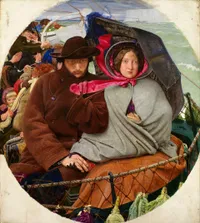
England is still in sight behind them, and neither of them turns to look.
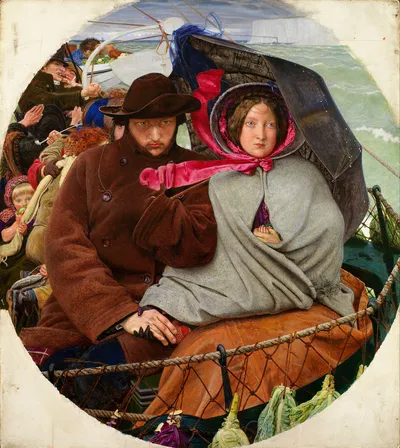
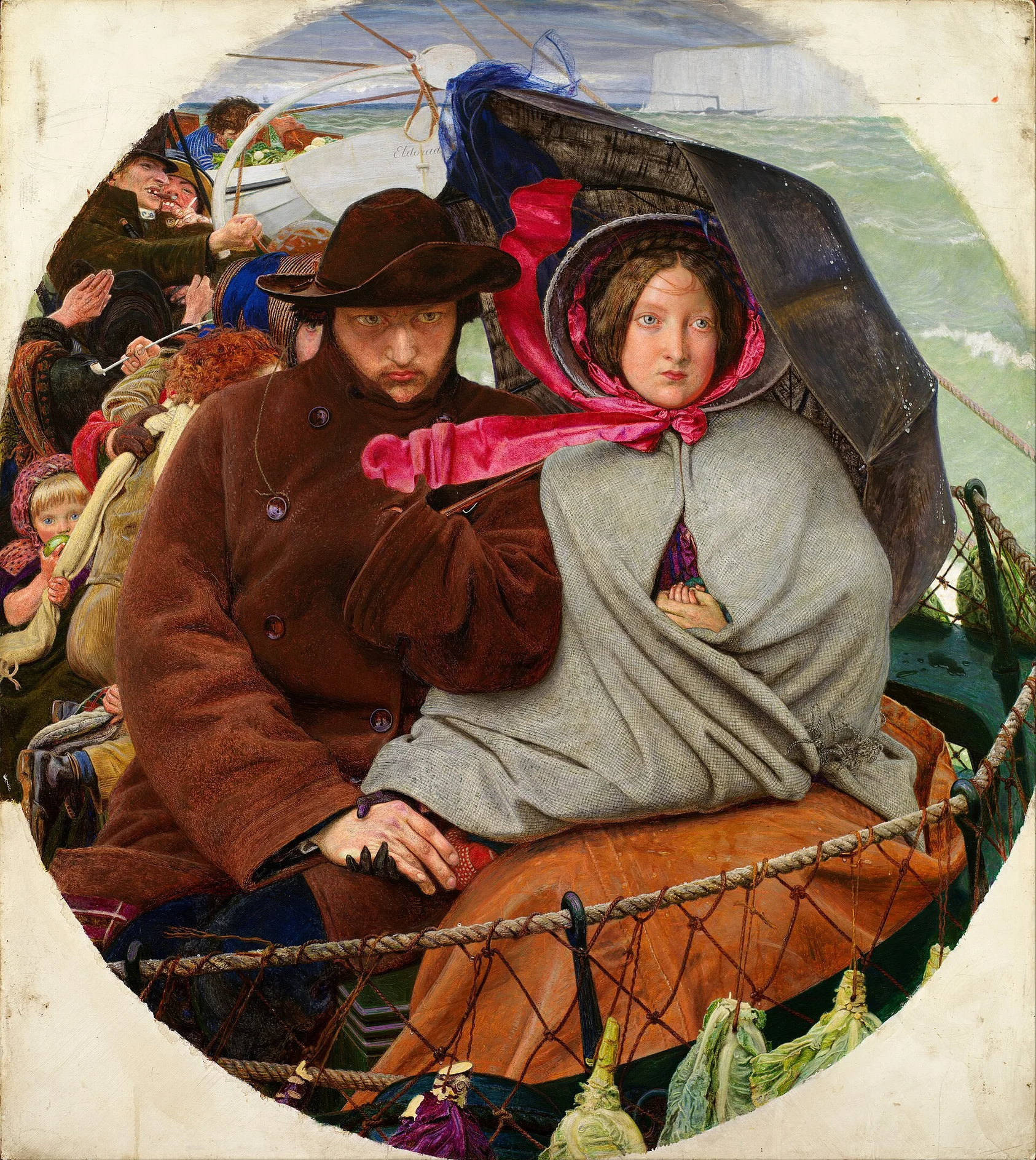
The Last of England, c. 1853. Ford Madox Brown. Birmingham Museum and Art Gallery.
Look closer
7 things to notice
 1
01
Eyes that won't turn back
Her pale blue eyes stare straight out from inside the bonnet, and her lips are pressed shut. Brown modelled her on his wife, Emma, and gave her, like her husband, a blank face. Whatever she feels, she seems to have decided not to show it to England.
02
He was glad his hand turned blue
His half-gloved hand rests over her bare one, and the skin looks red with cold. Brown painted mostly outdoors and was glad when the cold turned his own hand blue, because that was how he wanted these hands to look. His neighbours saw him working outside in all weathers and thought he was strange.
03
The smallest hand on board
In the gap of her grey cloak, she holds a tiny pink hand. The baby is hidden under the cloak, and it is said to be the couple's second child, Oliver. Of everything they are taking to the other side of the world, this seems to be the one thing she won't let go of.
04
The last of England
Far off at the top right, the white cliffs of Dover slip out of sight above a grey-green sea, with a small steamer passing in front of them. The couple do not look at them. Brown puts the thing the painting is named for where only we can see it.
05
Four weeks for a ribbon
A long magenta ribbon, tied in a bow under her chin, blows sideways across his chest. Brown's diary says the ribbons on her bonnet took him four weeks to paint. In all that stillness, it looks like the only thing the wind is allowed to move.
06
Cabbages for the long voyage
Below the rope and netting, a row of pale green cabbages hangs upside down from the rail, food for the long voyage. Details like these have been read as typical of Brown: odd and ordinary at once. Even in the middle of a farewell, someone has had to think about what everyone will eat.
07
Someone curses the shore
At the upper left the crowd is rougher: a grinning man with a pipe in his teeth, a hand raised in the air. Among the passengers are two drunken men, and Brown meant one of them to be shaking his fist and cursing his homeland. The couple leave in silence, and behind them someone leaves shouting.
Our take
You might expect a farewell to look back. Brown turns his couple away: the white cliffs of Dover are slipping out of sight behind them, and neither one looks. They stare straight ahead under an umbrella wet with sea spray, their faces blank. Home is still in sight, and already it is gone.
It seems to be a goodbye Brown was rehearsing. He began it in 1852, after his close friend Thomas Woolner left for Australia, while he was short of money himself and thinking of taking his family to India, and he gave the couple his own face and Emma's. Under her cloak she holds a baby's hand, and his hand rests over hers: whatever they are leaving behind, they seem to know what they are keeping.
The painter's moment
1821–1893Painted it at 32Pre-Raphaelite
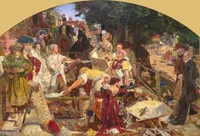
Ford Madox Brown began the painting in 1852. The idea came when his close friend, the sculptor Thomas Woolner, left for Australia. That year was a peak for leaving: more than 350,000 people emigrated from England. Brown's own paintings were not selling. He called himself very short of money and a little mad, and he was thinking of moving to India with his family. That same year he also began Work, which kept him busy until 1865.
He painted in a room over a china shop at 33 High Street, Hampstead, and his models sat for him in the garden. The wife is Emma Hill, a bricklayer's daughter who could not read. She had modelled for him since 1848, and at first social convention held him back from marrying her. They married at St Dunstan-in-the-West in April 1853. Their daughter Catherine, born in 1850, was the model for the blonde child biting an apple just behind the husband. Oliver, the son the hidden baby is said to be, was born in 1855 and died of blood poisoning in 1874. There are two finished versions, one in Birmingham and one at the Fitzwilliam Museum, Cambridge. Birmingham's museums have owned theirs since 1891. In a BBC Radio 4 poll, the painting came eighth among Britain's favourite pictures.
In its time
The Last of England was painted around 1853, when Brown was 32. Its Polish title is Pożegnanie Anglii. Where it stands on Art Through Time:
Its colors
Elsewhere in the world
- 1848Revolutions across EuropeRealists paint workers and the poor.
- 1848The Seneca Falls ConventionThe first women's rights convention demands the vote.
- 1850The Taiping RebellionSome 20 million die in China's civil war.
- 1853Japan opens to the WestJapanese prints astonish European painters.
- 1857The Uprising of 1857Indian soldiers and rulers rise against the Company; the Mughal court ends.
The facts
- Title
- The Last of England
- Artist
- Ford Madox Brown (1821–1893)
- Date
- c. 1853
- Original medium
- Oil on panel
- Style
- Pre-Raphaelite
- Made in
- United Kingdom
- Collection
- Birmingham Museum and Art Gallery
Living with it
The mood
Cold, close and quiet. It brings a held silence into a room, like the silence between two people who have made a hard decision together and are going through with it. It doesn't ask for attention, but once it has yours it keeps it.
The palette
Nearly all of it is the brown of wet wool and ship's timber under a grey sea light. The chalk of her face and the far cliffs is the light in it. The magenta ribbon across his chest is what you see from across a room.
Who it finds
- Anyone who has left a country and still knows exactly how its coast looked from the deck, or from the plane window.
- Anyone who has made a hard choice with one other person, and held their hand through it.
- Anyone whose family story begins with a ship, and with someone who never once turned around.
See it in a room
Your photo is never uploaded, and it's gone when you leave.
From across a room you see the shape before the story: a near-circle, two faces close together, the dark dome of the umbrella over them. The round format has been read as a sign of how unsteady the couple are at the start of a rough journey, and from a distance it does feel like something rocking. Come close and the small things appear: the baby's hand, the cabbages, the cliffs going out of sight.
It belongs where people stay a while, or near a door they leave by and come back to: a study, a landing, the end of a hallway, a reading chair. Give it enough size that the baby's hand and the white cliffs can be seen from where you stand.
How we make it
- True to the original
- Each file is color-matched to the museum original. If the color isn't right, we print it again, with our compliments.
- On canvas
- Fine-art canvas hand-stretched over a ¾″ solid-wood frame, with mirrored edges so nothing is lost.
- In our floating frame
- Our stretched canvas set in a slim floating frame, with a shadow gap so the painting seems to hover.
- As a framed print
- Archival pigment print on museum-grade cotton paper, in a solid-wood frame with UV-protective glazing.
- Ready to hang on arrival
- It arrives with the hanging hardware attached. No framer, no guesswork.
- Perfect on arrival
- If anything arrives damaged or not as you ordered, send us a photo within 7 days of delivery and we'll make it again, with our compliments.
Brown began them in 1852 with England slipping away behind them, and they have never once looked back. If they stay with you, give them somewhere to arrive.