The story · 4 min read
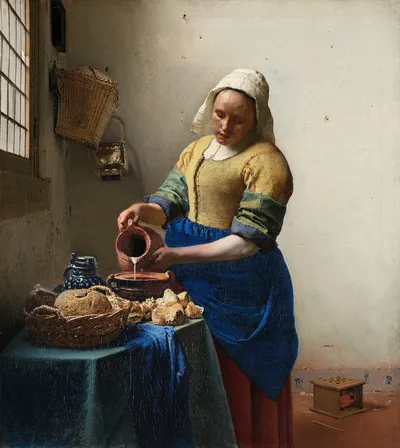
The milk keeps falling, and the rest of the room waits.
The Milkmaid, 1660. Johannes Vermeer. Rijksmuseum, Amsterdam.
Look closer
7 things to notice
 1
01
She may have lived in the house
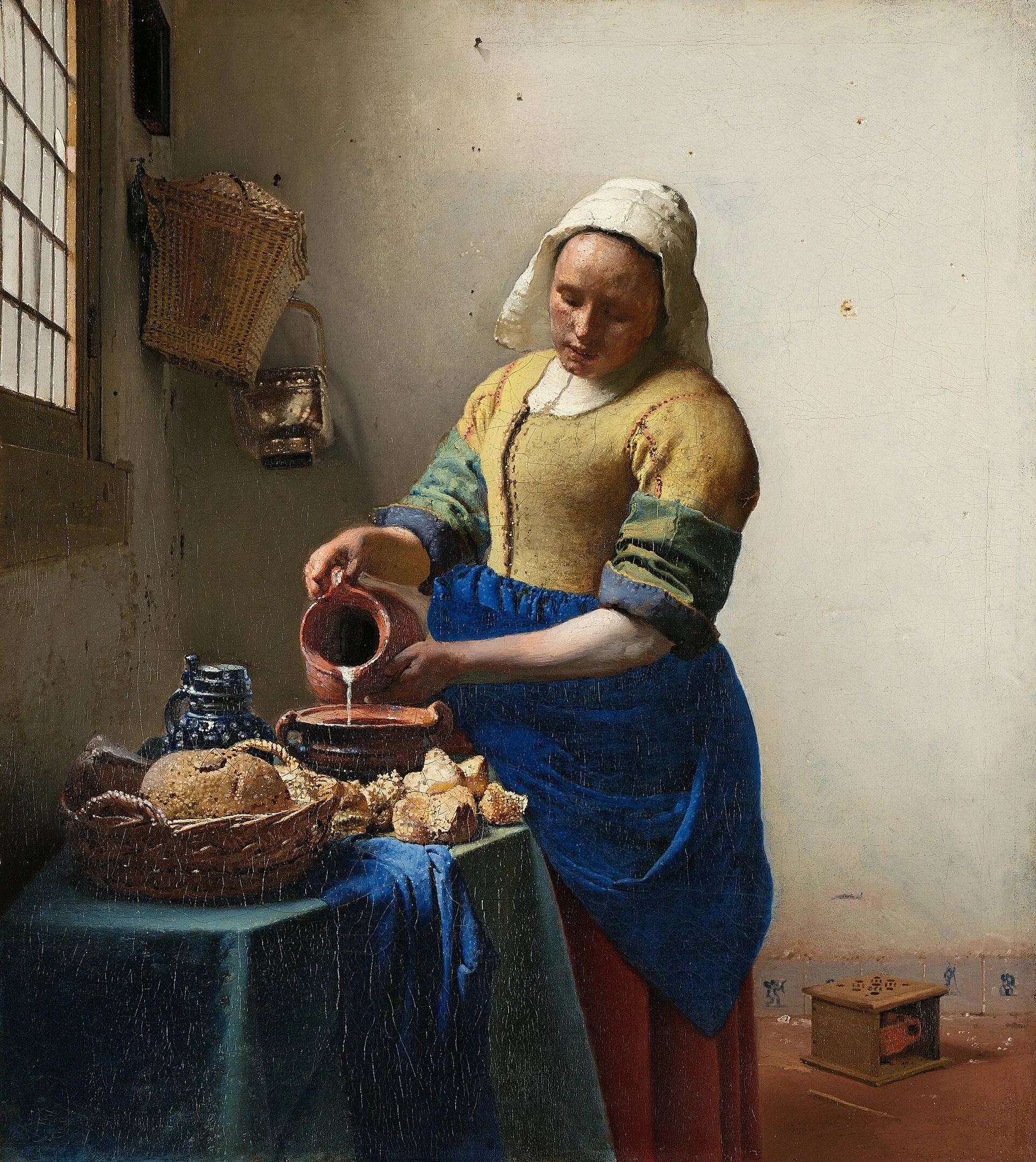
Her eyes stay down under a plain white linen cap, the far cheek in shadow. Nobody wrote down her name. Vermeer's biographer John Michael Montias suggested she may be Tanneke Everpoel, the maid who lived with Vermeer, his wife Catharina and Catharina's mother, Maria Thins, in Maria's house in Delft. If so, Vermeer painted someone he saw every day.
02
Not a milkmaid at all
Her sleeves are rolled to the elbow, and both bare forearms take the pitcher's weight as the milk runs into the pot in one thin white line. In Vermeer's day she would have been called a kitchen maid, a maid-of-all-work, not a milkmaid: milkmaids milked cows. The name came later. The arms tell you what her days were like.
03
Light in grains of paint
The crusts and the basket are covered in small raised dots of pale paint, and Vermeer used more of them here than in any other painting he made. Up close they are just points; a step back, they become the grit of old bread catching the window light. The art historian Walter Liedtke thought the milk and the stale bread were plausibly for bread porridge, a way of using it up.
04
He emptied this wall
Above her cap the plaster is nearly bare: a nail, a nail hole, the stains of a working kitchen. It was not always so empty. Rijksmuseum scans in 2022 found that Vermeer first painted a rack of jugs here, then painted it out; earlier X-rays had been read as a map. He kept the nail and took away everything that hung on it.
05
The costliest blue, on an apron
The apron is natural ultramarine, ground from lapis lazuli, when most painters made do with cheaper azurite. Vermeer laid a glaze of the same blue over it, a thin clear layer that makes the cloth look finer than the rough yellow bodice above. A servant's work apron got the most expensive color in his studio.
06
The buyer knew what he had
Daylight comes in from the left through small leaded panes and falls across the wall and the table. Vermeer's patron Pieter van Ruijven probably bought the picture straight from him. When it was sold again in 1696, the sale listed it as 'exceptionally good', and it fetched 175 guilders, beaten only by Vermeer's View of Delft at 200.
07
Cupid by the foot warmer
Dutch painters had long made kitchen maids into figures of flirtation, and milk itself carried a suggestive meaning. Vermeer keeps the hints small and low: a Delft tile of Cupid on the wall, and beside it a foot warmer, which painters often used to stand for a woman's desire. In a cold kitchen it may only be keeping her feet warm. The 2022 scans found he had first painted a fire basket here.
Our take
A thin line of milk joins the pitcher to the pot. Around it, Vermeer's kitchen servant has the weight of someone who knows her task, both hands occupied, eyes down beneath a white cap. The bread has been broken. The daylight has found the rough crusts and the pale wall. Everything is ready for this small action, and the painting gives it more attention than a whole kitchen usually receives. The pour is still unfinished.
That unoccupied wall took work. Research announced by the Rijksmuseum in 2022 found a jug holder beneath the paint behind her head; Vermeer had removed it from the finished scene. In our reading, the clearing matters as much as the things left on the table. Enough is here to sustain attention. A pitcher, a pot and the narrow white space between them.
The painter's moment
1632–1675Painted it at 28Dutch Golden Age
By the time of this painting, Johannes Vermeer had built a household as well as a working life. He married Catharina Bolnes in April 1653 and joined the painters' Guild of Saint Luke that December. The family lived in Delft with Catharina's mother. The Milkmaid, now dated about 1660 by the Rijksmuseum, brings that scale of domestic space into a canvas just 45.5 centimetres high and 41 wide. It gives a kitchen servant the space of the central figure, with the table rising towards her. Liedtke sees the low viewpoint as a source of her monumentality. So much weight fits inside a small rectangle.
The surface's precision can hide a quicker beginning. Scans announced in 2022 found broad black underpainting beneath her arm; the Rijksmuseum explains that Vermeer first established light and dark rapidly, before working out the detail. Look at the result and the broad decisions still matter, in the pale wall, the blue apron and the dark table. Smaller marks arrive within them, each crust and bright point asking for a closer look. The museum acquired the picture in 1908, and it remains in its Amsterdam collection. A public room now surrounds this private task. The milk has yet to finish pouring.
In its time
The Milkmaid was painted in 1660, when Vermeer was 28. Where it stands on Art Through Time:
Its colors
Elsewhere in the world
- 1654Jewish refugees reach New AmsterdamTwenty-three Jews from Recife found North America's first Jewish community.
The facts
- Title
- The Milkmaid
- Artist
- Johannes Vermeer (1632–1675)
- Date
- 1660
- Original medium
- Oil on canvas
- Style
- Dutch Golden Age
- Made in
- Netherlands
- Collection
- Rijksmuseum, Amsterdam
Living with it
The mood
A kitchen window that continues to give light after the room around it has changed. The pale plaster creates an open patch; the blue apron and dark table give it weight. One ordinary task occupies the centre.
The palette
Chalk and flax belong to the plaster and lit bread, walnut and clay to the basket and vessels. Ink gathers in the table's shadows. These broad tones surround the yellow bodice and blue apron; across a room, that blue gives the figure its place.
Who it finds
- For someone who has cooked from what was left in the cupboard; the broken bread still has a use.
- For someone whose work often goes unnoticed when it is done well; this kitchen gives the pouring its full attention.
- For someone who remembers another person's hands preparing a meal; the pitcher brings that memory down to a small movement.
See it in a room
Your photo is never uploaded, and it's gone when you leave.
The pale wall and yellow-and-blue figure remain clear from across a room. Move nearer and the attention changes scale, down to bread crusts, a pitcher rim and the white milk entering the pot. The hanging basket and metal vessel give the left-hand shadow its own small collection of surfaces.
A kitchen dining corner, a study or the wall beside a reading chair gives it a place among daily tasks. Keep it small enough to approach easily, with the centre near a standing or seated eye line. A larger print suits a longer view, provided the little stream stays distinct.
How we make it
- True to the original
- Each file is color-matched to the museum original. If the color isn't right, we print it again, with our compliments.
- On canvas
- Fine-art canvas hand-stretched over a ¾″ solid-wood frame, with mirrored edges so nothing is lost.
- In our floating frame
- Our stretched canvas set in a slim floating frame, with a shadow gap so the painting seems to hover.
- As a framed print
- Archival pigment print on museum-grade cotton paper, in a solid-wood frame with UV-protective glazing.
- Ready to hang on arrival
- It arrives with the hanging hardware attached. No framer, no guesswork.
- Perfect on arrival
- If anything arrives damaged or not as you ordered, send us a photo within 7 days of delivery and we'll make it again, with our compliments.
Around 1660, Vermeer gave this pour a room of its own. Hang it near the daily work that rarely gets looked at.