The story · 5 min read
Not night, and not a watch: a whole company caught in one second of light.
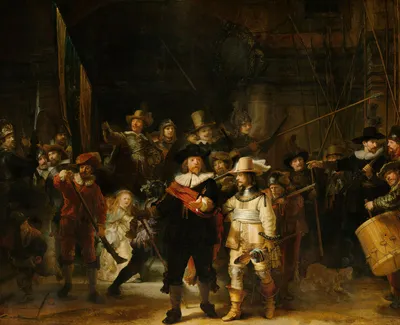
The Night Watch, 1642. Rembrandt. Amsterdam Museum, on display in the Rijksmuseum.
Look closer
7 things to notice
 1
01
The man who doesn't flinch
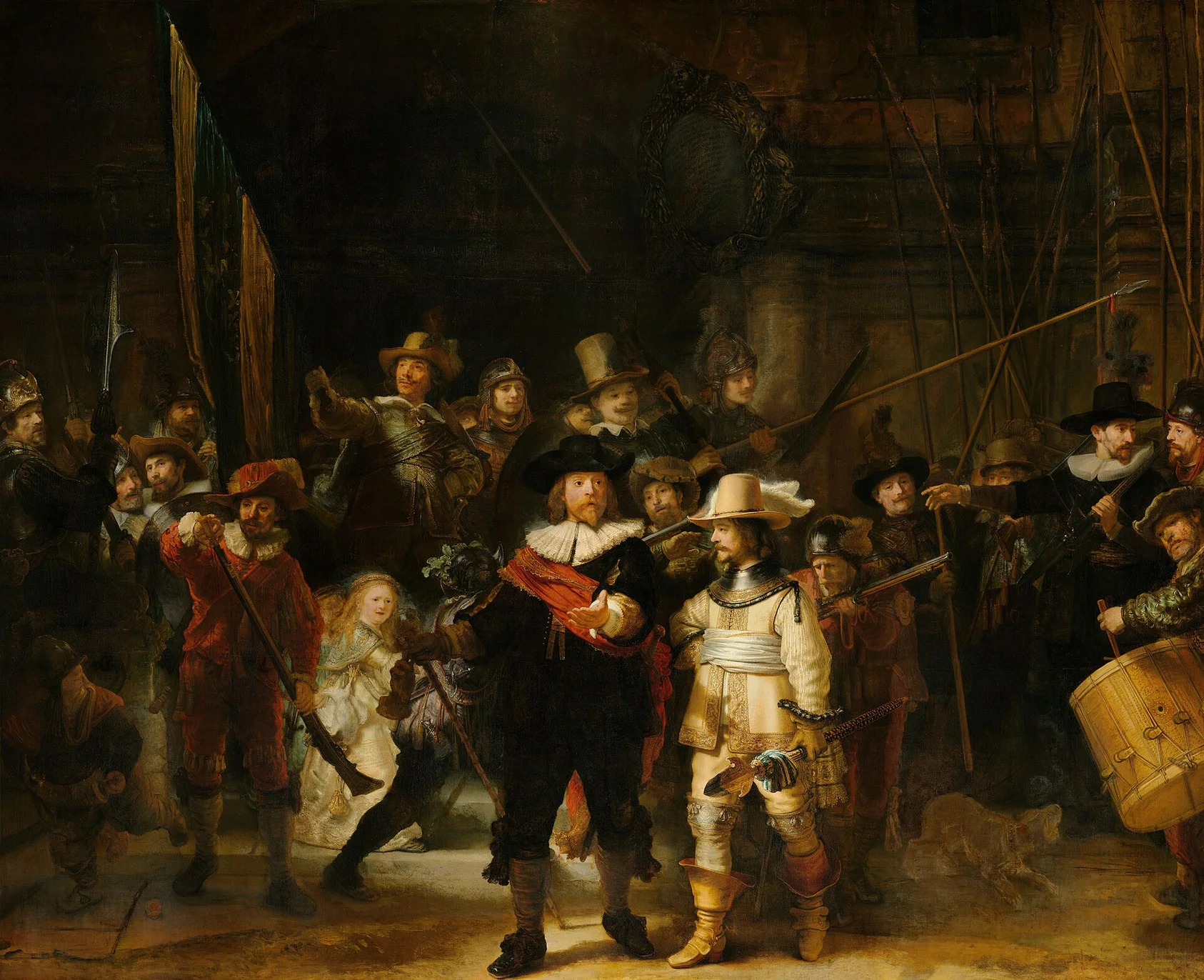
At the centre, Frans Banninck Cocq steps toward us in black with a red sash, a wide black hat and a white lace collar, his left hand held open as if he were giving an order. Behind him the company is in commotion, and he walks on as though none of it were happening. The art historian Joseph Manca reads that calm, his and his lieutenant's, as a sign of their moral excellence.
02
Half the light belongs to him
Beside the captain, Lieutenant Willem van Ruytenburch wears yellow with a white sash and a cream feathered hat, and holds a decorated ceremonial lance. Gold against the captain's black, he is the brightest man in the front rank, as if Rembrandt had split the light between the two who lead the company.
03
A girl who glows from within
Between the musketeers on the left, a small blonde girl in a pale gold dress peeks out, lit more brightly than almost anyone around her. Among men with muskets and lances she carries no weapon at all. Yet she shines like a second sun in the crowd, as if the light had come looking for her.
04
An emblem, carried by a child
At her waist hangs a pale shape: a dead chicken, hanging by its feet from her belt. It has been read as a nod to the arquebusiers' emblem. If so, the arquebusiers' sign is carried by the smallest figure in the crowd, not by a captain.
05
Running toward an edge that was cut away
In the dark lower left corner, a small figure in a helmet runs out of the picture. The picture once went further: in 1715, when the painting was moved to Amsterdam's Town Hall, it was cut down on all four sides and lost figures from its left side. A 17th-century copy by Gerrit Lundens still shows the whole scene as Rembrandt painted it.
06
A dog from another artist's page
Near the drummer's feet, a small brown dog crouches in the shadow, looking out. Rijksmuseum curator Anne Lenders saw that it seems to be copied from an illustration by Adriaen van de Venne, and X-rays showed more similarities. Even in a canvas this size, Rembrandt borrowed a dog.
07
Eighteen names, thirty-four people
High on the dark archway hangs an oval shield in a carved frame. It was added around 1715 and lists eighteen names, yet the painting holds 34 figures in all. Nearly half the crowd stands there unnamed, as if Rembrandt had filled the street with more life than the list could hold.
Our take
The Night Watch is not set at night. A dark varnish covered it for much of its life and gave it the nickname, and its formal title simply names an Amsterdam militia company: District II, under Captain Frans Banninck Cocq. It is huge, 363 by 437 centimetres, nearly twelve feet high and more than fourteen wide. The men in it paid to have their portraits made, and Rembrandt gave them a moment instead: a flag going up, a drum, a musket, a dog, and two officers stepping toward us through it all. Nobody is posing, and nobody is still.
What holds the commotion together is the light, and the light seems to choose. It finds the captain's open hand, the lieutenant's gold and a small girl who carries no musket at all, while men who paid the same as the others sink into the brown. Some have seen a serious work in the line of Raphael's School of Athens; others have seen it as humorous, even a parody. At full size the argument falls away, and you are simply standing in the street with them, a second before the next step.
The painter's moment
1606–1669Painted it at 36Dutch Golden Age
Rembrandt was about 36 when he finished it in Amsterdam in 1642. Banninck Cocq and seventeen of his militiamen commissioned it around 1639. It was one of seven militia group portraits ordered from different artists at about the same time, all for the banquet hall of the musketeers' new meeting hall, the Kloveniersdoelen. He worked on it from 1640 to 1642 and was paid 1,600 guilders, a large sum then, and the canvas was so big that he probably finished it in a lean-to in his garden. In 1639 he had also bought a 13,000-guilder house on the Breestraat, and its mortgage would later cause his money troubles.
These were also years of loss. Three of his and Saskia's children had died as babies; Titus, born in 1641, was the only one to live to adulthood. Saskia died in 1642, the year he finished the painting, probably of tuberculosis. From 1640 his painting quietened and lost some of its flourish, perhaps under the weight of grief, and over the next ten years he left behind sharp contrasts of light and dark for light falling from the front and broad fields of deep colour. The painting hung in the Kloveniersdoelen until 1715 and moved into the new Rijksmuseum in 1885. It spent four years of the Second World War rolled up in a safe in the caves of Maastricht, and it was attacked in 1911, 1975 and 1990. From July 2019 it was restored in public, inside a glass room in the Rijksmuseum, with the work streamed live, and research on it found lead(II) formate in Rembrandt's paint, a compound never seen before in historical oil paintings. It belongs to the Amsterdam Museum and hangs in the Rijksmuseum.
In its time
The Night Watch was painted in 1642, when Rembrandt was 36. Where it stands on Art Through Time:
Its colors
Elsewhere in the world
- c. 1636The Americas' first synagogueKahal Zur Israel opens in Dutch-ruled Recife, Brazil.
- 1642Tasman reaches AotearoaThe first recorded European visit ends in a clash with Māori.
- 1644The Qing dynastyManchu rule begins in China.
- 1648The Dutch Republic wins independenceA merchant republic buys paintings by the thousand.
- 1648The Khmelnytsky UprisingA Cossack revolt reshapes Ukraine; tens of thousands of Jews are killed.
The facts
- Title
- The Night Watch
- Artist
- Rembrandt (1606–1669)
- Date
- 1642
- Original medium
- Oil on canvas
- Style
- Dutch Golden Age
- Made in
- Netherlands
- Collection
- Amsterdam Museum, on display in the Rijksmuseum
Living with it
The mood
It fills a room the way a crowd fills a street: first with noise you can almost hear, then with one held instant of light. It makes a room feel larger and busier, like a stage in the second before the curtain. A painting to stand back from, then walk toward.
The palette
Almost all of it is brown and near-black, the colour of old varnish and a street in shadow. The light comes in ochre and gold and lands on only a few things: the lieutenant, the girl, the captain's collar. From across a room, those are what you see.
Who it finds
- Anyone who has belonged to a crew, a band or a team, and remembers the one moment when everyone moved at once.
- People who always notice the one who doesn't fit: a small girl in gold among men with muskets.
- Anyone who kept working through a year of loss. Rembrandt finished this one the year Saskia died.
See it in a room
Your photo is never uploaded, and it's gone when you leave.
From across a room it reads as a single movement: a dark street, a crowd, and two men and a girl lit in gold. Come close and it fills with small things: the chicken at the girl's belt, the dog in the shadows, the ropes of the drum, the shield of names high on the arch.
It was made to hang in a banquet hall, and it still belongs where people gather: a dining room, a long hall, the wall at the top of a stair. It is a little wider than it is tall. Go as large as the wall allows: small, the crowd becomes a pattern; large, it becomes people.
How we make it
- True to the original
- Each file is color-matched to the museum original. If the color isn't right, we print it again, with our compliments.
- On canvas
- Fine-art canvas hand-stretched over a ¾″ solid-wood frame, with mirrored edges so nothing is lost.
- In our floating frame
- Our stretched canvas set in a slim floating frame, with a shadow gap so the painting seems to hover.
- As a framed print
- Archival pigment print on museum-grade cotton paper, in a solid-wood frame with UV-protective glazing.
- Ready to hang on arrival
- It arrives with the hanging hardware attached. No framer, no guesswork.
- Perfect on arrival
- If anything arrives damaged or not as you ordered, send us a photo within 7 days of delivery and we'll make it again, with our compliments.
Rembrandt filled a street that never existed with 34 people, and they have been stepping into the light since 1642. Give them a wall wide enough to march.