The story · 4 min read
The hands that made the meal possible gather around it.
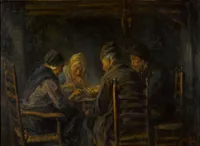
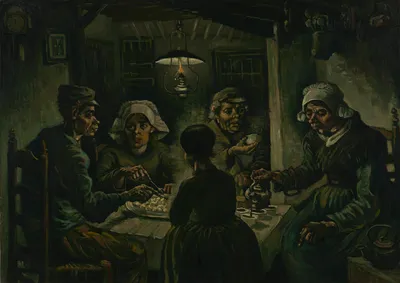
The Potato Eaters, 1885. Vincent van Gogh. Van Gogh Museum, Amsterdam (Vincent van Gogh Foundation).
Look closer
7 things to notice
 1
01
The same hands did the digging
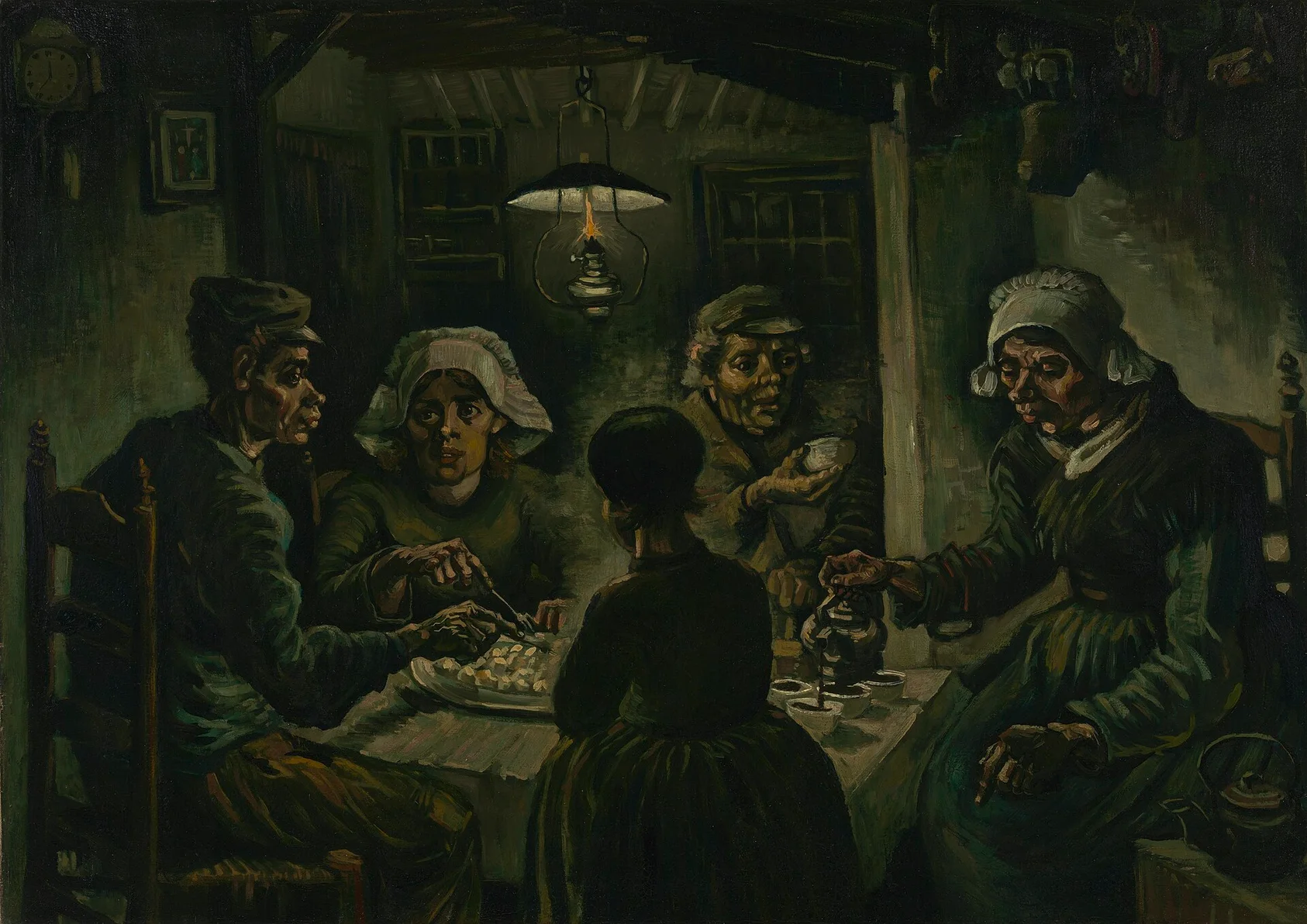
Long fingers gather above the potato dish at lower left. Van Gogh told Theo that the hands taking food should also look capable of having worked for it in the fields. The connection was central to his purpose. The knuckles remain prominent even beside the pale pieces of potato.
02
A small lamp sets the terms
The hanging lamp has a low shade and a bright flame inside its glass. Writing to Anthon van Rappard, Van Gogh said the cottage's unusual lighting had drawn him to the subject. He had made an early study there in the evening. The little flame governs which faces emerge.
03
Coffee entered the second version
A dark kettle pours into the pale cups on the right side of the table. The Van Gogh Museum notes that coffee bowls and a kettle appeared in the second painted study, along with other changes. The meal developed through preparation. This ordinary act was part of the picture's design.
04
He had sat before supper
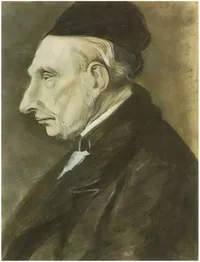
The older man at center right lifts a cup beneath his face. The museum connects him with a head study made about three months before the final painting. Van Gogh knew the household before arranging this group. The familiar face returned with a small cup added to its evening task.
05
The circle gained another person
The nearest figure sits with her back to us, dark against the lighted table. The museum's comparison of painted studies shows four people in the earliest version and five in the next. The gathering was not fixed at the outset. This broad back makes the table feel occupied on our side too.
06
A familiar face beneath the cap
The woman left of center wears a pale cap around her angular face. The Van Gogh Museum securely identifies Gordina de Groot, whom he painted repeatedly. The other sitters' exact identities are less certain. Her raised eyes belong to someone the painter had already spent time studying.
07
The darkness was worked out
The right-hand woman's dark clothing meets a green-brown wall with little difference in brightness. Van Gogh explained to Van Rappard that his light passages only looked light beside much darker colors. He also admitted that attention to this effect had cost the torsos clarity. Her torso nearly disappears against the cottage wall.
Our take
Supper occupies only a small island of light. Five people sit close around potatoes and coffee, their faces emerging unevenly from a room of brown and green. The nearest figure has her back to us, closing the circle at its lower edge. We can inspect the meal without becoming another diner.
Van Gogh wanted the hands at the dish to carry the history of the food: these people had worked the earth that produced it. He explained that intention to Theo in April 1885, after a winter of studies. The painting was meant to establish him as a serious painter of rural life. Its roughness was deliberate, even where its drawing remained vulnerable to criticism. The brightest marks belong to food, cups and the hands moving between them.
The painter's moment
1853–1890Painted it at 32Early Dutch period; Realism
In the spring of 1885, Vincent van Gogh was working in Nuenen, a village in the southern Netherlands, after months of painting local heads and hands. He had been living with his parents; his father died on March 26, just before the final push on this picture. Vincent wanted a substantial work that Theo could put before the Paris art world. The De Groot household gave him a subject he knew through repeated visits. On Theo's birthday, April 30, he wrote that he had hoped to send the painting but had not quite finished. The ambition was large enough to miss the family deadline.
Two painted studies and a lithograph accompanied the work toward its final form. The print was intended to make the composition known, but it also brought a painful judgment: Anthon van Rappard criticized its figures. Vincent returned the critical letter in May, a gesture the correspondence's editors describe as effectively breaking the friendship. He continued defending the painting while acknowledging weaknesses in it. By the end of 1885 he had left Nuenen for Antwerp, where further study lay ahead. The final canvas is now in the Van Gogh Museum in Amsterdam. Its difficult reception belongs to the period when recognition was still a hope, rather than a fact of his career.
In its time
The Potato Eaters was painted in 1885, when Van Gogh was 32. Its Dutch title is De Aardappeleters. Where it stands on Art Through Time:
Its colors
Elsewhere in the world
- 1884The Berlin ConferenceEurope's powers divide Africa among themselves.
- 1885Leopold II takes the CongoHis forced-labor regime costs millions of lives.
- 1885The Indian National Congress is foundedThe movement for self-rule takes shape.
- 1887French Indochina is formedFrance rules Vietnam and Cambodia, and later Laos.
- 1888Brazil abolishes slaveryThe Golden Law makes Brazil the last country in the Americas to end it.
The facts
- Title
- The Potato Eaters
- Artist
- Vincent van Gogh (1853–1890)
- Date
- 1885
- Original medium
- Oil on canvas
- Style
- Early Dutch period; Realism
- Made in
- Netherlands
- Collection
- Van Gogh Museum, Amsterdam (Vincent van Gogh Foundation)
Living with it
The mood
The picture places one low light inside a dark room, making faces and cups appear gradually. Green-black clothing fills much of the surface. It gives a wall a small occupied interior whose boundaries take time to distinguish.
The palette
Ebony and charcoal occupy the deepest corners and the foreground back; olive, moss and lichen describe the green-brown wall, clothing and dim light. The palette is deliberately narrow. Across a room, the lamp and the pale potato dish make the clearest points of orientation.
Who it finds
- For someone who remembers a family meal after physical work; the hands still carry the day's effort into supper.
- For someone who has worked for months on something others found awkward; Van Gogh's confidence had to survive that judgment.
- For someone who has learned a face by drawing it repeatedly; Gordina's place at the table began before this evening.
See it in a room
Your photo is never uploaded, and it's gone when you leave.
From farther away, the lamp and group form one compact shape. Nearer, separate faces, fingers and cups become legible within the dark paint. Give the picture even, adequate light; a poorly lit position would erase the differences that make this room inhabited rather than simply black.
A study or a place near a dining table can support that closer attention. A medium or large print helps the hands remain distinct. Van Gogh himself considered how it should be surrounded, favoring gold or a deep wheat tone and objecting to a dull dark background. A warm border can preserve that separation in a domestic setting.
How we make it
- True to the original
- Each file is color-matched to the museum original. If the color isn't right, we print it again, with our compliments.
- On canvas
- Fine-art canvas hand-stretched over a ¾″ solid-wood frame, with mirrored edges so nothing is lost.
- In our floating frame
- Our stretched canvas set in a slim floating frame, with a shadow gap so the painting seems to hover.
- As a framed print
- Archival pigment print on museum-grade cotton paper, in a solid-wood frame with UV-protective glazing.
- Ready to hang on arrival
- It arrives with the hanging hardware attached. No framer, no guesswork.
- Perfect on arrival
- If anything arrives damaged or not as you ordered, send us a photo within 7 days of delivery and we'll make it again, with our compliments.
Van Gogh finished this hard-earned supper in 1885. Give its dark interior a warm surrounding tone and enough light for the hands.