The story · 4 min read
They can see a ship. The ship may not see them.
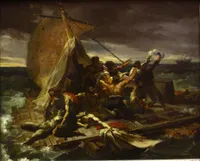
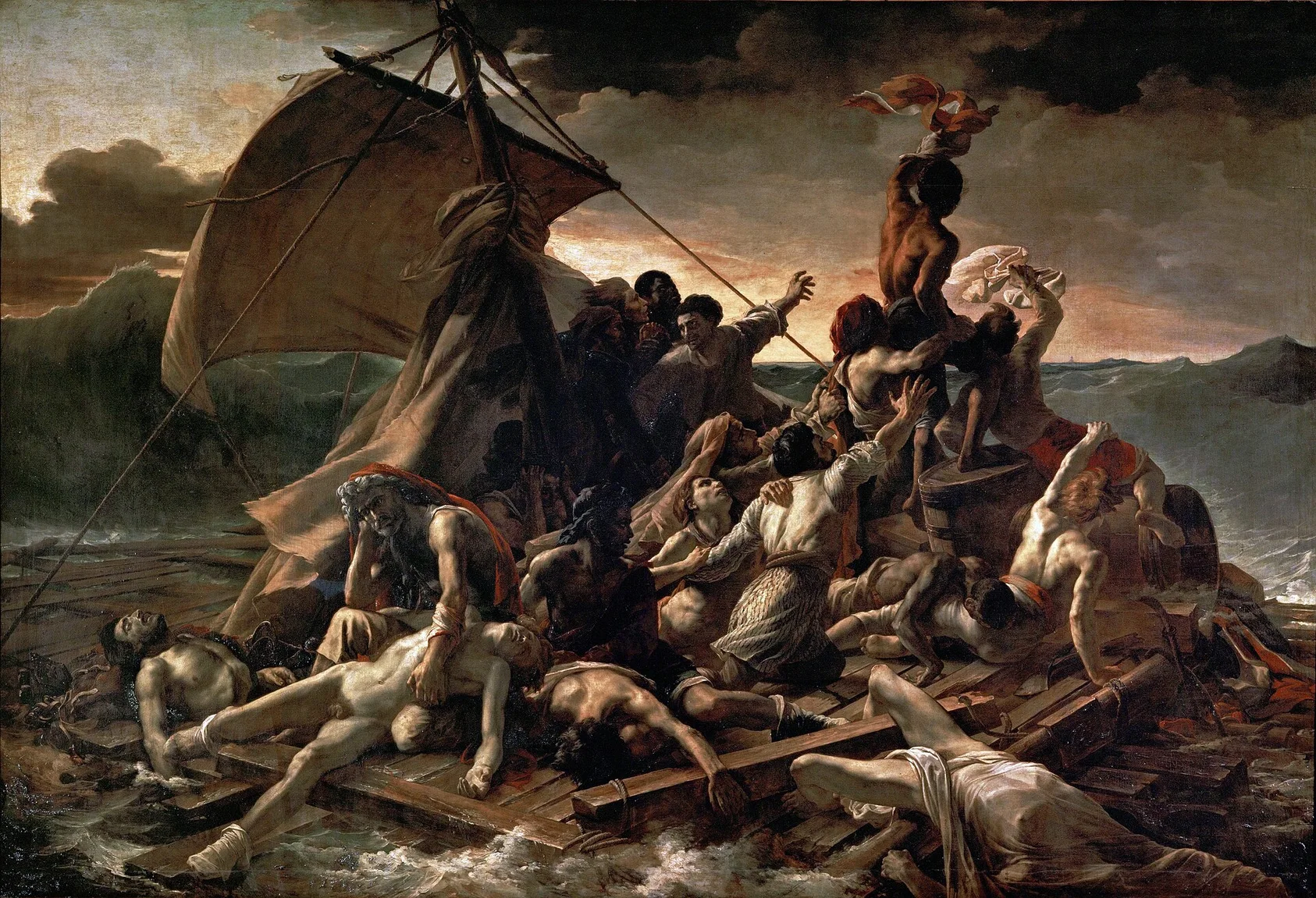
The Raft of the Medusa, 1819. Théodore Géricault. Musée du Louvre, Paris.
Look closer
7 things to notice
 1
01
The highest figure has a name
A Black man signals with cloth above the others, his back exposed as he balances on a barrel. The model was Joseph, a Haitian man who worked for Géricault. Getty places this work alongside the painter's sympathy with abolition. Joseph's body carries the highest, most visible signal in the picture.
02
Rescue is almost out of sight
The Argus appears as a minute dark mark on the horizon above the waves. Art historian Claire Black McCoy explains that the ship first passed without rescuing them, then returned. Géricault chose the uncertain sighting. At this distance, the men cannot yet know that help will come.
03
He has stopped watching the sea
A gray-haired man sits with his head in one hand and a young body across his lap. McCoy reads them as a father and his dead son, while keeping the relationship tentative. This is a painted human bond, not a verified family portrait. His other hand stays against the young man's chest.
04
Another painter lent his body
A dark-haired figure lies face down near the front, one arm beyond a crosspiece. Eugène Delacroix posed for this body. Géricault used people he knew alongside survivors and professional models to build the scene. The future painter of crowded public struggles appears here unable to lift his head.
05
The sail builds a second peak
The sail swells above the mast ropes at left, making a broad triangle. McCoy identifies two intersecting pyramids in the composition: one organized around the mast, the other around the people signaling. The disorder has a carefully planned structure. The ropes lead back down into the crowded boards.
06
The carpenter helped build this picture
Timbers cross the foreground at different angles, with water washing beneath them. The Medusa's carpenter supplied Géricault with a small model of the raft, McCoy records. Research established the platform before models supplied its occupants. The painter could study how the wooden pieces fitted together in his studio.
07
The body crosses our boundary
A pale figure in white cloth extends toward the lower-right edge, partly outside the picture. The Louvre connects this close framing with the demand to confront a recent public disaster. The body interrupts any comfortable distance between a viewer and an account in the news. Its head is beyond the visible boards.
Our take
Find the ship before you follow the arms. It is a tiny mark near the right-hand horizon, almost lost between sea and sky. The people on the raft have seen it, and those who can still move gather to signal. Géricault makes us search for their chance of rescue while the dead occupy the foreground at almost human scale. Hope takes up the least space.
The picture grew from a disaster the French public already knew. In 1816 the Medusa ran aground off West Africa; roughly 150 people were abandoned on a raft, and only fifteen were alive when rescue came. Géricault interviewed survivors and studied a model of the raft. That work gives the scene its weight without making every painted body a recorded individual. The boards are crowded all the way to the water.
The painter's moment
1791–1824Painted it at 28Romanticism
In 1817, Théodore Géricault returned to Paris from Italy, where he had gone at his own expense. The following year he began studies for a painting large enough to compete with the history pictures at the Salon. Its subject came from a recent scandal rather than an ancient hero. He spoke with survivors Henri Savigny and Alexandre Corréard, examined the raft's construction and studied bodies in hospitals and morgues. Those choices made the work demanding in a literal way: he had to learn what a shipwreck did to people before arranging models in a studio. Friends joined professional sitters in the preparation.
The finished canvas appeared at the Salon in 1819 under the more general title Shipwreck Scene. It measured over seven meters across, giving contemporary suffering the space usually reserved for major historical subjects. No sale to the state was completed during Géricault's lifetime. He sent the picture to London in 1820, where it was exhibited to paying visitors, and later it went to Dublin. Back in France by late 1821, he pursued other subjects, including portraits of people treated for mental illness. He died in 1824. The royal collection bought the raft painting that year, after the artist could no longer benefit from its purchase.
In its time
The Raft of the Medusa was painted in 1819, when Géricault was 28. Its French title is Le Radeau de la Méduse. Where it stands on Art Through Time:
Its colors
Elsewhere in the world
- 1816Shaka leads the ZuluA small chiefdom becomes a southern African power.
- 1822Brazil declares independencePedro I's cry of 'Independence or death!' founds an empire.
- 1824The Battle of AyacuchoSucre's victory all but ends Spanish rule in South America.
- 1825Thomas Cole paints the CatskillsThe Hudson River School begins as the Erie Canal opens.
The facts
- Title
- The Raft of the Medusa
- Artist
- Théodore Géricault (1791–1824)
- Date
- 1819
- Original medium
- Oil on canvas
- Style
- Romanticism
- Made in
- France
- Collection
- Musée du Louvre, Paris
Living with it
The mood
A wide mass of bodies and timber beneath a sky opening toward the horizon. The picture brings a grave public history into the room. Dark water surrounds the platform, while small areas of pale skin make the crowd legible.
The palette
Walnut and bark carry the raft and shadowed bodies; clay warms the clouds and skin. Ebony gathers beneath the sail, while linen marks the brightest cloth and flesh. Across a room, those pale areas form a path through the crowded foreground.
Who it finds
- For someone who has waited for news of people at sea; the distant ship gives that waiting a precise scale.
- For someone who has followed a public inquiry because names and decisions mattered; this picture began with survivors' accounts.
- For someone who has returned to a difficult history until its people became individuals; the raft asks for that patient attention.
See it in a room
Your photo is never uploaded, and it's gone when you leave.
From across a room, the rising group and the sail establish two large shapes. Closer, the tiny ship changes the meaning of the raised arms. The older man and the figures along the front require a slower look. This is an image to give deliberate attention, with enough space to step away again.
A study or room used for reading history offers that kind of setting. A broad print preserves the distance between the raft and its possible rescue. Keep nearby objects sparse and the light even, so the dark sea remains visible without turning the pale bodies into isolated highlights.
How we make it
- True to the original
- Each file is color-matched to the museum original. If the color isn't right, we print it again, with our compliments.
- On canvas
- Fine-art canvas hand-stretched over a ¾″ solid-wood frame, with mirrored edges so nothing is lost.
- In our floating frame
- Our stretched canvas set in a slim floating frame, with a shadow gap so the painting seems to hover.
- As a framed print
- Archival pigment print on museum-grade cotton paper, in a solid-wood frame with UV-protective glazing.
- Ready to hang on arrival
- It arrives with the hanging hardware attached. No framer, no guesswork.
- Perfect on arrival
- If anything arrives damaged or not as you ordered, send us a photo within 7 days of delivery and we'll make it again, with our compliments.
Painted in 1818–19, Géricault's raft keeps rescue on the horizon. Give its people a deliberate place, with room to approach and step back.