The story · 4 min read
They disagree at the center of a room built to contain them.
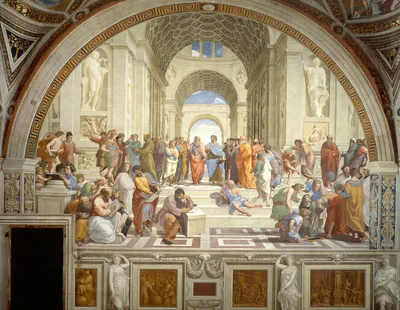
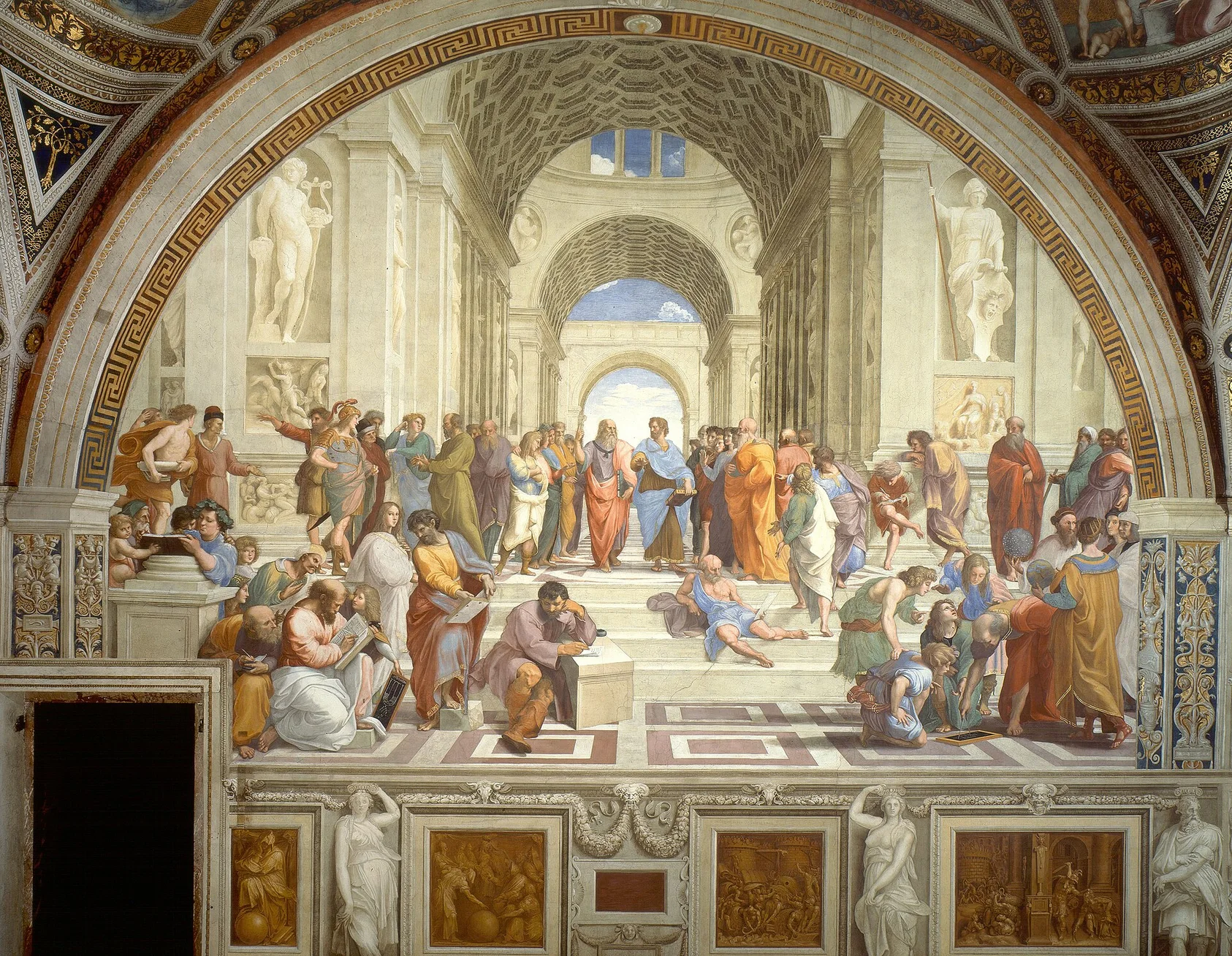
The School of Athens, 1512. Raphael. Vatican Museums, Stanza della Segnatura, Apostolic Palace, Vatican City.
Look closer
7 things to notice
 1
01
Two books keep the argument open
The central pair carry books as they gesture: Plato's Timaeus and Aristotle's Ethics, identified by the Vatican. Their different directions are often read as a contrast between ideal forms and the world of experience, though each philosophy is more complicated than one hand can explain. The books remain with them as they walk.
02
A crowd forms around a page
At lower left, a bearded man writes while others peer toward his book and tablet. The Vatican identifies him as Pythagoras explaining mathematical relationships. The group makes study a shared physical activity: heads come close, and another figure watches from behind. Knowledge has to fit onto a surface they can inspect.
03
The lesson reaches the floor
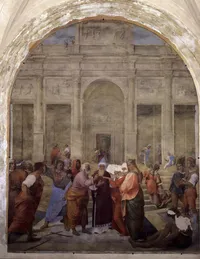
At lower right, a teacher bends over a tablet with a pair of compasses. The Vatican identifies him as Euclid teaching geometry. His pupils occupy different levels around the demonstration, one kneeling almost on the floor. An abstract subject becomes a small construction that several people can watch being made.
04
A colleague enters ancient history
The solitary writer at the front props his head on one hand beside a stone block. The Vatican identifies him as Heraclitus with Michelangelo's face; the Ambrosiana notes that the figure is absent from the surviving preparatory cartoon. The identification is debated, but the later addition is clear. He keeps his own desk apart.
05
The painter finds a place
Near the right edge, a young man in a black cap looks directly out. The Vatican identifies Raphael's self-portrait here. He has given himself a small position among people associated with learning, rather than a central throne. His face is close to the edge of the painted gathering.
06
The steps become a seat
A man in blue reclines across the central stairs, his legs interrupting the route upward. The Vatican identifies him as Diogenes, with a small dish beside him. He occupies the grand building without adopting the formal bearing of the central pair. The stone steps serve him as ordinary furniture.
07
Ancient thinkers get a new building
The coffered vault rises above the gathering and narrows toward the central opening. The Vatican connects this architecture with Bramante's contemporary plans for rebuilding St. Peter's. Raphael placed ancient philosophy inside a space informed by current Roman ambition. The immense ceiling belongs to an imagined building, not a recorded classroom.
Our take
Plato points upward; Aristotle extends his hand toward the space in front of him. The two philosophers walk together without making the same gesture. Around them, people read, argue, measure and listen, while one man sits alone on the steps. Raphael gives thought many bodily forms. Nobody needs to face the same way.
This assembly of ancient thinkers was painted for a pope's library and private study. The Vatican describes it as philosophy's place within a larger program that also includes theology, poetry and justice. It is an imagined meeting across different lifetimes, with some faces borrowed from Raphael's own world. At the far right, the young painter includes himself in a black cap, looking outward from the edge of the company.
The painter's moment
1483–1520Painted it at 29High Renaissance
When Raphael arrived in Rome in 1508, he was entering an unusually concentrated field of patronage and competition. Pope Julius II was rebuilding St. Peter's with Bramante, while Michelangelo worked on the Sistine Chapel ceiling nearby. Raphael had come from Florence without having completed a project on this scale. At first he was one of several painters employed in the papal apartments. His work in the room now called the Stanza della Segnatura won him a much larger responsibility. The rooms offered more than a commission: they put a young painter's decisions before the pope and the people who attended his court.
The School of Athens was painted around 1509–11 as part of that first room's decoration. A large preparatory drawing, now at the Ambrosiana in Milan, preserves much of the assembly but lacks the architecture and certain figures found in the fresco. The design developed beyond the drawing. Its place also shaped its meaning: philosophy faced theology across a room originally used for books and private work, while poetry and justice occupied the other walls. Raphael continued decorating the papal rooms, and his workshop carried on after his death in 1520. The fresco remains part of that building; its history is tied to walls and patrons rather than a succession of private owners.
In its time
The School of Athens was painted in 1512, when Raphael was 29. Its Italian title is Scuola di Atene. Where it stands on Art Through Time:
Its colors
Elsewhere in the world
- 1508Michelangelo paints the Sistine ceilingRome becomes the capital of the High Renaissance.
- 1511Portugal takes MalaccaEuropean empires arrive in the spice trade.
- 1516Venice creates the first ghettoThe city confines its Jews to a walled quarter; the word spreads.
- 1517The Reformation beginsEurope divides over images and faith.
- 1517Luther's 95 ThesesProtestant lands turn away from religious images.
The facts
- Title
- The School of Athens
- Artist
- Raphael (1483–1520)
- Date
- 1512
- Original medium
- Fresco
- Style
- High Renaissance
- Made in
- Italy
- Collection
- Vatican Museums, Stanza della Segnatura, Apostolic Palace, Vatican City
Living with it
The mood
A large hall opens within the picture, populated by small groups whose attention moves in different directions. The pale architecture gives the room distance. Red, blue and ocher robes keep the people distinct beneath the high ceiling.
The palette
Sandstone, linen and ivory describe the broad architecture; bronze warms the shaded vaults and walnut marks the darkest openings. The small red and blue robes become accents within that pale structure. From across a room, the central arch reads before any philosopher's face.
Who it finds
- For someone who has learned most from people who disagree; the central pair keep walking together with different gestures.
- For someone who remembers gathering around a teacher's unfinished diagram; the geometry lesson still has room for several heads.
- For someone who has felt new among experienced colleagues; Raphael placed his own young face at the gathering's edge.
See it in a room
Your photo is never uploaded, and it's gone when you leave.
At a distance, the arches and steps establish the whole assembly. Close up, books, compasses and gestures separate into individual exchanges. The supplied image includes surrounding wall decoration and a doorway, so a generous print size is especially useful: the main fresco occupies only part of the complete rectangle.
A library, study or large shared room gives this gathering an appropriate scale of attention. Leave space to stand squarely in front of it, where the central passage is easiest to follow. A small print would preserve the architecture but make the people difficult to distinguish; choose breadth if the conversations are what draw the eye.
How we make it
- True to the original
- Each file is color-matched to the museum original. If the color isn't right, we print it again, with our compliments.
- On canvas
- Fine-art canvas hand-stretched over a ¾″ solid-wood frame, with mirrored edges so nothing is lost.
- In our floating frame
- Our stretched canvas set in a slim floating frame, with a shadow gap so the painting seems to hover.
- As a framed print
- Archival pigment print on museum-grade cotton paper, in a solid-wood frame with UV-protective glazing.
- Ready to hang on arrival
- It arrives with the hanging hardware attached. No framer, no guesswork.
- Perfect on arrival
- If anything arrives damaged or not as you ordered, send us a photo within 7 days of delivery and we'll make it again, with our compliments.
Raphael painted this meeting around 1509–11. Give the arches room to open, and enough scale for the people beneath them to remain distinct.