The story · 4 min read
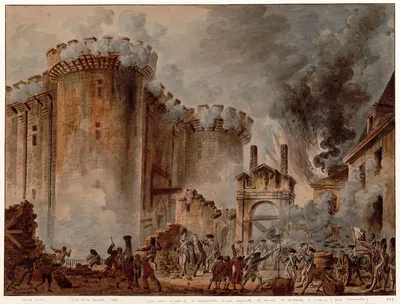
The fortress is still standing; its governor has already lost his protection.
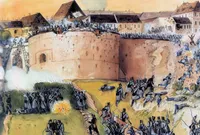
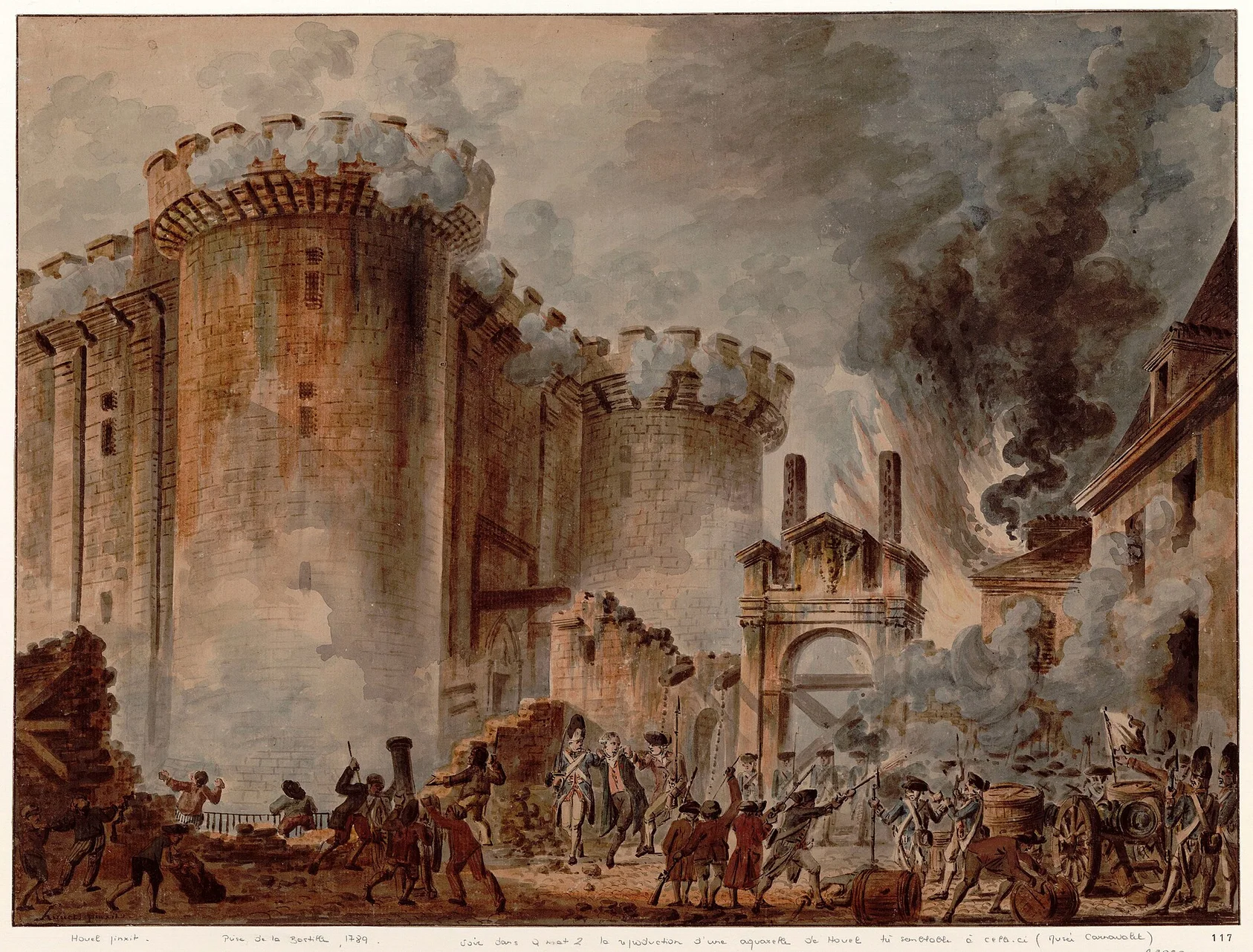
The Storming of the Bastille, 1789. Jean-Pierre Houël. Bibliothèque nationale de France, Department of Prints and Photography, Paris.
Look closer
7 things to notice
 1
01
The governor comes out alive
Three figures occupy the gap in the foreground rubble, the middle man in a dark coat. Aix-Marseille University's image study identifies the arrest of Bernard-René Jourdan de Launay, the Bastille's governor. He was killed later that day at Place de Grève. Houël leaves him here, still upright between his escorts.
02
So much stone for seven prisoners
A round tower fills the left side, its narrow windows cut into broad courses of masonry. The Bastille began as a medieval fortress; by the day of its capture it contained seven prisoners. Its size in this watercolor far exceeds the space given to any person. The windows remain small and dark.
03
Guns needed something to fire
Barrels and a wheeled gun crowd the lower right, beside men carrying long weapons. Paris Musées explains that the attackers had obtained firearms at the Invalides but needed ammunition; the Bastille stored several tons of gunpowder. The containers in the image are not individually labeled. The gun's wheel stands among them.
04
Smoke could hide either side
A column of dark smoke rises behind the entrance buildings, with pale flame below. During the assault, attackers burned damp straw in wagons to screen their movements; the smoke obstructed both sides. This watercolor does not let us assign every cloud to a particular fire. The gate disappears behind the lower gray patches.
05
The entrance changed hands
The stone gateway stands right of center, its arch partly obscured by smoke and raised weapons. Negotiators had asked for the fortress guns to be withdrawn and its powder released. After fighting, de Launay surrendered and opened the gates. Houël places the crowd directly across that formerly controlled passage.
06
Soldiers were among the attackers
Long gun barrels cross above the foreground group, some nearly upright and others aimed into the picture. The assault included mutinous French Guards, whose arrival with cannon strengthened the crowd. Clothing alone cannot establish each painted man's unit. The raised weapons bring several different bodies into one dense group.
07
A landscape painter meets a wall
Brown washes describe the tower's curved side, with thin dark strokes marking the stones. Houël specialized in landscapes and had worked among Italian sites before making this watercolor. Here the broad washes give the building volume without filling every inch with hard outlines. Pale paper remains visible through the masonry.
Our take
The tallest things in Houël's storming of the Bastille painting are the walls. The people who have overcome them occupy a narrow strip below, almost lost among guns, rubble and smoke. At the center, the prison's governor is being taken away. This is July 14, 1789, during the French Revolution. The building has ceased to protect the man responsible for it.
Only seven prisoners were inside; the crowd wanted the gunpowder stored there. Houël gives the struggle an immense setting, with stone towers rising far above the men. He had spent years making landscapes and drawings for illustrated travel books. Here that practiced attention to a place meets an event that will remove it. Pale brown masonry fills the sheet; small figures control the gate.
The painter's moment
1735–1813Painted it at 54Historical scene
By 1789, Jean-Pierre Houël had already made a career of looking closely at places. A place at the French Academy in Rome in 1769 took the landscape painter to Italy, and a later journey through Sicily, Lipari and Malta supplied drawings for four illustrated travel volumes published between 1782 and 1787. He financed the undertaking in part by selling preliminary drawings in Paris in 1780. Making images and paying for their publication were connected tasks. The travel books demanded attention to buildings, ground and atmosphere, the same visible elements that occupy most of this scene. Paris now supplied a subject close to home.
The BnF dates this storming of the Bastille painting to 1789 and records it as a watercolor, about 38 centimeters high and 51 wide. That modest sheet contains an event with an enormous architectural backdrop. The Bastille's demolition began the day after its capture, under the contractor Palloy, and Houël also made an image of that work. The subject could be followed from assault to dismantling. Related versions survive at the Musée Carnavalet; this sheet belongs to the Bibliothèque nationale de France's Department of Prints and Photography. The distinction matters: several similar compositions carry the artist's name, but they are separate objects.
In its time
The Storming of the Bastille was painted in 1789, when Houël was 54. Where it stands on Art Through Time:
Its colors
Elsewhere in the world
- 1788Colonization of Australia beginsConvicts, Australia's first Jews among them, land on Gadigal country; Aboriginal nations face devastation.
- 1789The French RevolutionPainters take sides; history painting turns political.
- 1791France makes its Jews full citizensThe first country in Europe to grant Jews equal rights.
- 1791The Pale of SettlementRussia confines its Jews to its western borderlands.
- 1795Poland is erased from the mapRussia, Prussia and Austria complete the partitions.
The facts
- Title
- The Storming of the Bastille
- Artist
- Jean-Pierre Houël (1735–1813)
- Date
- 1789
- Original medium
- Watercolor
- Style
- Historical scene
- Made in
- France
- Collection
- Bibliothèque nationale de France, Department of Prints and Photography, Paris
Living with it
The mood
Towers occupy most of the rectangle, with a strip of people beneath them and smoke interrupting the sky. The pale stone gives a room breadth; the small armed figures prevent that breadth from becoming an empty architectural view.
The palette
Clay and sand belong to the masonry, walnut and umber to windows, figures and smoke. Linen marks the lighter sky and paper. Across a room, the tower's pale vertical mass arrives first; the red clothing becomes legible closer to the image.
Who it finds
- For someone who has watched a familiar building disappear; Houël followed this fortress from its capture into its demolition.
- For someone who remembers a large event through one small group of people; the governor's escorts occupy the gap below the towers.
- For someone whose work begins by looking carefully at a place; the watercolor keeps individual stones within an overwhelming wall.
See it in a room
Your photo is never uploaded, and it's gone when you leave.
Seen from the far side of a room, the image divides into pale towers and a darker plume. At closer range, the people under the walls separate into escorts, onlookers and armed groups. The full reproduction includes the sheet's light border and writing beneath the picture, which need space to remain distinct.
A study or reading room gives the historical scene a place for sustained attention. Choose enough width for the central arrest to remain readable from a chair, then allow an unobstructed approach. A narrow passage makes the building impressive but offers less opportunity to examine the small figures along its base.
How we make it
- True to the original
- Each file is color-matched to the museum original. If the color isn't right, we print it again, with our compliments.
- On canvas
- Fine-art canvas hand-stretched over a ¾″ solid-wood frame, with mirrored edges so nothing is lost.
- In our floating frame
- Our stretched canvas set in a slim floating frame, with a shadow gap so the painting seems to hover.
- As a framed print
- Archival pigment print on museum-grade cotton paper, in a solid-wood frame with UV-protective glazing.
- Ready to hang on arrival
- It arrives with the hanging hardware attached. No framer, no guesswork.
- Perfect on arrival
- If anything arrives damaged or not as you ordered, send us a photo within 7 days of delivery and we'll make it again, with our compliments.
Houël's 1789 watercolor gives a fallen fortress its full height. Hang it where the small figures beneath the towers can still be approached.