The story · 4 min read
The light makes him visible. It cannot make him safe.
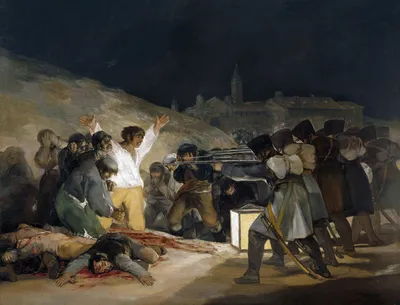
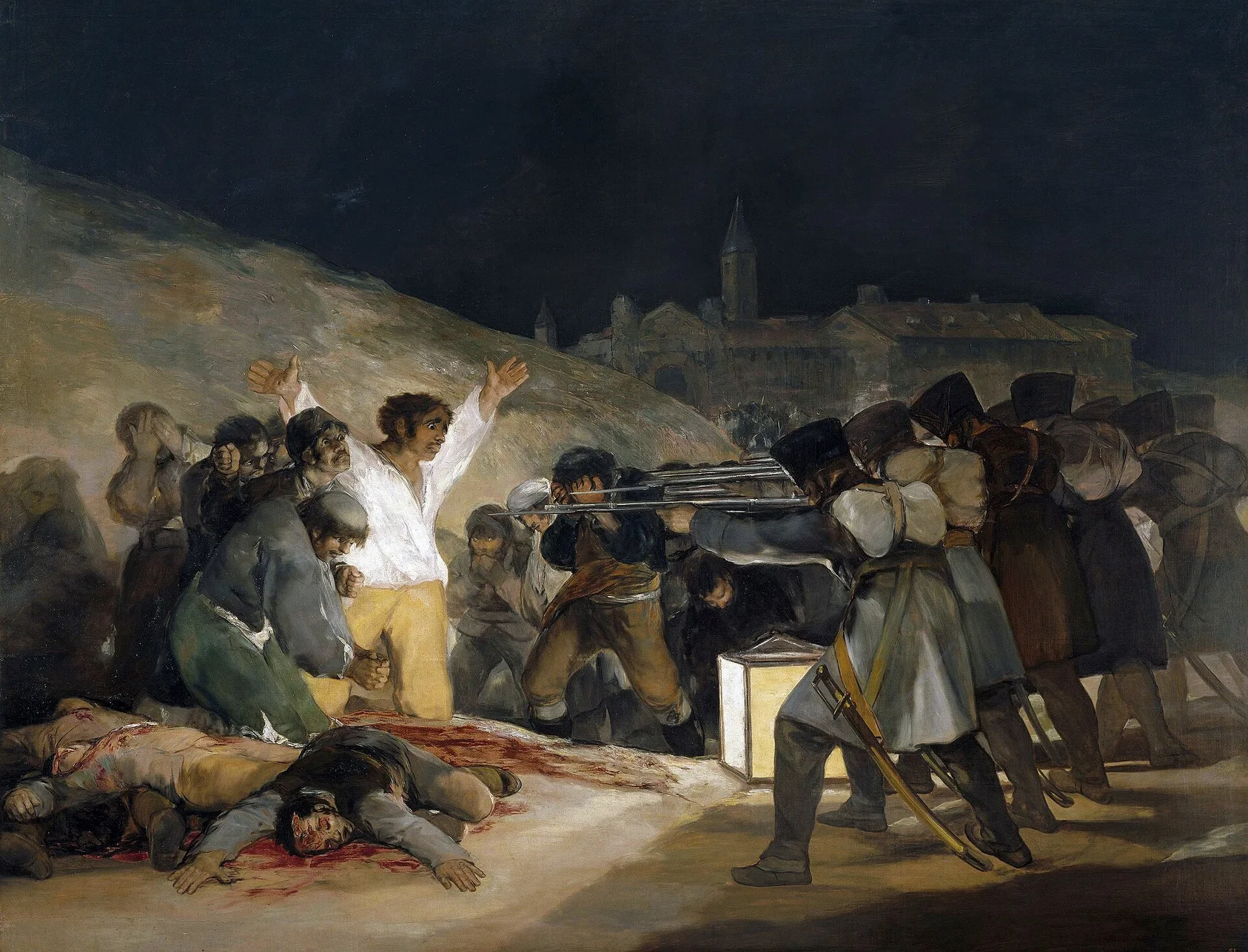
The Third of May 1808, 1814. Francisco Goya. Museo Nacional del Prado, Madrid.
Look closer
7 things to notice
 1
01
He has nothing to give them
The kneeling man stretches both arms above his head, palms open, white sleeves broad against the earth bank. Kandice Rawlings, writing for Oxford University Press, connects this gesture to the Crucifixion. The religious echo gives his exposed body a familiar shape. His hands still have no protection to offer his chest.
02
The lamp takes no side
A square lantern stands on the ground near the soldiers, its pale face below a small sloping roof. Its light reaches the place where the prisoners kneel. In our reading, the ordinary usefulness of the object is part of the horror. Someone has brought a lamp to this work.
03
A row without a face
The soldiers lean into their firing stance at right, packs high on their backs, dark hats repeating above grey coats. The Fundación Goya en Aragón reads their obscured faces as part of the violence's anonymity. Each man is almost absorbed into the next. A face cannot answer from inside this row.
04
His hands have another task
A grey-clad monk bows beside the man in white, his head down, hands together in front of him. The praying figure is one of the different responses gathered among the prisoners. His fingers seem to seek a familiar action when the body has nowhere to go. They stay together.
05
He tries to close the world
A man covers his face behind the rifle barrels, fingers against his eyes, elbows beside his head. He belongs to the group waiting its turn for execution. The foundation distinguishes the prisoners through their different gestures. He seems to be making the smallest possible shelter out of his hands.
06
The ground has taken his weight
The nearest dead man's arms extend across the foreground, his hands against the earth, blood visible beneath him. His position puts the outcome of the shooting within the same small space as the waiting prisoners. Goya leaves the body where we must see it. Those hands will not rise.
07
The city is still standing
A steeple breaks the dark skyline behind the soldiers, low roofs beneath it, the sky almost black. The foundation records competing proposals for the precise site on Madrid's outskirts. No street name is needed to find the distance in this crop. Buildings remain beyond the reach of the lantern.
Our take
His hands are empty. He raises them above a white shirt, open palms facing the soldiers, while the rifles make a straight line towards his chest. These are the French reprisals after Madrid's uprising of May 1808, painted by Goya six years later. The men who have already been killed lie at his knees; others wait behind him. We arrive before this man's death and after someone else's. The guns are still level.
The picture's first intended rooms appear to have been a king's. The Prado points to payments for its frame in royal accounts, evidence that complicates the familiar story of a painting made for display in the streets. That distance matters here. Looking from a room, we confront a face lit for the men who will shoot it. The white shirt carries the lantern's light straight into ours.
The painter's moment
1746–1828Painted it at 68Romanticism
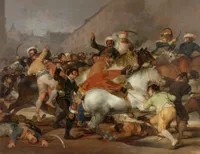
By 1814, Spain was preparing for Ferdinand VII's return, and Francisco Goya faced a commission to paint what had happened in Madrid six years earlier. The Regency Council ordered the work in February; the Prado records the acceptance of his terms on 24 May. The two subjects form a sequence. The Second of May 1808 takes up the city's attack on the occupying troops. This canvas follows with the executions. Between the two pictures, the people move from fighting in the streets to facing guns at close range. Here the painter gives each waiting man a different gesture. The distance between the rifles and their bodies is small.
The canvas measures 268 by 347 centimetres, large enough for those gestures to confront a room. Its early destination has often been told differently. The Prado cites invoices for the two frames, charged to the royal bedchamber account in July and November 1814, as evidence that the pictures were intended for rooms in the palace. The museum rejects the older account of a street exhibition. By 1834, this painting was recorded at the Prado, where it remains in the collection. Our own position resembles that of any visitor entering a room to find it there. The lantern is already lit.
In its time
The Third of May 1808 was painted in 1814, when Goya was 68. Its Spanish title is El 3 de mayo en Madrid. Where it stands on Art Through Time:
Its colors
Elsewhere in the world
- 1810The Cry of DoloresFather Hidalgo calls Mexico to rise; it wins independence in 1821.
- 1810Kamehameha unites HawaiʻiThe islands become one kingdom.
- 1816Shaka leads the ZuluA small chiefdom becomes a southern African power.
The facts
- Title
- The Third of May 1808
- Artist
- Francisco Goya (1746–1828)
- Date
- 1814
- Original medium
- Oil on canvas
- Style
- Romanticism
- Made in
- Spain
- Collection
- Museo Nacional del Prado, Madrid
Living with it
The mood
A lit patch of ground under a great weight of dark sky. The picture makes a room a place from which to witness an execution, with the man in white facing outward through the soldiers' line. It asks for sustained attention.
The palette
Blue-black occupies the sky, while bark, clay and walnut run through uniforms and earth. The lighter linen tone appears in the bank and illuminated ground. Across a room, the strongest contrast is the white shirt against the surrounding brown and black.
Who it finds
- For someone who has returned to a difficult family history and wanted the people named; these prisoners each have a different face.
- For someone who has kept looking when looking was painful; the open hands make that act of attention specific.
- For someone who has stood before a memorial and read every name; this painting gives the unnamed men room to remain individuals.
See it in a room
Your photo is never uploaded, and it's gone when you leave.
From the far side of a room, the white shirt and the line of soldiers establish what is happening. Come closer and the differences between the prisoners become clear, in their eyes, their mouths and the positions of their hands. Give that second encounter enough space; this picture needs more than a passing glance.
A study or a room used for reading history gives it a deliberate place. Choose a size that keeps the hands and faces legible without requiring someone to stand against the furniture. Leave the area around it spare. The image itself supplies the confrontation.
How we make it
- True to the original
- Each file is color-matched to the museum original. If the color isn't right, we print it again, with our compliments.
- On canvas
- Fine-art canvas hand-stretched over a ¾″ solid-wood frame, with mirrored edges so nothing is lost.
- In our floating frame
- Our stretched canvas set in a slim floating frame, with a shadow gap so the painting seems to hover.
- As a framed print
- Archival pigment print on museum-grade cotton paper, in a solid-wood frame with UV-protective glazing.
- Ready to hang on arrival
- It arrives with the hanging hardware attached. No framer, no guesswork.
- Perfect on arrival
- If anything arrives damaged or not as you ordered, send us a photo within 7 days of delivery and we'll make it again, with our compliments.
Goya painted this night in 1814, six years after the executions. If it stays with you, give the open hands a considered place.