The story · 5 min read
The sea at its highest, and the mountain at its smallest.
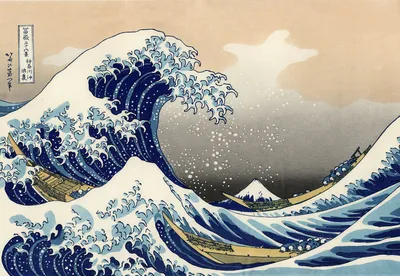
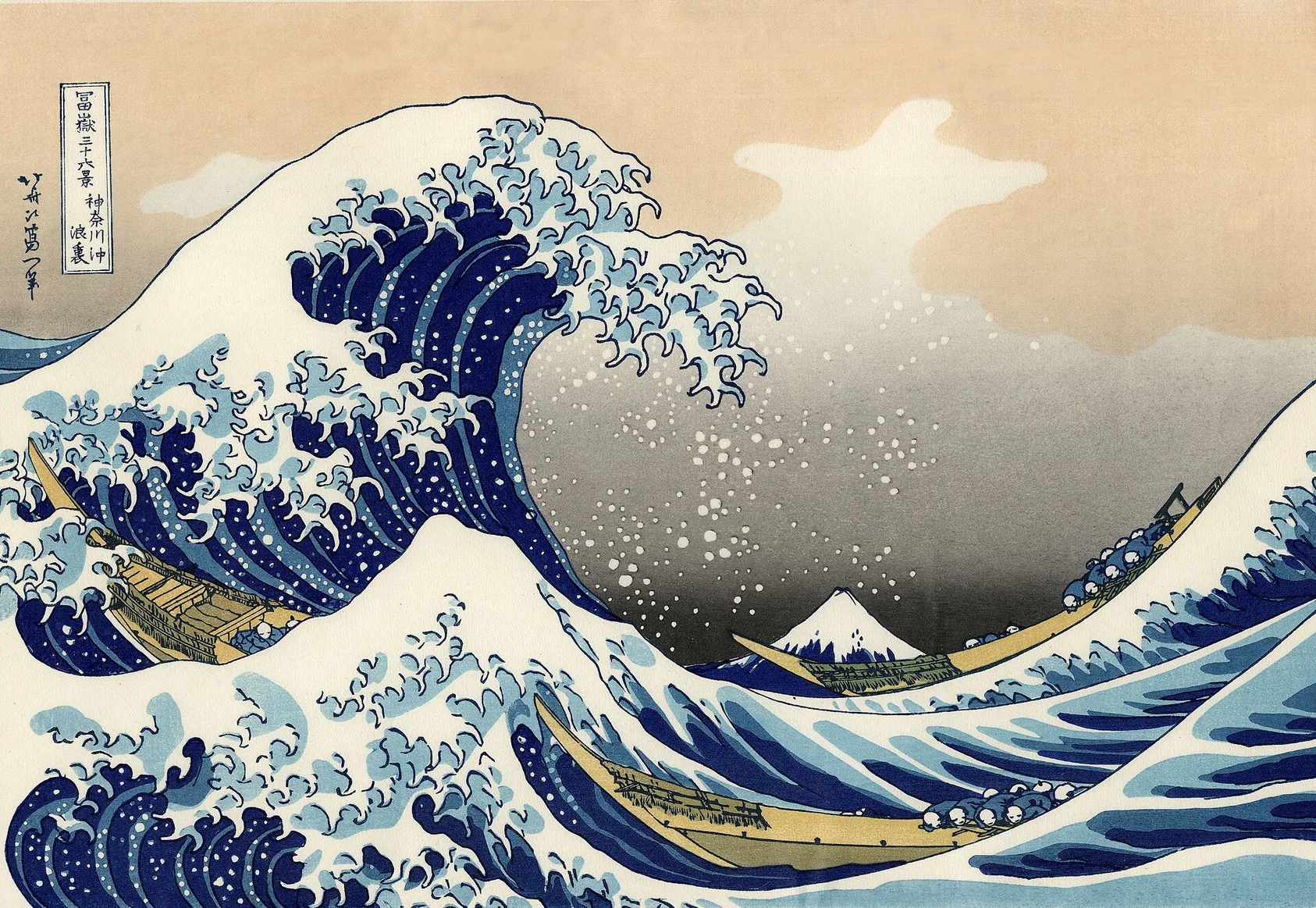
Under the Wave off Kanagawa, 1831. Katsushika Hokusai. Wikimedia Commons.
Look closer
7 things to notice
 1
01
The sea has claws
At the top of the curl, the crest breaks into white-and-blue fingers of foam, each one curling forward toward the boats. They read like claws, or grasping hands, reaching over the men below. It is the one part of the wave that seems alive, and it seems about to close.
02
Half swallowed already
On the left, a long wooden boat slides under the dark blue wall of water, and half of it is already out of sight. Hokusai doesn't show it sinking, only disappearing under the curve, as if the sea were folding it in. Whether it comes out the other side, the picture keeps to itself.
03
Heads down, holding on
Near the end of the lowest boat, small figures press their heads down as the water rises around them. They seem not to fight the sea so much as brace against it. They look like men who have done this before and know the one thing to do: stay low and let it pass.
04
Snow from the sea
White dots of spray drift down through the darkening sky in front of the mountain. Beside Fuji's snowy cap they look almost like snowfall, as if the wave were already falling on the mountain from miles away.
05
The mountain, made small
Low on the horizon, under the curl, sits Mount Fuji: snow-capped, tiny, the subject of the whole series. Hokusai was among the earliest Japanese artists to try out Western linear perspective, and he studied European styles in engravings brought from France and the Netherlands; the perspective studies in his Manga sketchbooks have been seen as feeding into this print. It has been read as using what would then have counted as Western perspective to give the water depth and volume, pushing the mountain, it seems, far into the distance.
06
A second Fuji, made of water
In the foreground, a smaller white-topped wave rises to a peak with much the shape of the mountain. The sea seems to be making its own Fuji, close and moving, beside the real one, far off and still. One will be gone in a second; the other will still be standing tomorrow.
07
A man of many names
Just left of the title box, a column of brushed black characters signs the print. The name Hokusai means 'north studio', taken in tribute to the North Star. In 1820 he took up yet another name, Iitsu, and under it his fame began to spread across Japan; from 1834 he would work as Gakyō Rōjin Manji, 'The Old Man Mad About Art'.
Our take
Under the Wave off Kanagawa is the print the world knows as The Great Wave: a wall of dark blue water curling over three boats, with Mount Fuji small and white beneath it. Hokusai made it as a woodblock print, dated 1831, for his series Thirty-Six Views of Mount Fuji. It is a picture of Fuji in which Fuji is almost the smallest thing in sight. The crest hangs over the boats with its fingers of foam spread, and the men below keep their heads down. The wave is about to fall, and it has been about to fall since 1831.
As we see it, it is also a picture about the journey. Hokusai made the series partly because travel within Japan was booming, and partly out of his own interest in the mountain. A travel picture might show you the road there. This one puts you in the sea, low down with the oarsmen and looking up, while far off under a darkening sky the mountain waits, still and white, exactly where it has always been.
The painter's moment
1760–1849Painted it at 71Momoyama & Edo
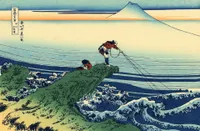
Katsushika Hokusai was about 71. He was born in Honjo, in Edo, on 31 October 1760, and trained under the ukiyo-e artist Katsukawa Shunshō. The Fuji series came out of a boom in travel within Japan and out of his own interest in the mountain, and around the same time he was making A Tour of the Waterfalls of the Provinces and Oceans of Wisdom, and starting on detailed single prints of flowers and birds. His youngest daughter, Ei, also called Ōi, would become an artist herself and his assistant, and he kept a close watch on how his designs were cut and printed. Among the views dated to the same year is Kajikazawa in Kai province. That same year, John Constable painted Salisbury Cathedral from the Meadows.
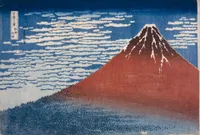
This print and Fine Wind, Clear Morning made him famous in Japan and abroad, and the series sold so well that ten more prints were added to it. A few years later he wrote that nothing he had drawn before seventy was worth anything, and that only at seventy-three did he begin to understand the structure of animals, birds, insects and fish. Hard years followed: his publishers ran into money trouble in the mid-1830s, in 1839 fire took his studio and a great deal of his work, and by the late 1830s his career was fading as younger artists such as Hiroshige won the public. But the wave kept travelling. His work had a strong influence on Van Gogh and Monet, and Debussy kept an impression of the print in his living room and asked for it on the cover of the score of La Mer, a piece that has been read as inspired by it.
In its time
Under the Wave off Kanagawa was made in 1831, when Hokusai was 71. Where it stands on Art Through Time:
Its colors
Elsewhere in the world
- 1825Thomas Cole paints the CatskillsThe Hudson River School begins as the Erie Canal opens.
- 1830The Indian Removal ActForced removals from ancestral lands.
The facts
- Title
- Under the Wave off Kanagawa
- Artist
- Katsushika Hokusai (1760–1849)
- Date
- 1831
- Original medium
- Style
- Momoyama & Edo
- Made in
- Japan
- Collection
- Wikimedia Commons
Living with it
The mood
Wide and bracing, with a stillness at its centre. It doesn't make a room restless; it gives it a horizon, a sense of weather and distance beyond the walls. It is the kind of picture you might stop in front of on the way to somewhere else, and stay.
The palette
A peach-and-grey sky over deep blue water. The pale foam and the warm sky carry across a room; the deep blue of the wave holds everything together up close.
Who it finds
- People who have kept their heads down through something huge and come out the other side. The men in the boats are still there, still holding on.
- Anyone who has travelled a long way to see one famous place, and found that the journey there was the real picture.
- People who believe their best work is still ahead of them. Hokusai made this at about seventy, and later wrote that everything he had drawn before seventy counted for nothing.
See it in a room
Your photo is never uploaded, and it's gone when you leave.
From across a room it reads at once as a single shape: the great curl, the white claws at its edge, the small peak below. Come close and it gives you the rest: the bowed heads in the boats, the spray drifting in front of Fuji, the little Fuji made of water in the foreground.
Hang it where there is a long view to it: the end of a hallway, a living room, the wall a desk faces. The shape is simple enough to read even small, but the wave was drawn to tower. Give it as much width as the wall allows, and the boats start to feel as small as they should.
How we make it
- True to the original
- Each file is color-matched to the museum original. If the color isn't right, we print it again, with our compliments.
- On canvas
- Fine-art canvas hand-stretched over a ¾″ solid-wood frame, with mirrored edges so nothing is lost.
- In our floating frame
- Our stretched canvas set in a slim floating frame, with a shadow gap so the painting seems to hover.
- As a framed print
- Archival pigment print on museum-grade cotton paper, in a solid-wood frame with UV-protective glazing.
- Ready to hang on arrival
- It arrives with the hanging hardware attached. No framer, no guesswork.
- Perfect on arrival
- If anything arrives damaged or not as you ordered, send us a photo within 7 days of delivery and we'll make it again, with our compliments.
Hokusai raised this wave in 1831, and it has hung over the boats ever since without falling. Give it room to tower.