The story · 4 min read
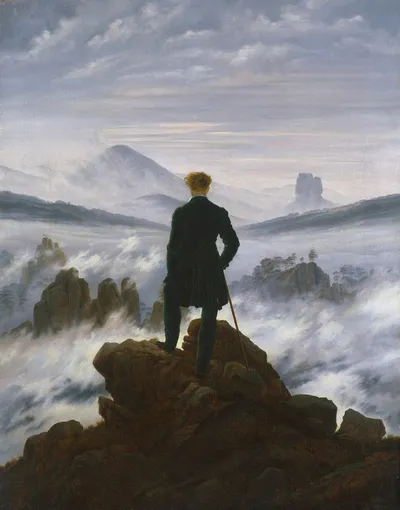
He has climbed as far as the rock goes, and the world below is still hidden.
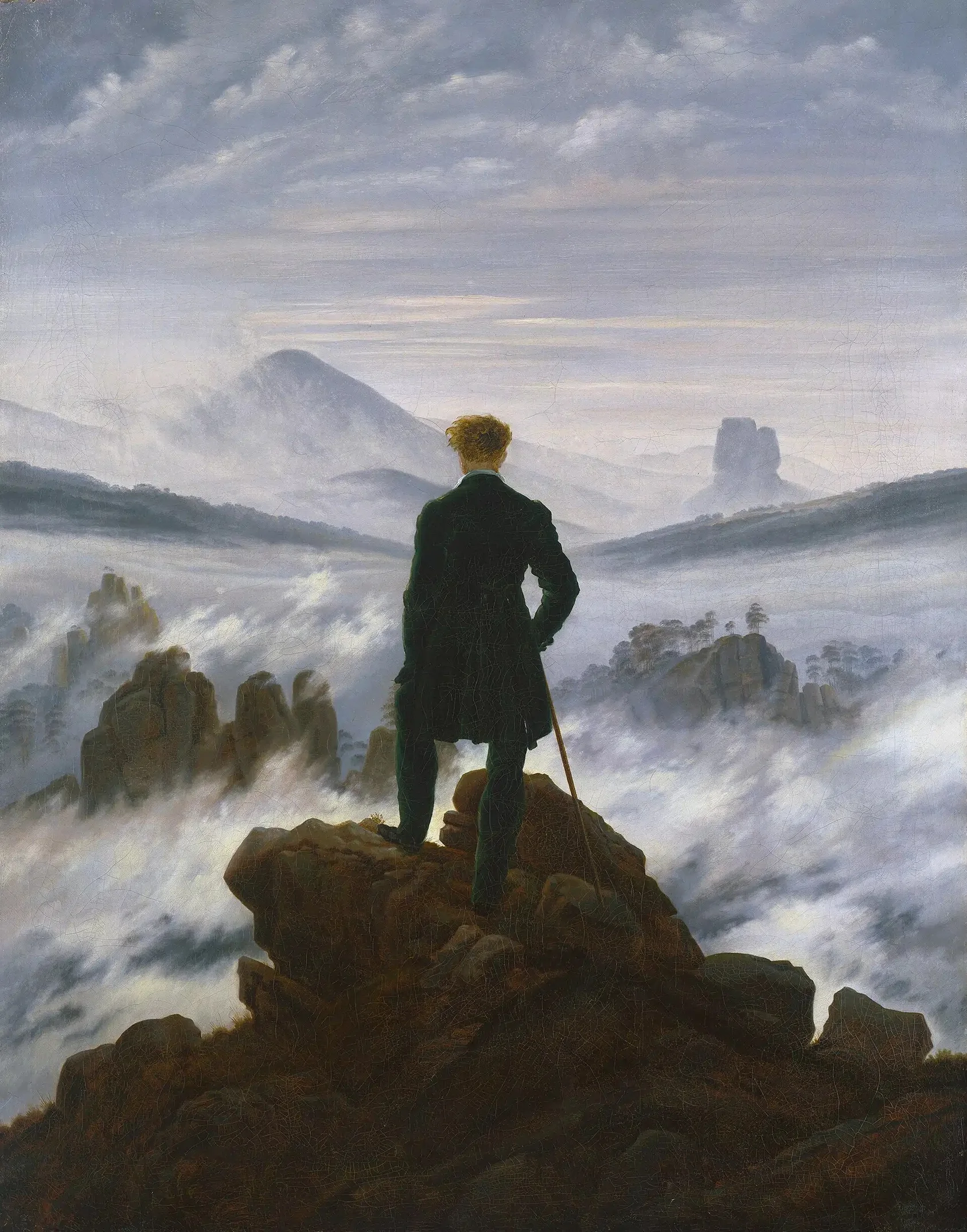
Wanderer above the Sea of Fog, 1818. Caspar David Friedrich. Hamburger Kunsthalle.
Look closer
7 things to notice
 1
01
Perhaps the most famous back in art
He stands at the very top with his back to us, and he never turns around. A figure seen from behind like this is called a Rückenfigur, and he may be the best known in all of art. The art historian Helmut Börsch-Supan said that, more than in any other painting, it is hard to picture this landscape without its figure.
02
The painter's own hair, perhaps
The wind has caught his reddish hair and pushed it sideways, above a thin white collar. Some writers think the wanderer is Friedrich himself, and they point to that red hair. It is one reason the picture is read as a painting about looking inward, as if the man had climbed up here to face himself as much as the view.
03
A coat that might be a statement
He wears a dark green overcoat, rests his right hand at his hip, and holds a thin walking stick that slants down to the rock. The art historian Norbert Wolf, following Joseph Koerner, reads the clothes as an 'Old German' outfit, which in those years was a liberal-nationalist political statement. Markus Bertsch disagrees: to him the clothes only tell us the man lives in a city.
04
One step from the drop
His left foot is planted at the very edge of the rock, beside a small tuft of grass, with nothing beyond it but fog. The rocks he stands on are a group on the Kaiserkrone, in the Elbe Sandstone Mountains. He has gone as far as the ground goes, as if the only step left were into the view itself.
05
Real mountains, rearranged
On the far right, a flat-topped column of rock rises out of the haze. It is the Zirkelstein, a real peak. Friedrich drew his studies almost entirely in pencil and noted the topography on them, then moved the pieces into place in his studio. The pieces are real; the arrangement is his.
06
Hidden to look larger
In the left distance, a large cone-shaped mountain is half lost in drifting white mist. It may be the Rosenberg or the Kaltenberg, and the group of rocks in front of it is the Gamrig, near Rathen. Friedrich wrote that mist makes a landscape look bigger and more sublime, and stirs the imagination like a veiled girl.
07
A world not yet made
Far off, pale bands of fog and low cloud fade into each other, and there is no horizon line at all. Joseph Koerner suggests the picture could show something like the Creation: a man looking at an unknown land still hidden in mist, which he links to Carl Gustav Carus's writing on the fog in Genesis 2:6. Werner Hofmann finds the painting more open-ended and questioning than most Romantic works, and this is the part of it where the question seems to have no end.
Our take
A man has climbed to the top of the rocks and stands with his back to us, looking out over mountains buried in fog. Caspar David Friedrich painted it in about 1818, and the place is both real and invented: he sketched the rocks of the Elbe Sandstone Mountains outdoors, then rearranged them in his studio into a summit no one could ever walk to. Whatever road brought the man here has disappeared into the white. He has climbed as far as he can, and the world is still hidden.
We never see his face, and that seems to be the point. We stand just behind him and look where he looks, so the view becomes ours too. Friedrich believed an artist should paint what he sees inside himself as well as what is in front of him, and this fog reads like both: a far country, and the weather of a mind looking at it.
The painter's moment
1774–1840Painted it at 44Romanticism
Caspar David Friedrich was about 44. In June 1816 he had applied for Saxon citizenship, to put distance between himself and Prussian authority, and that same year brought one of his periods of depression. In 1817 he became friends with the scientist Carl Gustav Carus and the Norwegian painter Johan Christian Dahl. On 21 January 1818 he married Caroline, 25, the daughter of a Dresden dyer, and the couple spent weeks on honeymoon in his hometown, Greifswald. That year the Saxon Academy also made him a member, with a yearly payment of 150 thalers.
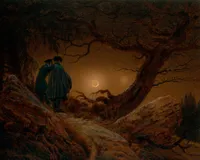
The paintings he made after the marriage feel lighter, among them Chalk Cliffs on Rügen, painted after the honeymoon, and people appear in them more and more often. Around 1819 he painted Two Men Contemplating the Moon, now in Dresden, and in 1820 his first child, Emma, was born. The Wanderer itself drops out of sight for the rest of the century. By 1939 it was on show at Wilhelm August Luz's gallery in Berlin; it was apparently sold to a lawyer, Ernst Henke, and then went back to the gallery. The Hamburger Kunsthalle bought it in 1970 and has shown it ever since.
In its time
Wanderer above the Sea of Fog was painted in 1818, when Friedrich was 44. Its German title is Der Wanderer über dem Nebelmeer. Where it stands on Art Through Time:
Its colors
Elsewhere in the world
- 1816Shaka leads the ZuluA small chiefdom becomes a southern African power.
- 1822Brazil declares independencePedro I's cry of 'Independence or death!' founds an empire.
- 1824The Battle of AyacuchoSucre's victory all but ends Spanish rule in South America.
The facts
- Title
- Wanderer above the Sea of Fog
- Artist
- Caspar David Friedrich (1774–1840)
- Date
- 1818
- Original medium
- Oil on canvas
- Style
- Romanticism
- Made in
- Sweden
- Collection
- Hamburger Kunsthalle
Living with it
The mood
Wide and cool, with a hush in it. It opens a room outward the way a high window does, and gives it the quiet of a summit where the wind is the only sound. You will likely stand in front of it a minute longer than you meant to.
The palette
Nearly all of it is the grey of fog and cloud, from pearl to slate. Only the umber of the rocks and the man's dark coat break it, and that dark shape against the pale is what you see from across a room.
Who it finds
- Anyone who has climbed something hard, a mountain or a year, and found at the top that the view was still a question.
- People about to set out for somewhere they can't yet picture: a new city, new work, a far shore.
- Those who go walking alone to think, and come home with more weather in them than answers.
See it in a room
Your photo is never uploaded, and it's gone when you leave.
From across the room it reads at once: a dark figure on a dark rock, against a pale sea of fog. Come close and the fog fills with places: the Zirkelstein on the right, the Gamrig's pillars on the left, the wind in his hair, his foot at the very edge.
It belongs where a room looks outward or upward: above a desk, at the head of a stair, at the end of a hallway that walks you toward it, in a study where the next journey gets planned. The original is 67 by 74.8 cm, a little wider than tall. Go larger if the wall allows, so the fog has room to spread and the far peaks can still be read from the doorway.
How we make it
- True to the original
- Each file is color-matched to the museum original. If the color isn't right, we print it again, with our compliments.
- On canvas
- Fine-art canvas hand-stretched over a ¾″ solid-wood frame, with mirrored edges so nothing is lost.
- In our floating frame
- Our stretched canvas set in a slim floating frame, with a shadow gap so the painting seems to hover.
- As a framed print
- Archival pigment print on museum-grade cotton paper, in a solid-wood frame with UV-protective glazing.
- Ready to hang on arrival
- It arrives with the hanging hardware attached. No framer, no guesswork.
- Perfect on arrival
- If anything arrives damaged or not as you ordered, send us a photo within 7 days of delivery and we'll make it again, with our compliments.
Friedrich set him on that summit two centuries ago, and he still hasn't turned around. Give him a wall to look out from.