The story · 4 min read
The field offers three paths and keeps their destinations out of sight.
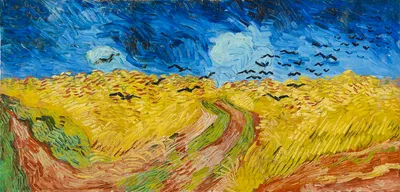
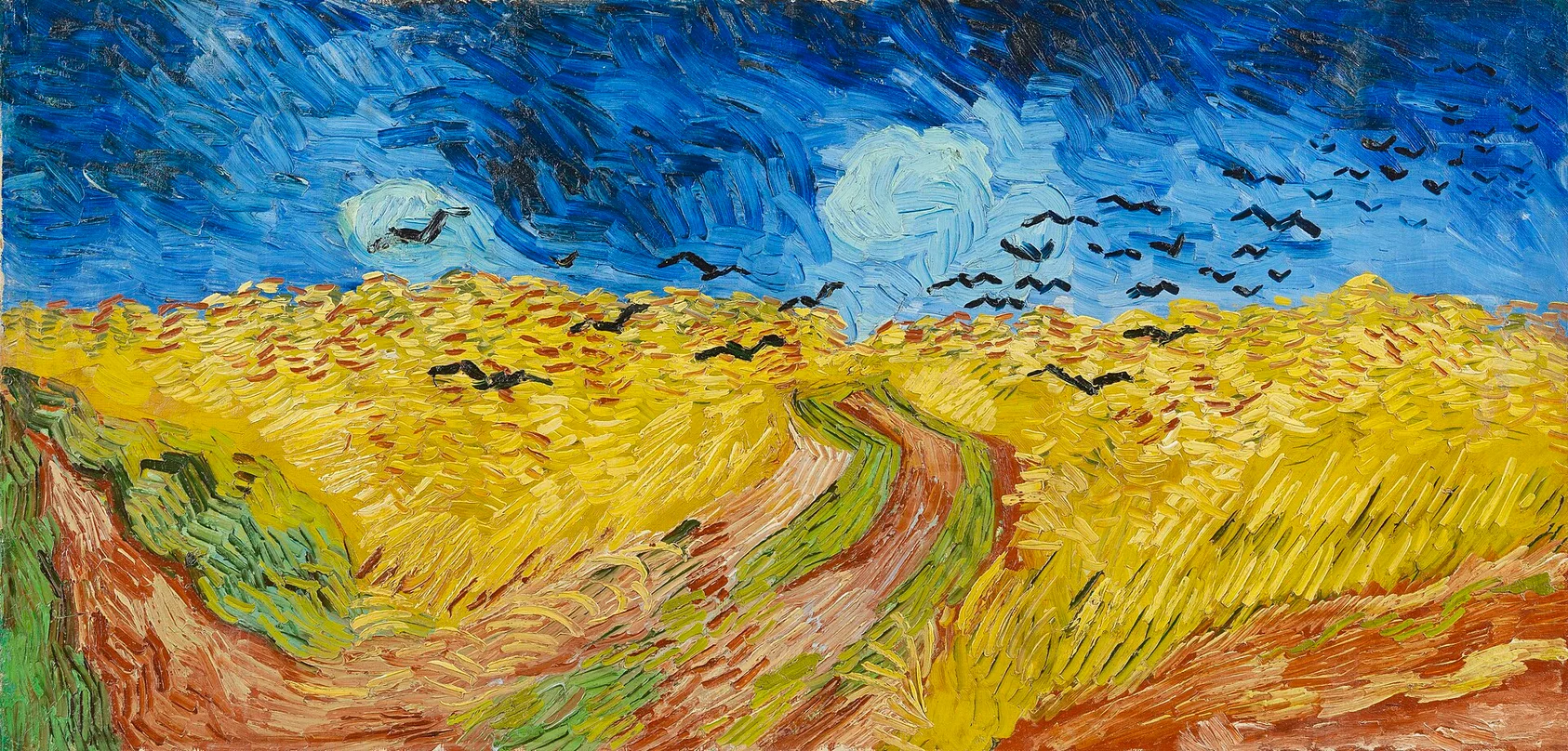
Wheatfield with Crows, 1890. Vincent van Gogh. Van Gogh Museum, Amsterdam (Vincent van Gogh Foundation).
Look closer
7 things to notice
 1
01
Birds without a fixed message
Black wings become smaller toward the upper right, where the flock thins into the blue. Van Gogh specialist Martin Bailey warns against reading the whole scene through the artist's approaching death. He also finds life in its birds, crop and changing weather. The crows have no single agreed direction of flight.
02
A route loses its destination
The central red-brown path narrows between green edges and disappears among the wheat. Bailey reads the diverging tracks as routes whose destinations remain unavailable to us. That is a reading of the picture, not evidence that Van Gogh intended a farewell. The far end gives us only more grain.
03
Two colors make each other stronger
Bright yellow wheat meets blue sky along a rough horizon. The Van Gogh Museum emphasizes this blue against yellow-orange pairing, alongside red against green in the tracks. Color builds the landscape's force before any symbolic meaning enters it. Each yellow mark looks sharper beside the blue.
04
The weather could carry a feeling
Dark strokes gather above the pale blue near the center-left of the sky. Around 10 July, Van Gogh told Theo and Jo that he had worked to give his wheatfield pictures a sense of grief and isolation. He made that intention explicit in writing. Here it has the shape of heavy blue marks.
05
He had divided a path before
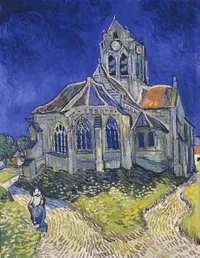
The left track runs between green strips before leaving the image. Bailey compares the diverging paths here with those in The Church at Auvers, painted the previous month. The same compositional choice can serve different moods. The green border follows the track out of the picture.
06
The field could still offer something
Long yellow strokes fill the right foreground, with pale tips and orange marks among them. In the same letter that described loneliness, Van Gogh said the countryside gave him renewed strength. He wanted the pictures to communicate what words could not. The crop occupies nearly every gap in this patch.
07
A wider space was deliberate
The reddish track at the lower right exits through the edge beside yellow wheat. This unusually wide canvas belongs to Van Gogh's late experiments in a format roughly twice as wide as high. The Musée d'Orsay stresses that he chose those proportions deliberately. The field continues beyond the cropped track.
Our take
Walk into this field and the path disappears before you arrive anywhere. Wheat crowds its narrow end; two other tracks leave through the sides of the picture. Above them, black birds cross a blue sky marked by dark strokes. The yellow is almost too bright for the weather. No person waits at the far end.
Van Gogh painted this landscape in July 1890, but it was not his last picture. The Van Gogh Museum rejects that familiar story. His own letter from around this time also refuses a single mood: he wanted his wheatfields to convey loneliness, yet he found strength in the countryside and hoped to bring the canvases to Paris. The yellow field can be abundant and the way ahead uncertain at once. Small black wings scatter above the grain.
The painter's moment
1853–1890Painted it at 37Post-Impressionism
In May 1890, Vincent van Gogh left the psychiatric hospital at Saint-Rémy and traveled north. He arrived in Auvers-sur-Oise, a village near Paris, on 20 May. His brother Theo and Theo's young family would be closer, and the physician Paul Gachet offered companionship and encouragement to work. Vincent rented an attic room at the Auberge Ravoux, using a room downstairs for painting and storage. He went out into the surrounding countryside with his materials. The village and its surroundings offered subjects close at hand: houses, gardens, the church, and the fields above it.
By July, anxiety about money and dependence on Theo had returned. A letter from Jo reassured him that the family understood his efforts. He wrote back around 10 July about three new canvases, including wheatfields under troubled weather, and hoped to bring them to Paris. Wheatfield with Crows belongs to this period of work on elongated canvases. It was followed by other paintings; the exact order of every work remains a matter for research. Van Gogh died on 29 July after shooting himself two days earlier. His brother was with him. This landscape now belongs to the Van Gogh Museum in Amsterdam, through the Vincent van Gogh Foundation.
In its time
Wheatfield with Crows was painted in 1890, when Van Gogh was 37. Its Dutch title is Tarwe gebied met kraaien. Where it stands on Art Through Time:
Its colors
Elsewhere in the world
- 1884The Berlin ConferenceEurope's powers divide Africa among themselves.
- 1887French Indochina is formedFrance rules Vietnam and Cambodia, and later Laos.
- 1888Brazil abolishes slaveryThe Golden Law makes Brazil the last country in the Americas to end it.
- 1890Wounded KneeU.S. soldiers kill some 250 Lakota men, women and children.
- 1894The Dreyfus AffairA Jewish officer is falsely convicted of treason; France, and its painters, split in two.
The facts
- Title
- Wheatfield with Crows
- Artist
- Vincent van Gogh (1853–1890)
- Date
- 1890
- Original medium
- Oil on canvas
- Style
- Post-Impressionism
- Made in
- Netherlands
- Collection
- Van Gogh Museum, Amsterdam (Vincent van Gogh Foundation)
Living with it
The mood
A wide band of yellow gives the room an immediate brightness, crossed by red-brown tracks and green margins. The blue sky has equal force above it. From across the room, the black birds remain small marks inside those broad areas.
The palette
Saffron and ochre belong to the wheat, while cobalt and azure separate the darker and lighter sky. Clay appears in the paths beneath pale strokes. The yellow field is the first large shape to register; the black birds interrupt it without becoming a solid mass.
Who it finds
- For someone who has found a familiar walk changed by the weather; the same field carries bright grain and a darkening sky.
- For someone who has needed help while still working hard; Van Gogh wanted Theo and Jo to understand the effort inside these canvases.
- For someone who learned a famous story and later had to revise it; this field still has plenty to say without being the last.
See it in a room
Your photo is never uploaded, and it's gone when you leave.
From a doorway, the long yellow field and deep blue sky read as two broad areas. Closer, the paths separate into red, pale pink and green strokes, and the birds resolve into a few dark marks apiece. A wide print preserves that movement between the whole landscape and its rough painted surface.
A living room above a low cabinet offers the horizontal space this composition needs. Keep nearby patterns simple so the tracks remain legible. In a study, place it where the chair faces the full width of the image; a narrow gap between shelves would make the central path carry too much of the picture alone.
How we make it
- True to the original
- Each file is color-matched to the museum original. If the color isn't right, we print it again, with our compliments.
- On canvas
- Fine-art canvas hand-stretched over a ¾″ solid-wood frame, with mirrored edges so nothing is lost.
- In our floating frame
- Our stretched canvas set in a slim floating frame, with a shadow gap so the painting seems to hover.
- As a framed print
- Archival pigment print on museum-grade cotton paper, in a solid-wood frame with UV-protective glazing.
- Ready to hang on arrival
- It arrives with the hanging hardware attached. No framer, no guesswork.
- Perfect on arrival
- If anything arrives damaged or not as you ordered, send us a photo within 7 days of delivery and we'll make it again, with our compliments.
Van Gogh's July 1890 wheatfield puts three paths beneath scattered crows. Give its broad yellow and blue enough wall space for the tracks to separate.