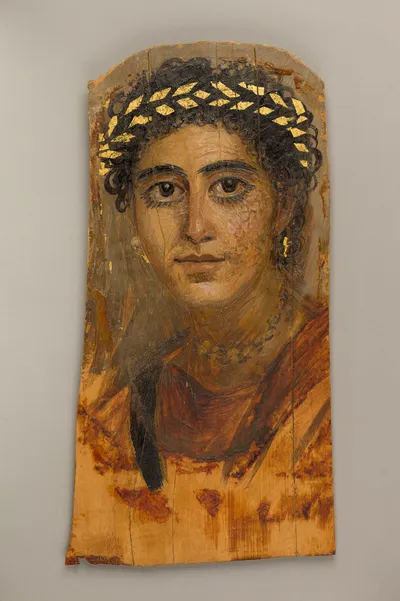
Portrait of a young woman in red
Painted in wax, with gold leaf, on a thin board of linden wood.
Printed for you, as a giclée
Art Through Time · Roman Egypt, 30 BCE to 250 CE
The Fayum mummy portraits of Roman Egypt
For about 250 years, families in Roman Egypt had a painter make a portrait of one of their own on a thin wooden panel. When that person died, the portrait was wrapped into the mummy, over the face. About 900 survive. They look like people you could pass on the street today.
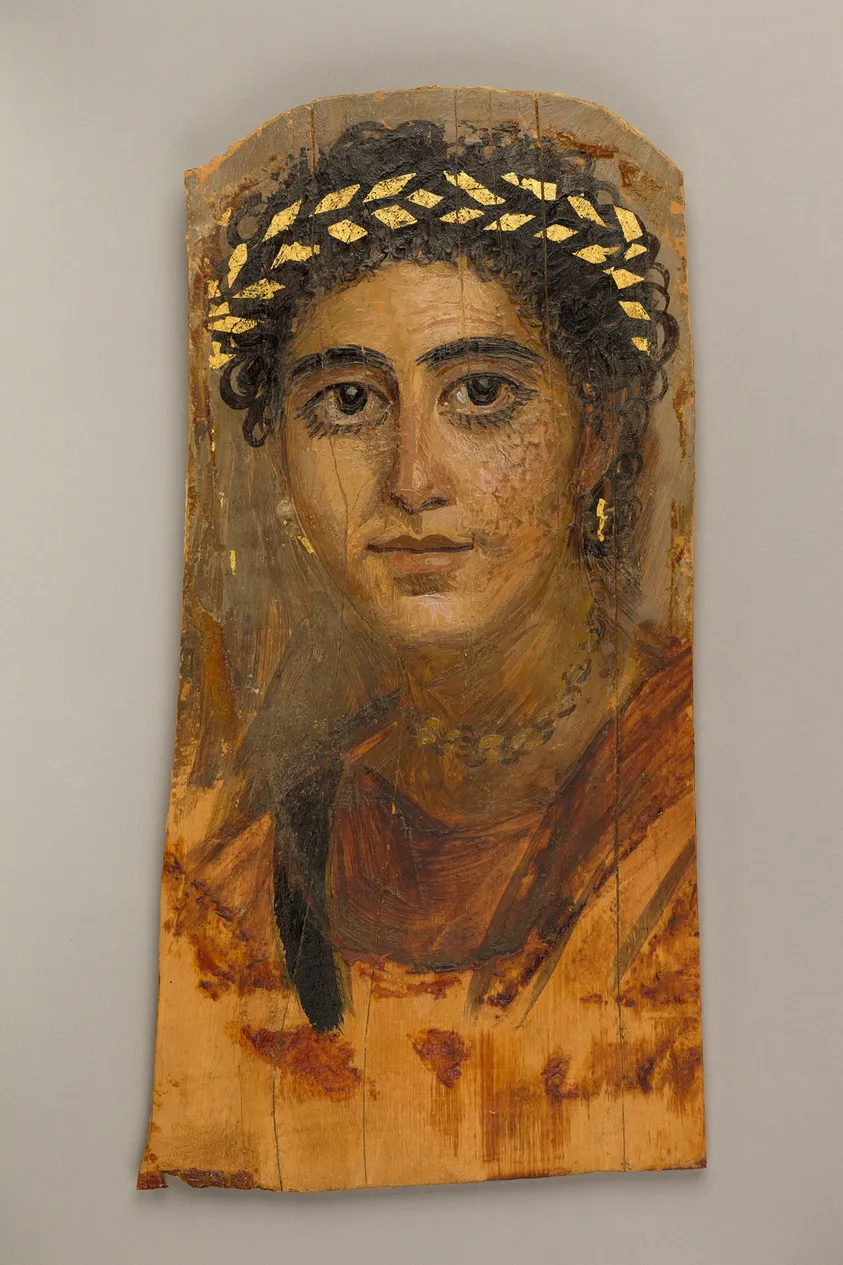
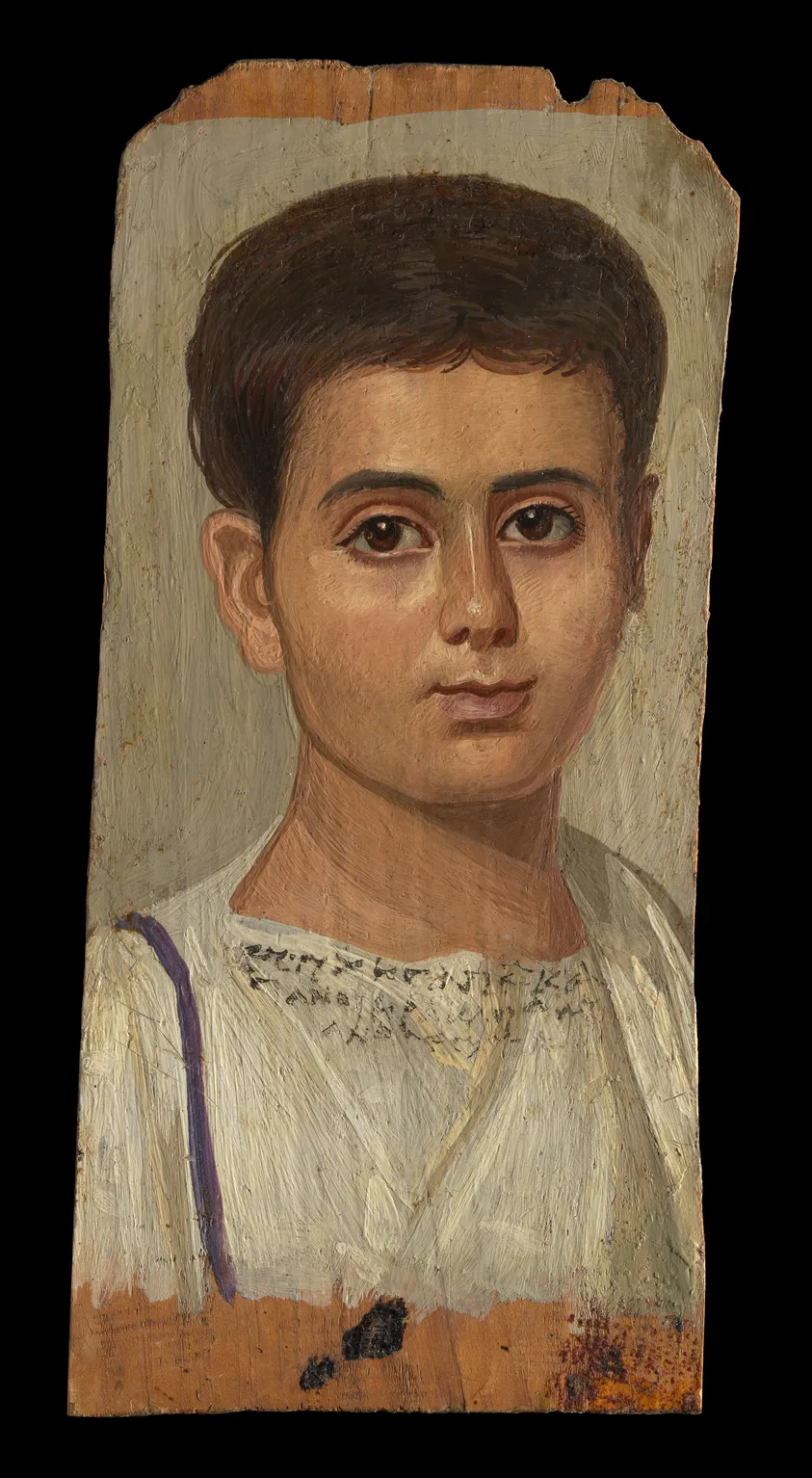
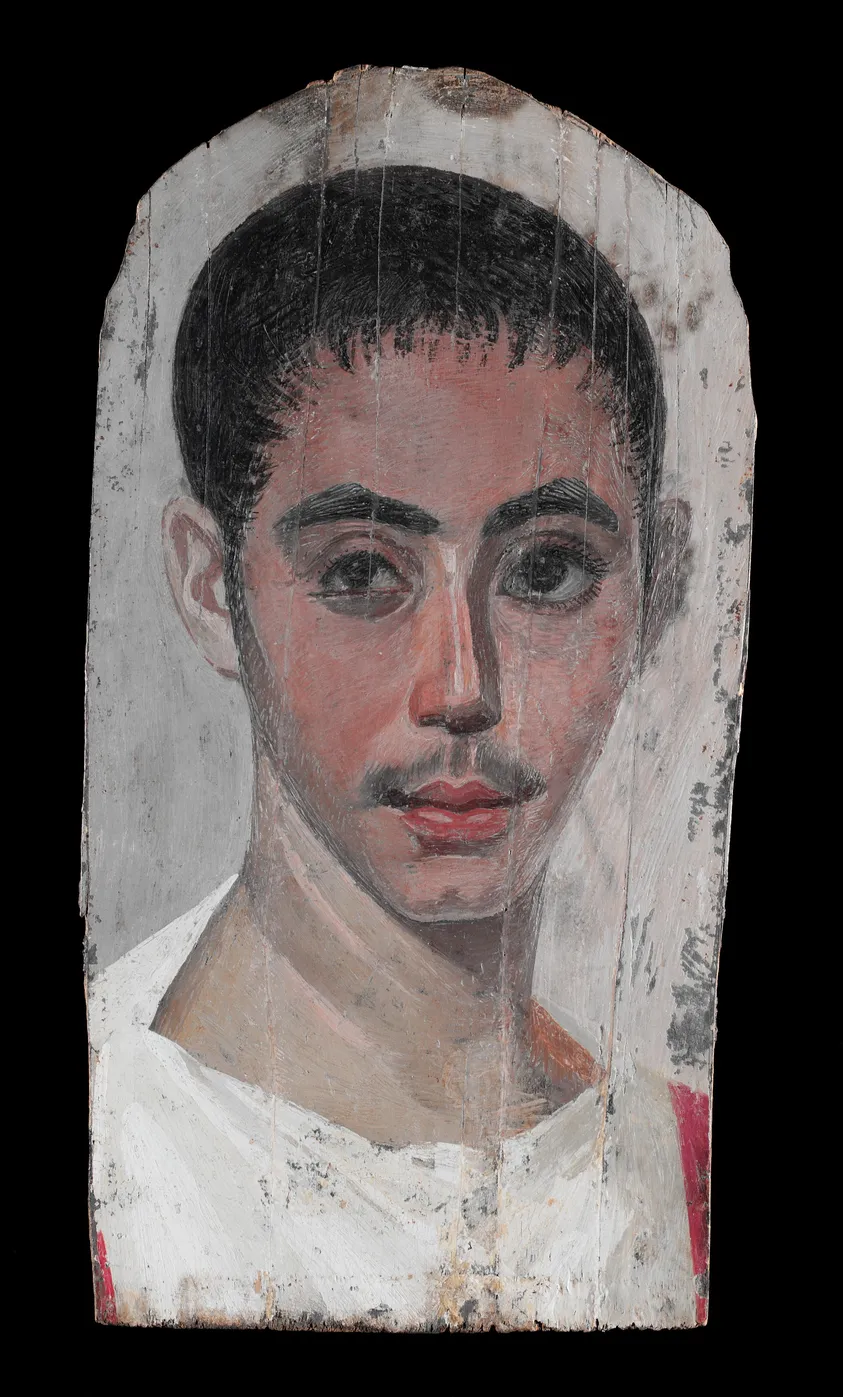
Greek and Roman painters were famous for portraits on wooden panels. Writers of the time praised them by name. Almost all of that painting is lost: wood rots, and panels burn. Egypt’s dry sand kept these. They are the largest group of painted portraits of real people to survive from the ancient world, and nearly all that is left of Greek and Roman panel painting.
“Realistic portraiture indeed has for many generations been the highest ambition of art.” Pliny the Elder, Rome, 1st century CE
The people in these portraits lived in the towns of the Fayum, a basin of farmland west of the Nile, and in cities along the river such as Antinoopolis. Most were Egyptians, many with Greek names and a Greek education, in families that had mixed Egyptian and Greek ways for three centuries and now lived under Roman rule. They could afford a portrait: officials, soldiers, priests, and their wives and children. When the archaeologist Flinders Petrie dug the cemetery at Hawara, he found a portrait on only one or two mummies in a hundred.
Many of them are young. CT scans of mummies that still carry their portraits show that the age and sex in the painting match the body inside. Life was short, and these families lost children and young adults often.
The painters worked in the Greek tradition, which prized a true likeness above all. They kept what a flattering painter would leave out: a mole on the nose, a thin face, a teenager’s first beard, a scar on an eyelid.
Women followed the hairstyles of the empresses in Rome, and those changed often, so a hairstyle dates a portrait to within a few decades. A woman with the plaited style of Trajan’s court was painted between 98 and 117 CE. Earrings changed with the fashion too.
Most were painted in encaustic: pigment mixed into hot beeswax, laid on with brushes and worked with flat metal tools. Wax holds its color, which is why so many still look fresh. Others were painted in tempera, pigment bound with animal glue, which dries softer and chalkier. The panels are thin boards of imported wood, often linden or oak, and a few portraits are painted on linen. Gold leaf marks wreaths and jewelry.
Scientists studying the portraits have found Egyptian blue, the oldest man-made pigment, in at least 47 of them, in backgrounds and in the shadows of faces.
Painted in wax, with gold leaf, on a thin board of linden wood.
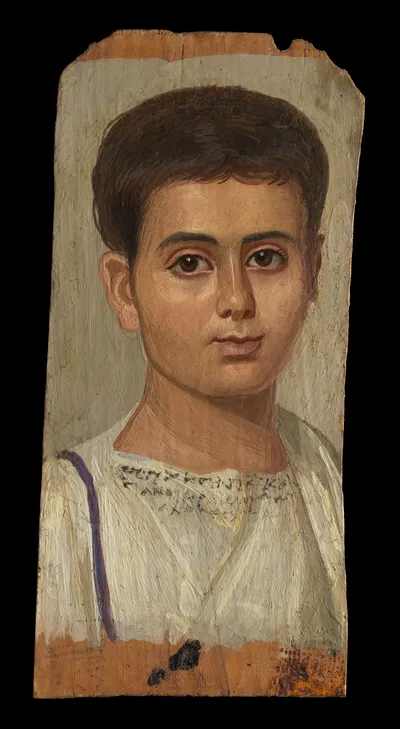
A line of Greek under his collar reads “Eutyches, freedman of Kasanios.” He was born enslaved, was freed, and died young.
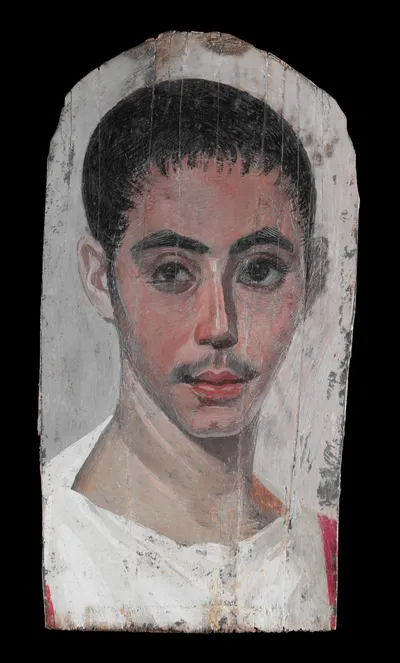
A faint first beard marks him as a teenager. The straight line on his lower right eyelid is a surgical cut: someone had operated on his eye.
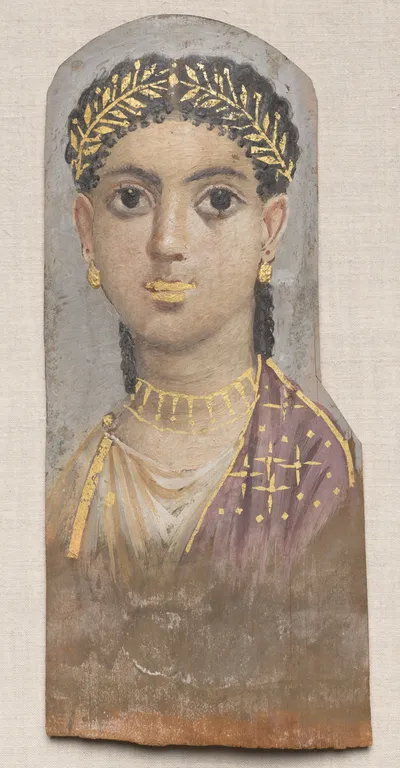
One of the earliest. Her lips are gold, which the Cleveland Museum of Art reads as her change into an akh, a spirit of the dead in Egyptian belief.
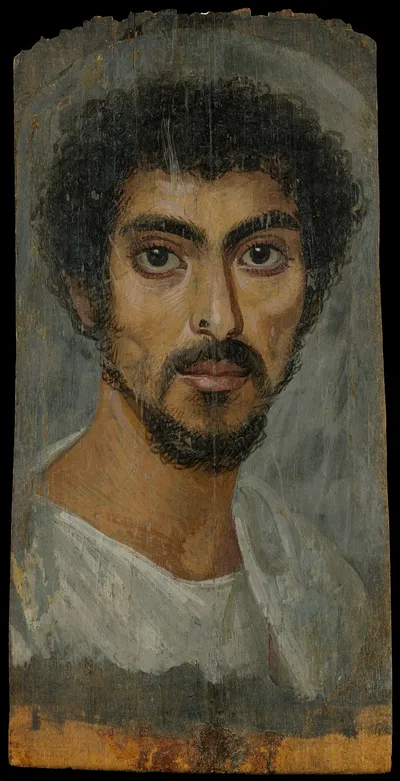
The painter kept the mole on his nose.
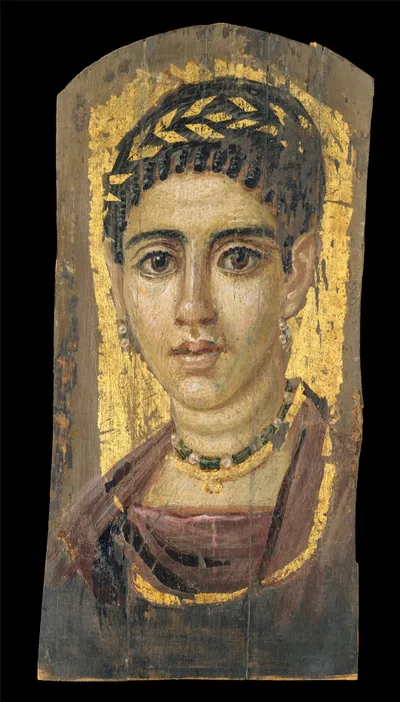
The gilded wreath is the crown of justification, given in Egyptian belief to the dead who passed judgment before Osiris.
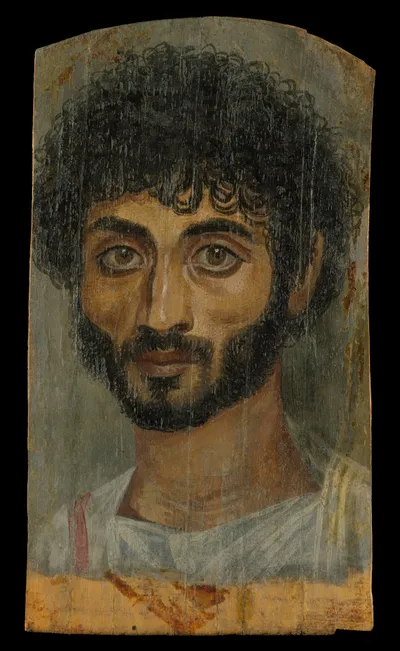
His full beard follows the fashion Rome’s emperors set from Hadrian on.
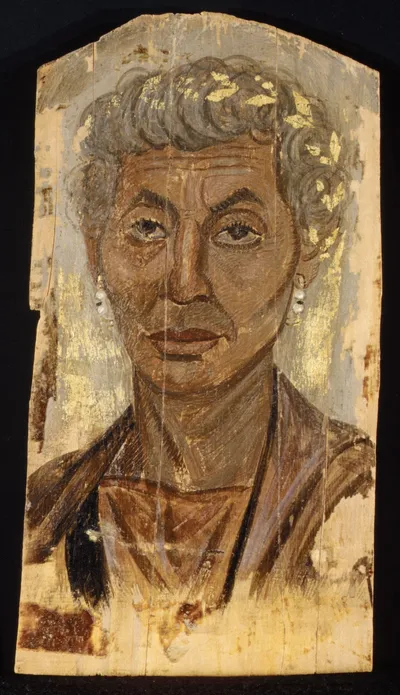
Most of the faces are young. She is one of the few who reached old age.
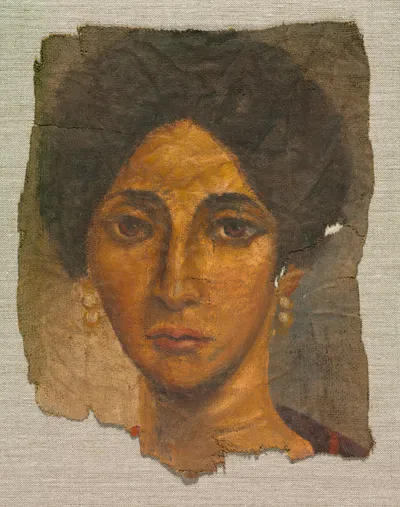
Painted on linen rather than wood. The gold was added at her burial.
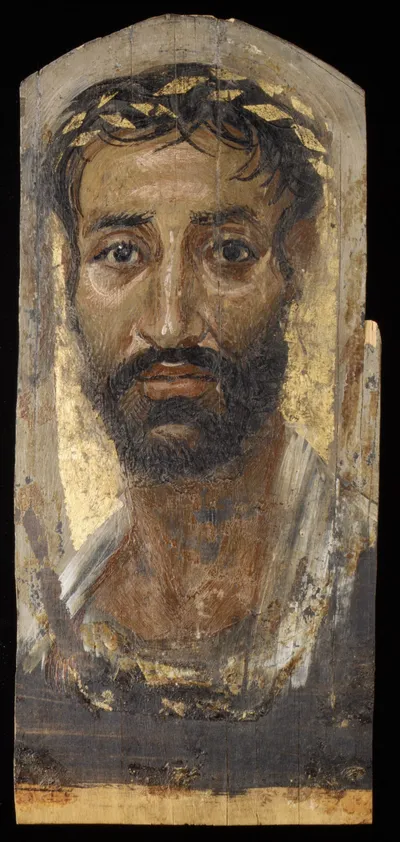
Gold leaf picks out his wreath.
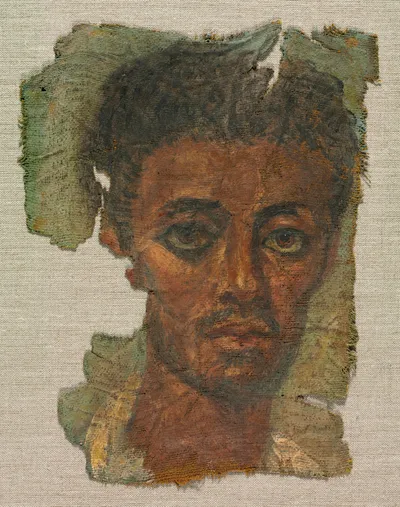
Painted on linen, which takes only a brush. On wood, painters also worked the wax with flat metal tools.
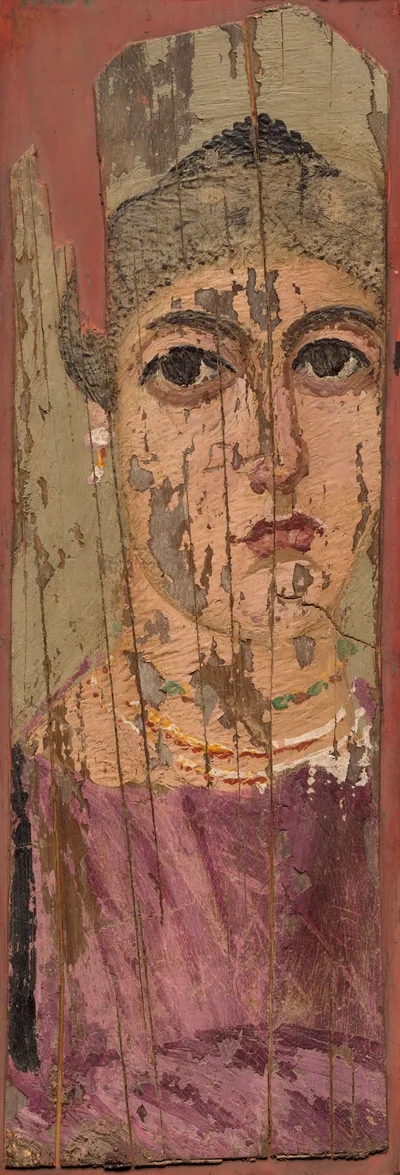
Wax on wood, 2nd century CE.
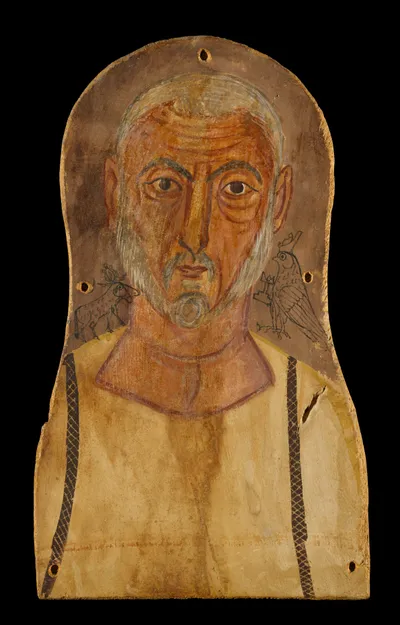
Painted near the end, around 250 CE: a man in the Roman manner, standing between the gods of Egypt.
Both. Some panels were trimmed at the edges to fit the mummy’s wrappings, a sign they were painted earlier and kept at home. Others were painted at the time of death. In 2020, researchers rebuilt a small boy’s face from CT scans of his mummy and found it so close to his portrait that it was painted just before or just after he died.
In 1615 the Italian traveler Pietro della Valle bought two portrait mummies near Saqqara; they are now in Dresden. In 1887, finders burned most of a group of about fifty as firewood before two were saved. In the 1890s the dealer Theodor Graf sold the portraits found at er-Rubayat across Europe and America. Flinders Petrie dug at Hawara from 1887 and found 81 portraits in his first season, and about 70 more when he returned in 1910. His notes are still the best record of where any of them were found.
By the middle of the 3rd century the portraits end. The empire was in an economic crisis, religion in Egypt was changing, and from 212 CE every free person in the empire was a Roman citizen. The look did not disappear. The straight-on gaze, the large eyes and the wax on wood return in the first Christian icons, such as the 6th-century icons at Saint Catherine’s Monastery in Sinai.
From November 5, 2026 to May 2, 2027, about 50 Fayum portraits hang together at the Ara Pacis Museum in Rome, in the exhibition Egypt and Rome: The Faces of Fayum. Portraits from Egypt’s own collections are lent abroad for the first time, beside 23 works from the Louvre.
Portraits painted on thin wooden panels or linen in Roman Egypt and wrapped into mummies over the face of the dead. They are named after the Fayum, the farming region west of the Nile where most were found.
They were painted from the start of Roman rule in Egypt, around 30 BCE, to the middle of the 3rd century CE. The faces on this page are between about 1,775 and 2,000 years old.
About 900. Museums hold more than 700 of them, about 130 in North America.
Families who could afford a portrait: officials, soldiers, priests, and their wives and children. Most were Egyptians, many with Greek names and a Greek education, living under Roman rule.
Much like people today. The portraits were painted from real people, and the painters kept what they saw: moles, thin faces, first beards, the hairstyles in fashion that decade.
Most in encaustic, pigment mixed into hot beeswax; others in tempera, pigment bound with animal glue. Gold leaf marks wreaths and jewelry.
In the Metropolitan Museum of Art, the British Museum, the Louvre, the Getty Villa, the Egyptian Museum in Cairo and Berlin’s Egyptian Museum, among others. From November 5, 2026 to May 2, 2027, about 50 hang together at the Ara Pacis Museum in Rome.
Yes. Every portrait on this page is available as a canvas or framed print, made to order.
Before you explore
We use cookies for analytics, heatmaps and session recordings, so we can see what visitors love and keep making the gallery better. Anything you type stays private. You can change your choice at any time in our privacy policy.