The story · 4 min read
The patterns crowd around her; the face keeps its distance.
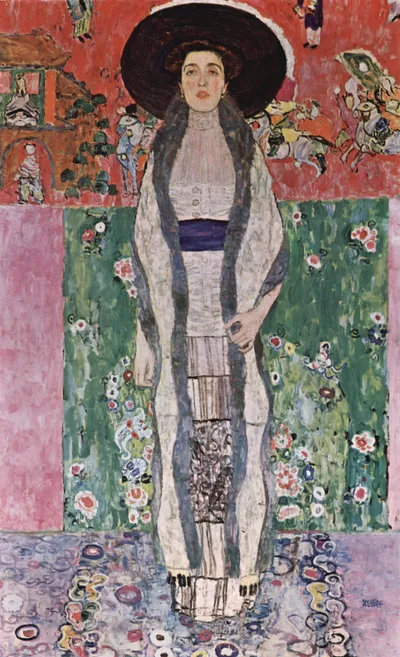
Adele Bloch-Bauer II, 1912. Gustav Klimt. Private collection.
Look closer
7 things to notice
 1
01
She helped make this world
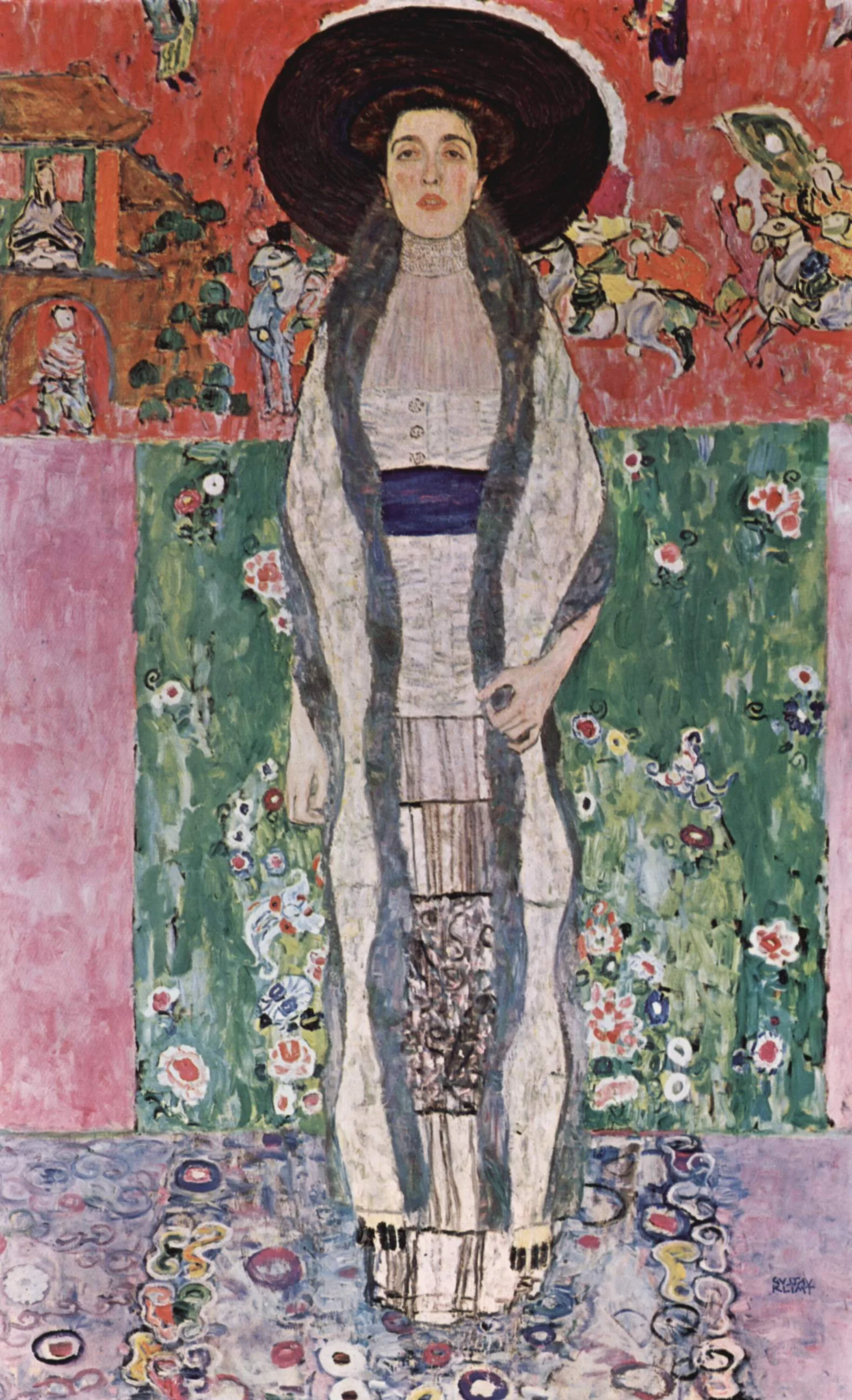
Adele's pale face appears beneath the dark hat, her eyes directed toward us. The daughter of a Viennese banking executive, she helped establish a salon where writers, musicians and artists met. The Klimt Foundation records her financial support for social democrats as well. This patron had interests beyond her own portrait.
02
The black gives her an edge
The hat's broad right brim forms a dark oval against the red background. The Klimt Foundation identifies its feather trimming and describes the hat as the strongest separation between sitter and surroundings. Elsewhere, her patterned clothing merges more readily with the setting. The brim gives her head a firm outline.
03
The dress was a decision
A blue sash crosses the pale dress at her waist. Klimt's surviving studies record Adele in different dresses, according to the Klimt Foundation. The finished outfit followed choices made during the sittings. Against the dense little marks of the bodice, this plain blue band makes one clear horizontal division.
04
A fortune behind the ring
Her left hand lies against the long scarf, with a large dark ring on one finger. MoMA places this formal portrait within the wealthy world Adele shared with her industrialist husband, Ferdinand. The jewelry belongs to that public presentation. Her fingers remain still beside the busy surface of the cloth.
05
The riders came from elsewhere
Mounted figures cross the red panel to the right of her head. The Klimt Foundation connects such Asian motifs with art objects the painter collected and studied. These are elements of his constructed setting, not people present at the sitting. A horse and rider occupy the space beside her shoulder.
06
Color followed the years of gold
White-edged flowers interrupt the green field beside the lower skirt. In its exhibition account, the Neue Galerie connects this portrait's strong colors with Impressionism. The earlier gold portrait had given Adele a different setting. Here the red flower centers remain separate marks against uneven green paint.
07
Standing began on cheap paper
The long hem meets a floor filled with small colored shapes. A preparatory drawing at the Wien Museum, dated 1911, studies a standing woman in a long gown using pencil on packing paper. The museum links it to this portrait. The final dress almost hides where her feet meet the floor.
Our take
Adele stands almost the full height of the canvas, dressed for a room more formal than the one Klimt gives her. Behind her, mounted figures cross a red panel; flowers fill a green rectangle below. The floor has another pattern altogether. Her pale face and enormous dark hat remain easy to find. The rest keeps changing scale.
This was Klimt's second formal portrait of Adele Bloch-Bauer, completed five years after the first portrait's gold-covered surface. She and her husband were important patrons, and Klimt belonged to the social world they helped assemble. MoMA reads this later image as an assertion of her place in Vienna's cultural elite. The painting gives her considerable height, expensive clothing and a steady gaze. Around that carefully presented woman, tiny riders pass at shoulder level.
The painter's moment
1862–1918Painted it at 50Art Nouveau; late period
In 1912, Gustav Klimt returned to a sitter whose family had supported him for years. Ferdinand had commissioned Adele's first portrait in 1903; Klimt finished it in 1907. Their relationship extended beyond business. The painter attended dinners and concerts with the couple, and in 1910 he and Adele were among a group hearing Mahler's Third Symphony in Munich. He also visited their estate near Prague. The second portrait therefore grew from an established acquaintance, at a point when his painting was moving away from the gold surfaces that had made the first Adele so distinctive. Familiar patronage left room for a changed picture.
Preparatory drawings considered her standing in different dresses, and the portrait appeared at Munich's international art exhibition in June 1913. Although commonly dated 1912, the Belvedere now gives 1912–13. Its later history belongs to the destruction of the Bloch-Bauers' world: the Nazis seized the family's pictures in 1938, and this canvas eventually entered the Belvedere. After a prolonged restitution struggle, it was returned in 2006 to the family's heirs, including Maria Altmann, and sold that year. It remains privately owned. A return to the Belvedere in 2023 was a temporary visit for research, conservation and exhibition, not a reversal of the restitution.
In its time
Adele Bloch-Bauer II was painted in 1912, when Klimt was 50. Where it stands on Art Through Time:
Its colors
Elsewhere in the world
- 1910The Mexican RevolutionA decade of upheaval; the muralists will paint its history.
- 1911The Xinhai RevolutionTwo thousand years of empire end in China.
- 1913The Armory ShowEuropean modernism shocks New York.
- 1913Tagore wins the Nobel PrizeThe first Nobel laureate from outside Europe.
- 1914The First World WarExpressionists and Dadaists answer the catastrophe.
The facts
- Title
- Adele Bloch-Bauer II
- Artist
- Gustav Klimt (1862–1918)
- Date
- 1912
- Original medium
- Oil on canvas
- Style
- Art Nouveau; late period
- Made in
- Austria
- Collection
- Private collection
Living with it
The mood
The tall pale dress divides a wall into a strong central figure and blocks of patterned color. Red dominates above, green below, with a dark hat near the top. The portrait brings the scale of a standing person into the room.
The palette
Slate and rose run through the dress, scarf and patterned floor; sage softens the green panel. Clay echoes the warmer background, while walnut belongs to the hat's deepest passages. From across a room, the dark hat above the pale dress is the clearest contrast.
Who it finds
- For someone who has dressed carefully for a room full of acquaintances; Adele's formal face stays composed amid the patterned surroundings.
- For someone who has gathered friends from different parts of life around one table; her salon was part of her work.
- For someone whose family has fought to recover something taken from them; the portrait's later history includes years of that effort.
See it in a room
Your photo is never uploaded, and it's gone when you leave.
At a distance, Adele's height and the hat establish the portrait before the smaller motifs become legible. Nearby, the mounted figures and separate flower marks reward a slower look. A larger vertical print preserves that difference in scale; a small one would give most of its space to the dress.
A living room or a broad hallway can accommodate the long figure with some air around it. Choose a position where the top of the portrait stays visible rather than disappearing above a tall cabinet. Plain upholstery nearby helps distinguish the painted textiles from the room's own patterns. Let the red and green remain the busy surfaces.
How we make it
- True to the original
- Each file is color-matched to the museum original. If the color isn't right, we print it again, with our compliments.
- On canvas
- Fine-art canvas hand-stretched over a ¾″ solid-wood frame, with mirrored edges so nothing is lost.
- In our floating frame
- Our stretched canvas set in a slim floating frame, with a shadow gap so the painting seems to hover.
- As a framed print
- Archival pigment print on museum-grade cotton paper, in a solid-wood frame with UV-protective glazing.
- Ready to hang on arrival
- It arrives with the hanging hardware attached. No framer, no guesswork.
- Perfect on arrival
- If anything arrives damaged or not as you ordered, send us a photo within 7 days of delivery and we'll make it again, with our compliments.
In this portrait of 1912–13, Adele's pale dress divides red from green. Allow the tall figure enough space for the smaller patterns.

.jpeg&w=200)



.jpg&w=200)