The story · 4 min read
He hides his face, she closes her eyes, and neither needs to see.
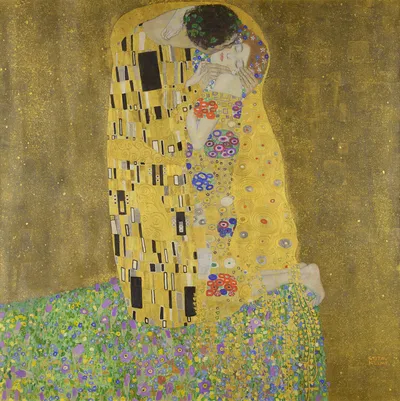
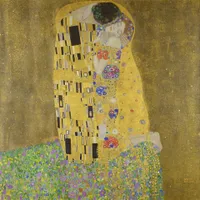
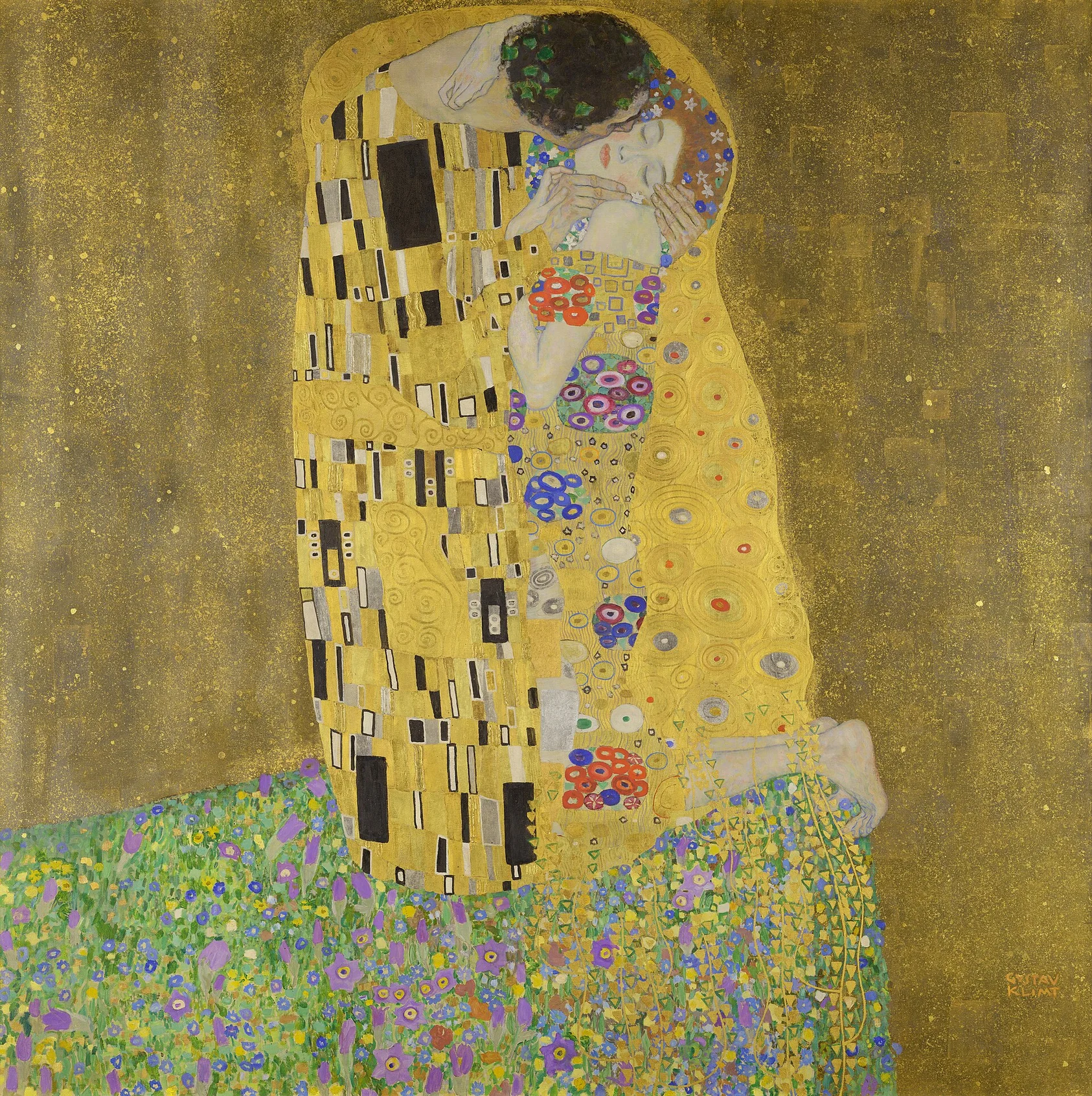
The Kiss, 1907. Gustav Klimt. Österreichische Galerie Belvedere.
Look closer
7 things to notice
 1
01
Eyes shut, lost in it
Her pale face is turned up against his shoulder, eyes shut, lips closed and red, her cheek pressed to his. Some have read the scene as Apollo kissing Daphne, from Ovid's Metamorphoses. Some art historians see Orpheus and Eurydice instead, and in that reading she looks slightly see-through, as if she is already fading away.
02
The man who keeps his face
We never see his face. He bends down to her cheek, his dark curls crowned with vine leaves and pushed almost against the top edge, and that crowding against the frame has been read as a sign of Japanese prints' influence. Who he is, he keeps to himself: many scholars see Klimt and Emilie Flöge, his companion for life, though the two were probably never lovers.
03
Held as if she might break
Two long-fingered hands hold her face, one under her chin and one on her far cheek. It looks like the way you hold something you are afraid of breaking. In a picture made of gold and pattern, this seems the plainest and gentlest thing in it.
04
A cloak of hard edges
His robe is covered in upright black, white and silver rectangles, some set one inside another, with thin gold lines curling into soft spirals between them. Some of the painting's shine is real metal: on top of the oil, Klimt added gold leaf, silver and platinum. Next to her flowers it reads, to us, like a wall of hard edges that has something soft inside it.
05
She is all in bloom
Her dress is crowded with round, flower-like shapes in purple, pink, blue and red, packed as close as a garden bed. Where his robe stands in blocks, hers blooms in circles, and the two patterns seem to touch without ever mixing. It is as if Klimt had to find a separate language for each of them before he could join them.
06
Toes curled over the edge
Her pale bare feet reach the right edge of the meadow, toes curled over the last of the flowers. Just below them the meadow ends, and there is nothing but plain gold. Her toes seem to be holding on: whatever this kiss is, it happens at the very brink.
07
Gold from old churches
Behind them the gold is flat and brownish, covered in tiny bright specks, with faint squares showing through. It has been read as calling to mind the gold grounds of the Middle Ages: the shining pages of hand-decorated books, and the walls of early mosaics. Klimt's gold leaf came out of a trip to Italy in 1903, where in Ravenna he saw the Byzantine mosaics of the Church of San Vitale.
Our take
The Kiss is a painting of two people becoming one shape. Gustav Klimt wraps a kneeling couple in one cloak of gold, then hides almost everything. His face is turned away, her eyes are shut, and the kiss lands on her cheek, not her mouth. One of them has hidden his face and the other has closed her eyes, and neither needs to see.
It is also a painting of an edge. The meadow stops just under her bare feet, and past it there is only gold, as if their whole world were the small bank of flowers they kneel on. His robe is all hard upright blocks and hers is all round flowers. Klimt seems to paint how different two people are, and then fold one golden shape around them both.
The painter's moment
1862–1918Painted it at 45Symbolism
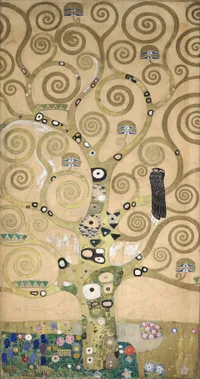
Klimt was about 45. The Kiss came soon after his three ceiling paintings for the University of Vienna, which had caused a scandal. Gold ran in the family: his father was a gold engraver from a farming family in Bohemia. These were his golden years, the years of Portrait of Adele Bloch-Bauer I in 1907 and of the Stoclet Frieze, and of five pictures of society women wrapped in fur painted between 1907 and 1909. The couple in each other's arms was not new to him. He had already used it in the Beethoven Frieze, and it appears in the Stoclet Frieze as well.
The Kiss was first shown in Vienna at the Kunstschau of 1908, where the catalogue called it Liebespaar, meaning 'the lovers'. The Austrian government bought it at that exhibition while it was still unfinished, and it has belonged to the Belvedere ever since. It hangs in the Upper Belvedere Palace in Vienna. Critics praised the work of his golden phase, and it made him money. A century later the picture was still everywhere: a Google Doodle for his 150th birthday in 2012, an image the Syrian artist Tammam Azzam placed onto a bombed building in 2013, and in 2016 the last coin in the Austrian Mint's gold series 'Klimt and His Women'.
In its time
The Kiss was painted in 1907, when Klimt was 45. Where it stands on Art Through Time:
Its colors
Elsewhere in the world
- 1904The Herero and Nama genocideGerman troops kill tens of thousands in Namibia.
- 1905Partition of BengalSwadeshi protest inspires the Bengal School.
- 1910The Mexican RevolutionA decade of upheaval; the muralists will paint its history.
- 1910Japan annexes KoreaThe end of the Joseon dynasty.
- c. 1910The Stolen GenerationsFor six decades, Aboriginal children are taken from their families.
The facts
- Title
- The Kiss
- Artist
- Gustav Klimt (1862–1918)
- Date
- 1907
- Original medium
- Oil on canvas
- Style
- Symbolism
- Made in
- Austria
- Collection
- Österreichische Galerie Belvedere
Living with it
The mood
Warm and close, like a room with the curtains drawn and one lamp lit. It doesn't fill a room with romance; it narrows it down to two people. The gold glows rather than glitters, and it glows more as the light goes.
The palette
Almost all of it is gold in different moods, from bronze in the shadows to bright gilt where the light catches, with a cool green-grey running through it like lichen on old metal. What breaks the gold is small: the purple, blue and red of the meadow and her flowered dress.
Who it finds
- Anyone who has closed their eyes during a kiss and felt the rest of the world go quiet.
- Two people who have held on to each other at the edge of something. The meadow ends under her feet, and they stay anyway.
- Anyone who has loved someone for years without ever quite naming what it was. Klimt and Emilie Flöge were close for a lifetime, and probably never lovers.
See it in a room
Your photo is never uploaded, and it's gone when you leave.
From across the room it is one golden shape, two people folded into a single form against the gold. Up close it opens into the small things: the hands on her face, the flowers in her hair, the rectangles and spirals on his robe, her toes curled over the last of the meadow.
Hang it where two people end the day: a bedroom, above a bed, a sitting room in the evening. The original is a perfect square, 180 centimetres a side, so give it space on all four sides, and choose a size large enough that the hands on her face can be read from where you sit.
How we make it
- True to the original
- Each file is color-matched to the museum original. If the color isn't right, we print it again, with our compliments.
- On canvas
- Fine-art canvas hand-stretched over a ¾″ solid-wood frame, with mirrored edges so nothing is lost.
- In our floating frame
- Our stretched canvas set in a slim floating frame, with a shadow gap so the painting seems to hover.
- As a framed print
- Archival pigment print on museum-grade cotton paper, in a solid-wood frame with UV-protective glazing.
- Ready to hang on arrival
- It arrives with the hanging hardware attached. No framer, no guesswork.
- Perfect on arrival
- If anything arrives damaged or not as you ordered, send us a photo within 7 days of delivery and we'll make it again, with our compliments.
Klimt began them in 1907, and they haven't let go of each other since. Give them a wall to hold on to.