The story · 4 min read
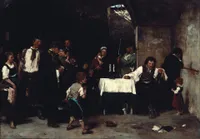
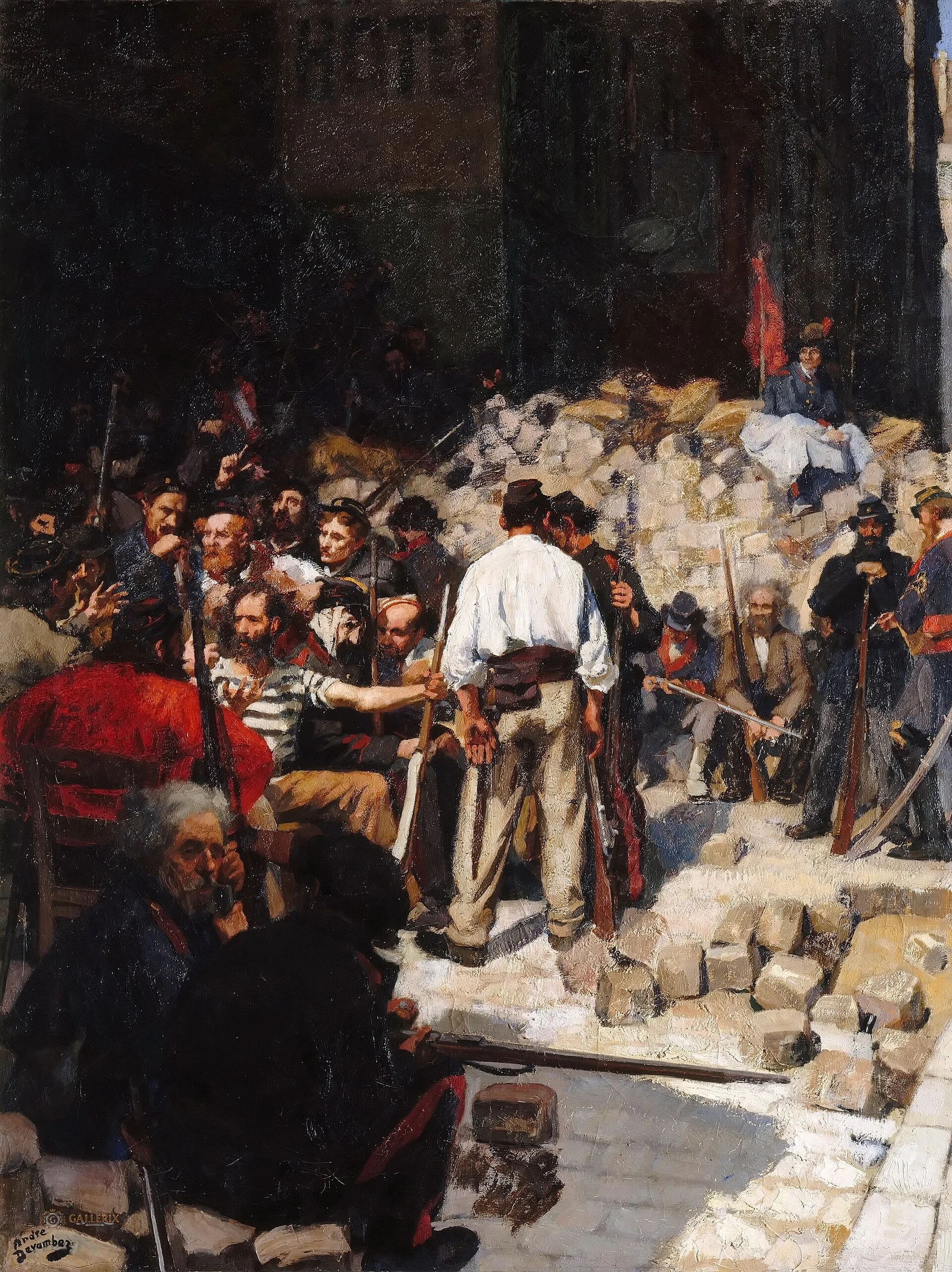
The barricade is ready; its defenders still have time to talk.
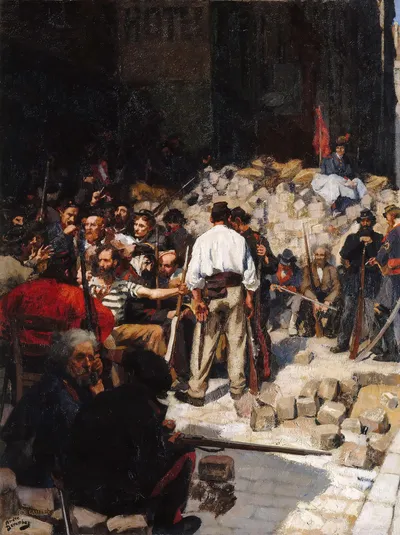
Barricade, the Paris Commune, May 1871, 1911. André Devambez. Musée national des châteaux de Versailles et de Trianon.
Look closer
7 things to notice
 1
01
A back takes the central place
The man in the white shirt faces away from us, his hands low and his cap dark against the stones. The Musée historique de l'environnement urbain identifies the moment as waiting before action. His empty hand belongs to the pause before he needs the rifle beside him.
02
The talk has not run out
The striped-shirted man extends one arm across the seated group, his other hand open near his chest. The urban history museum connects this gathering with Devambez's recurring interest in crowds. The gestures seem to continue a disagreement despite the shared danger; several faces attend to the man whose pale forearm crosses the group.
03
The nearest man looks away
An older man sits low in the foreground, his fingers against his cheek, gray hair and beard surrounding a shadowed face. Devambez was born in 1867 and painted this in 1911. The Paris Commune painting belongs to his adult reconstruction of a childhood event; this worn face was imagined forty years afterward.
04
A weapon waits across the knees
A long rifle crosses the lower foreground above the pale street. The Musée de l'Armée dates the final fighting to 21–28 May 1871, when government troops recovered Paris district by district. Devambez puts us before that violence, close enough to the seated defender to look along his idle weapon.
05
Red remains above the waiting
A red flag hangs beside the upper defender, a narrow strip against the dark wall. The painting dates to 1911, forty years after the events named in its title. Devambez knew the Commune's outcome when he put this small red marker above people who were still waiting for it.
06
The highest seat is still a seat
A figure in blue and white sits high on the barricade, pale trousers bright against the stones. The alternative title, L'Attente, names the waiting that the urban history museum identifies as the subject. Even the person with the clearest view beyond the barrier has found a place to sit.
07
The street becomes a wall
Pale squared stones occupy the lower right, their exposed sides facing different directions. The urban history museum identifies the material as paving lifted from the street. The same blocks that once carried ordinary journeys now stand between the seated men and anyone coming toward them.
Our take
Waiting leaves room for an argument. In Devambez's Paris Commune painting, a man in a striped shirt gestures across the group while another stands with his back to us. Rifles are close at hand. Above them, a seated figure watches from the piled stones. No attacker has entered the picture. The men still have each other to look at.
Devambez painted this scene in 1911, forty years after the Commune's final struggle in May 1871. He had been a small child when it happened. The Musée historique de l'environnement urbain describes the picture as a scene of everyday life within the uprising: people waiting beside a barricade made from their street. The pale paving stones occupy almost as much space as the men. A narrow strip of daylight reaches the standing man's white shirt.
The painter's moment
1867–1944Painted it at 44History painting
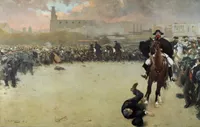
By 1911, André Devambez had made Parisian crowds a recurring subject. His training had led through the École des Beaux-Arts and the Prix de Rome, which he won in 1890, toward the established career of a history painter. The city around him supplied other stories. In La Charge, painted in 1902–03, he looked down on a nighttime confrontation between police and demonstrators on boulevard Montmartre. The people became small within a long view of the street. Here the observer comes close enough to distinguish shirts, faces and a hand beside a trouser leg. The barrier cuts off the street beyond.
The 1911 canvas looks back to May 1871, when troops from Versailles ended the Commune during the week of fighting and repression called the Bloody Week. Devambez was born in 1867, too young to have watched it with an adult painter's understanding. His reconstruction chooses the interval before an attack, giving its defenders several different ways of passing time. The French state acquired the painting, now in the Château de Versailles collection. Its other title, L'Attente, keeps the emphasis on waiting. Four years later, Devambez was wounded by a shell at Amiens while serving in the First World War. His leg and left eye were injured. His own war continued in a hospital bed.
In its time
Barricade, the Paris Commune, May 1871 was painted in 1911, when Devambez was 44. Where it stands on Art Through Time:
Its colors
Elsewhere in the world
- 1910The Mexican RevolutionA decade of upheaval; the muralists will paint its history.
- 1910Japan annexes KoreaThe end of the Joseon dynasty.
- c. 1910The Stolen GenerationsFor six decades, Aboriginal children are taken from their families.
- 1911The Xinhai RevolutionTwo thousand years of empire end in China.
- 1914The First World WarExpressionists and Dadaists answer the catastrophe.
The facts
- Title
- Barricade, the Paris Commune, May 1871
- Artist
- André Devambez (1867–1944)
- Date
- 1911
- Original medium
- Oil on canvas
- Style
- History painting
- Made in
- France
- Collection
- Musée national des châteaux de Versailles et de Trianon
Living with it
The mood
The upper half is almost black, while light falls across the white shirt and pale stones below. Small areas of red punctuate the group. In a room, the tall image begins as a division between dark architecture and sunlit street.
The palette
Charcoal and bark occupy the high wall and shadowed crowd. Walnut warms clothing and faces; clay gives the paving its shaded sides. Linen belongs to the shirt and brightest stones. Across a room, that pale lower half carries the image.
Who it finds
- For someone who remembers the talk before a difficult undertaking; the men still have time to address one another.
- For someone who has known a city through its streets; familiar paving has become a barrier across the way.
- For someone who notices the oldest person in a group; a gray-haired man occupies the nearest chair.
See it in a room
Your photo is never uploaded, and it's gone when you leave.
From farther away, the white shirt becomes a single person between the dark crowd and the light stones. Closer, the different hands and the seated man's face at lower left become distinct. An open approach lets these smaller exchanges emerge after the broad division of light and shade.
A tall space in a study or living room suits the upright composition. Give the print enough height for the figures to remain readable, especially the upper lookout and the older man near the bottom. Keep its lower edge clear of furniture: the long rifle and scattered stones occupy that part of the scene.
How we make it
- True to the original
- Each file is color-matched to the museum original. If the color isn't right, we print it again, with our compliments.
- On canvas
- Fine-art canvas hand-stretched over a ¾″ solid-wood frame, with mirrored edges so nothing is lost.
- In our floating frame
- Our stretched canvas set in a slim floating frame, with a shadow gap so the painting seems to hover.
- As a framed print
- Archival pigment print on museum-grade cotton paper, in a solid-wood frame with UV-protective glazing.
- Ready to hang on arrival
- It arrives with the hanging hardware attached. No framer, no guesswork.
- Perfect on arrival
- If anything arrives damaged or not as you ordered, send us a photo within 7 days of delivery and we'll make it again, with our compliments.
Painted in 1911, forty years after the Commune, these defenders are still waiting. Leave room below them for the scattered street stones.