The story · 3 min read
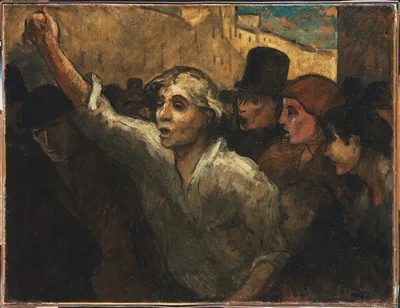
One raised arm gives a crowded street a direction.
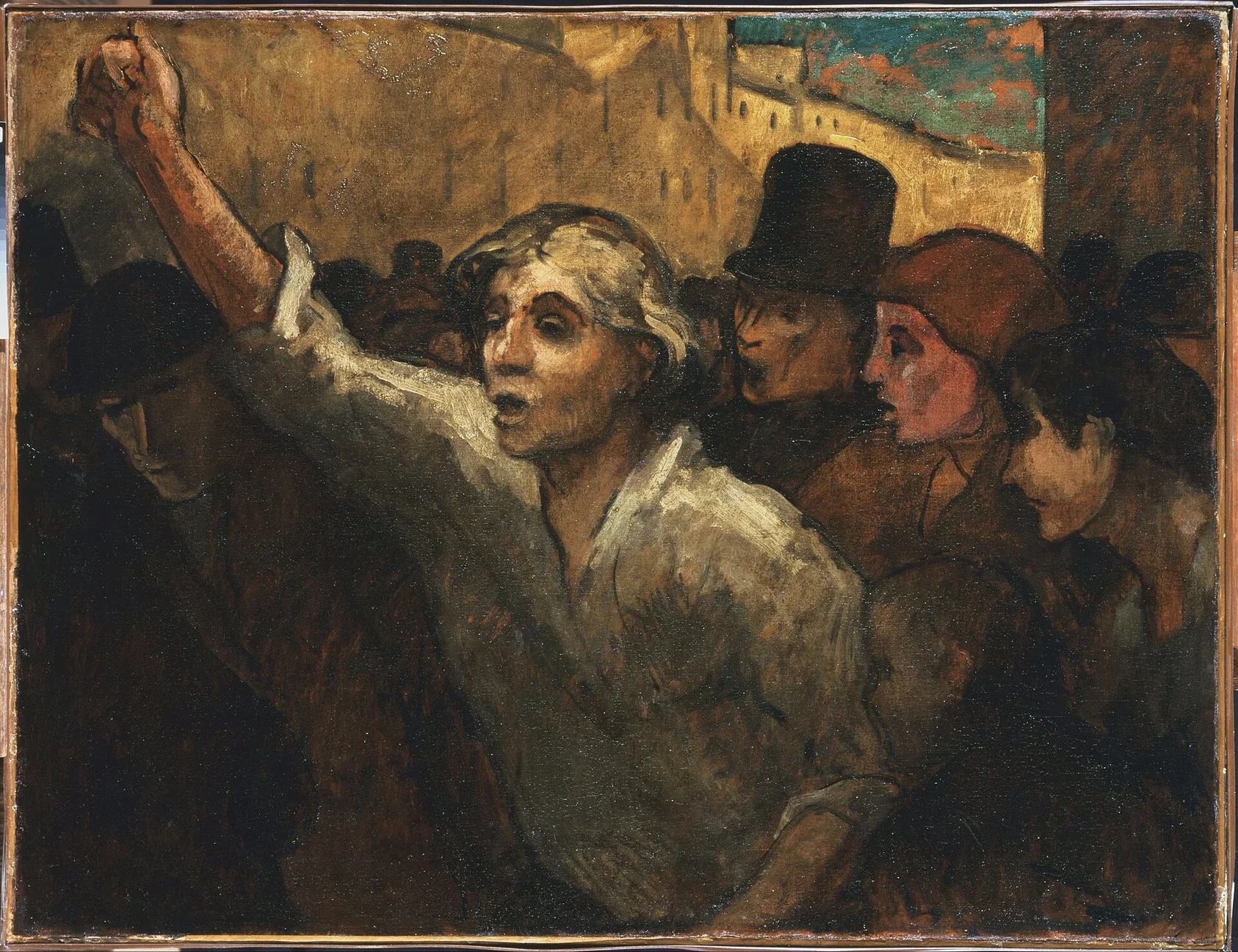
The Uprising (L'Emeute), Undated (1808–1879). Honoré Daumier. The Phillips Collection, Washington, D.C..
Look closer
7 things to notice
 1
01
The shout has a face
The central face is lit beneath a pale cap, with dark eyes and an open mouth. Henri Focillon read this figure's attention as inward, absorbed by the idea that gathers the crowd. The eyes do not fix on us. The mouth is a small dark opening below them.
02
A fist finds the upper edge
The raised hand closes into a fist near the top left, dark strokes separating the fingers. Duncan Phillips understood this figure as accumulated human indignation given a body. The gesture has very little sky around it. Knuckles stop just short of the painted edge.
03
The drawing survives the paint
Black strokes run through the pale shirt at the center. The Phillips teaching guide reports charcoal and lithographic crayon in the painting's dark drawing, visible beneath thin color. Daumier brought materials familiar from drawing into this oil painting. The shirt remains open to the lines beneath it.
04
A neighbor nearly disappears
The man at the left lowers his face beneath a broad black hat. The Phillips Collection reads this side's deep shadow as a device that compresses the group. His cheek catches enough light to distinguish him from the coat beside it. A face survives inside the dark mass.
05
Separate faces share the space
A black top hat and a red cap rise above two faces to the right of the central figure. The Phillips teaching guide cautions that these are not identifiable historical people. Each has different features without supplying a name. The red cap comes down close to its wearer's brow.
06
The street loses its distance
Ochre building fronts fill the upper middle, their windows reduced to small dark strokes. The Phillips Collection describes the architecture as narrowing the crowd's space. The street behind cannot open into a broad view. Its few windows remain above the approaching heads.
07
The wall closes one side
A dark upright wall borders the street at the right. In the museum's account, this vertical barrier makes the crowd's confinement more forceful. For Daumier, The Uprising needs very little setting to become a human encounter. The wall ends against a nearby black hat.
Our take
The crowd arrives without leaving us anywhere to stand. For Daumier, The Uprising begins with a figure in white, an open mouth and an arm raised above the surrounding hats. The buildings narrow the space behind the people. Their bodies fill the lower edge before any destination comes into view. We meet them at shoulder height.
The Phillips Collection dates the canvas to 1848 or later and connects it, cautiously, to the revolution that overthrew Louis-Philippe. Daumier left the work unfinished. Duncan Phillips admired that unresolved surface, according to the museum's teaching guide, finding it suited the force of the scene. Drawing remains visible through the paint. A black line at the white shirt's edge still does the work of separating one body from the next.
The painter's moment
1808–1879Realism
The king whose caricature had sent Honoré Daumier to prison lost his throne in February 1848. Daumier had served six months in 1832 after attacking Louis-Philippe in print; tighter censorship in 1835 had redirected much of his newspaper work toward social satire. The new republic briefly offered different possibilities. In 1848 he entered a government competition for an image of the Republic, placing eleventh among twenty designs. He was also giving more time to oil painting. A man known for pictures readers could buy with a newspaper was working toward paintings large enough to confront them across a room.
Lorenz Eitner places The Uprising among the unfinished projects of this period. The precise date remains uncertain, and the sources do not establish why Daumier stopped. Its thin paint and dark drawing leave parts of the making visible. Daumier exhibited other oils at the Salons of 1849 and 1850–51, but critics paid them little attention. The Uprising eventually found a different advocate in Duncan Phillips, who acquired it in 1925 for his Washington collection. Phillips repeatedly ranked it among his most valued paintings. The crowded street had survived the painter's death and decades of neglect. Its central figure still advances with one arm raised.
In its time
No date is recorded for The Uprising (L'Emeute); Daumier lived from 1808 to 1879. Where it stands on Art Through Time:
Its colors
The facts
- Title
- The Uprising (L'Emeute)
- Artist
- Honoré Daumier (1808–1879)
- Date
- Undated (1808–1879)
- Original medium
- Oil on canvas
- Style
- Realism
- Made in
- France
- Collection
- The Phillips Collection, Washington, D.C.
Living with it
The mood
A white shirt appears first within the broad brown crowd. The raised arm sends the eye toward the upper corner, then back through the faces. In a room, the image feels close, with almost no empty space between people and painted edge.
The palette
Charcoal gives the hats and outlines their weight. Clay and walnut warm the faces, with bark in the surrounding coats. Ochre belongs to the buildings behind. The pale shirt interrupts these earth colors and stays visible from the far side of a room.
Who it finds
- For someone who has found their voice among other people; the open mouth belongs to one face within a crowd.
- For someone who has worked a thought out by drawing; the shirt still carries the marks that built it.
- For someone who remembers standing shoulder to shoulder in a narrow street; the buildings leave little space behind these heads.
See it in a room
Your photo is never uploaded, and it's gone when you leave.
From a doorway, the arm and white shirt form the clearest shape. Nearer, the separate faces and the rough dark drawing become more distinct. Place the image where someone can approach it without furniture cutting across the lower edge, where the crowd comes closest to the viewer.
A study or living room with a clear wall gives the raised fist room above the heads. A medium or larger print makes the visible drawing in the shirt easier to inspect. Keep nearby objects few: the painting already contains a dense group, and its small windows need the surrounding wall's open space.
How we make it
- True to the original
- Each file is color-matched to the museum original. If the color isn't right, we print it again, with our compliments.
- On canvas
- Fine-art canvas hand-stretched over a ¾″ solid-wood frame, with mirrored edges so nothing is lost.
- In our floating frame
- Our stretched canvas set in a slim floating frame, with a shadow gap so the painting seems to hover.
- As a framed print
- Archival pigment print on museum-grade cotton paper, in a solid-wood frame with UV-protective glazing.
- Ready to hang on arrival
- It arrives with the hanging hardware attached. No framer, no guesswork.
- Perfect on arrival
- If anything arrives damaged or not as you ordered, send us a photo within 7 days of delivery and we'll make it again, with our compliments.
Painted in 1848 or later, this street comes close before its destination appears. Give the raised arm open wall above the crowd.



.jpg&w=200)

.jpg&w=200)