The story · 3 min read
The basket is filling; the street gives him less and less cover.
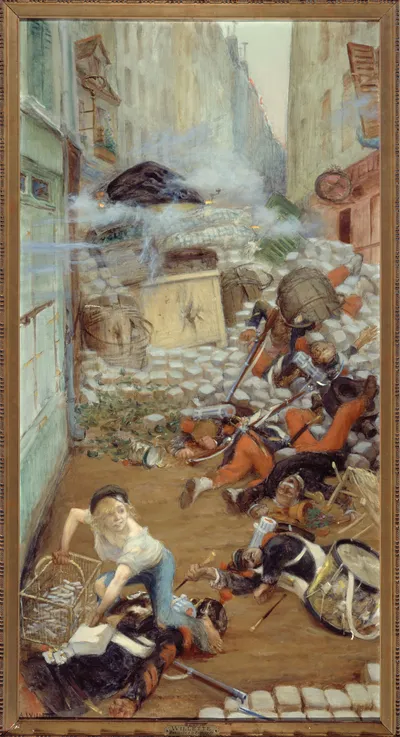
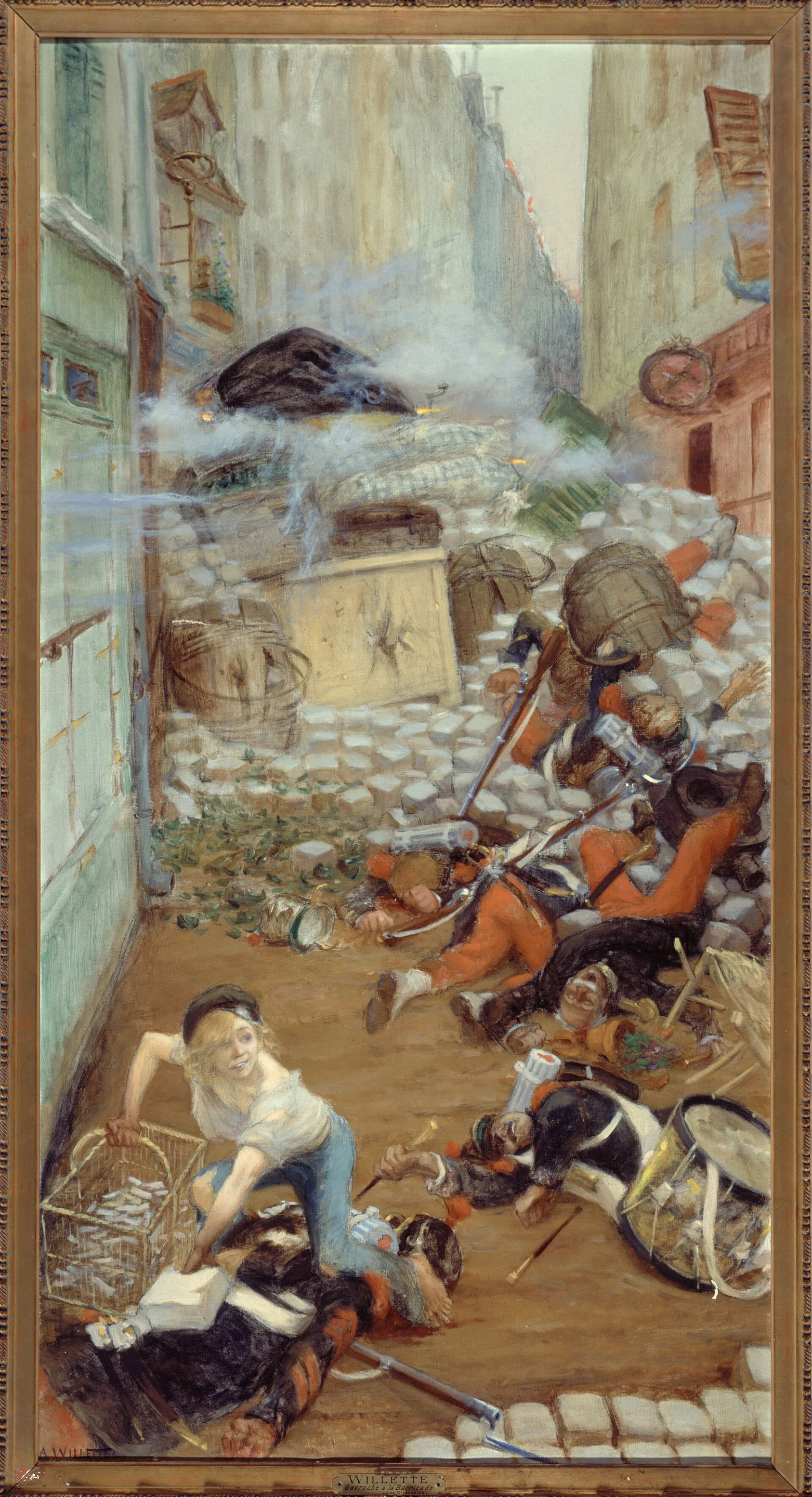
Gavroche ramassant des balles pour la barricade, 1903. Adolphe Willette. Maisons de Victor Hugo Paris–Guernsey, Maison de Victor Hugo, Paris.
Look closer
7 things to notice
 1
01
The song has not stopped
Gavroche's mouth opens below his cap, with one eye partly screened by pale hair. In Hugo's episode he sings while collecting cartridges and is killed before the task is done. Willette chooses the living face inside that fatal sequence. The small teeth remain visible in the open mouth.
02
A basket meant for something else
Pale cartridges lie across the bottom of the wicker basket beside the boy. The museum connects the image to the chapter in which he empties soldiers' ammunition pouches. An ordinary container becomes part of the fighting. Its curved handle remains just below his hand.
03
He steps where others fell
A bare foot finds space beside a fallen soldier, below the boy's blue trouser leg. Hugo sends Gavroche out because the barricade's ammunition is running short. The task takes him among the bodies left in the street. His toes touch the ground beside the uniform.
04
The dead have left their equipment
A soldier lies below the barricade with a strapped container beside him. The passage identified by the museum describes Gavroche moving between dead men and emptying their cartridge pouches. The painting gives that supply a human cost. A pale cuff remains beside the dark uniform.
05
A home has become a defense
Barrels, pale stones and furniture block the street beneath trails of smoke. Hugo's fictional barricade belongs to the failed republican uprising of June 1832. Household objects acquire a public use in Willette's reconstruction. A broad wooden panel stands among the piled stones.
06
No one beats the drum
A drum lies on its side at right, its pale head above a yellow-brown shell. This is Willette's addition to the equipment around Hugo's fallen soldiers, visible in the painted street rather than named in the museum's quoted passage. The loose cords cross a silent surface.
07
The windows still have flowers
A flower box sits under an upper window, above the firing and overturned furniture. The scene belongs to an illustrated novel, not a surviving view of this exact street. Willette keeps domestic life in the architecture around the barricade. Small purple flowers remain against the pale wall.
Our take
The boy smiles among people who will never get up. This is Gavroche in Les Misérables, outside the barricade collecting ammunition from dead soldiers. Hugo placed the episode in the June Rebellion of 1832, four decades after the French Revolution began. Willette makes the street steep and narrow, with the child nearest us. He still has a job to finish.
Paul Meurice commissioned the painting for the new museum devoted to Hugo, but it seems to have arrived late. Letters mentioned Willette's poor health; the work appeared at the Salon in 1905 before its documented place in a museum catalog. The museum dates it 1903–1905. A delayed tribute preserves a boy already running out of time, one hand down beside the open basket.
The painter's moment
1857–1926Painted it at 46Literary illustration in oil
A new museum gave Adolphe Willette a reason to return to Hugo's street child. Paul Meurice, Hugo's friend and literary executor, had proposed a museum to the City of Paris in 1901. He gathered the writer's drawings, books and furnishings, and commissioned artists to make pictures inspired by his work. The museum opened in 1903 in Hugo's former home on the Place des Vosges. Willette had trained under Alexandre Cabanel and worked extensively as an illustrator, caricaturist and decorator. A scene from Les Misérables belonged to that experience of telling a story through a single arrangement of bodies, clothing and objects.
The painting's arrival is less straightforward than its recorded donation date of 1903 suggests. It was absent from the opening publication and a guide issued the next year. In 1905 Willette exhibited it under the title La Mort de Gavroche, and it appears in the museum's 1907 catalog. The collection record therefore proposes delivery after the Salon and connects the delay with letters about his health. It dates the work between 1903 and 1905. The title anticipates a death that has not yet occurred in the foreground. Beyond the smiling child, Willette fills a tall canvas with the distance between the basket and the barricade.
In its time
Gavroche ramassant des balles pour la barricade was painted in 1903, when Willette was 46. Where it stands on Art Through Time:
Its colors
Elsewhere in the world
- 1897Benin City is burnedBritish troops loot thousands of bronzes, now in museums worldwide.
- 1898The Philippines declares independenceThe U.S. takes the islands instead; some 200,000 Filipino civilians die in the war that follows.
- 1901Australia becomes a nationSix colonies federate on ancient land.
- 1904The Herero and Nama genocideGerman troops kill tens of thousands in Namibia.
- 1905Partition of BengalSwadeshi protest inspires the Bengal School.
The facts
- Title
- Gavroche ramassant des balles pour la barricade
- Artist
- Adolphe Willette (1857–1926)
- Date
- 1903
- Original medium
- Oil on canvas
- Style
- Literary illustration in oil
- Made in
- France
- Collection
- Maisons de Victor Hugo Paris–Guernsey, Maison de Victor Hugo, Paris
Living with it
The mood
A narrow street rises above the boy, with pale walls occupying much of the upper picture. Below, bodies and scattered equipment interrupt the brown ground. The tall format makes the distance from his face to the barricade part of the room's first view.
The palette
Bronze and walnut gather in the earth, barrels and uniforms. Khaki and flax soften the stonework, while sage belongs to the pale greenish walls and smoke. From a distance, that cool upper street separates from the warmer ground around the boy.
Who it finds
- For someone who remembers a child insisting on helping with an adult task; Gavroche has found a basket.
- For someone who has returned to a novel and dreaded a familiar page; the boy is still smiling here.
- For someone who notices the ordinary objects left after a crisis; barrels, a drum and flower boxes occupy this street.
See it in a room
Your photo is never uploaded, and it's gone when you leave.
From across a room, the tall street and diagonal barricade establish the scene before the small objects become clear. Closer, the basket's cartridges and the boy's bare feet give the danger its scale. Keep the lower portion unobstructed; the human center sits much nearer the bottom than the middle.
A narrow wall in a study or reading room suits this unusually tall image. Give it enough height for Gavroche's expression to remain readable without making the top of the street difficult to inspect. A position beside a low chair allows both the long view and a closer look at the foreground.
How we make it
- True to the original
- Each file is color-matched to the museum original. If the color isn't right, we print it again, with our compliments.
- On canvas
- Fine-art canvas hand-stretched over a ¾″ solid-wood frame, with mirrored edges so nothing is lost.
- In our floating frame
- Our stretched canvas set in a slim floating frame, with a shadow gap so the painting seems to hover.
- As a framed print
- Archival pigment print on museum-grade cotton paper, in a solid-wood frame with UV-protective glazing.
- Ready to hang on arrival
- It arrives with the hanging hardware attached. No framer, no guesswork.
- Perfect on arrival
- If anything arrives damaged or not as you ordered, send us a photo within 7 days of delivery and we'll make it again, with our compliments.
Willette's 1903–1905 street rises far above Gavroche's basket. Hang the tall image where his small face can be met at close range.