The story · 4 min read
She can see the world. She cannot yet take part.
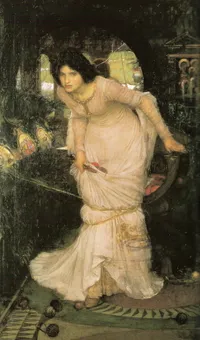
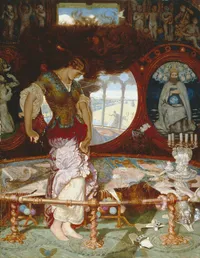
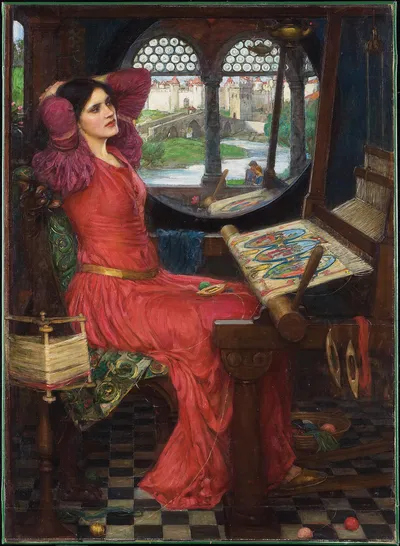
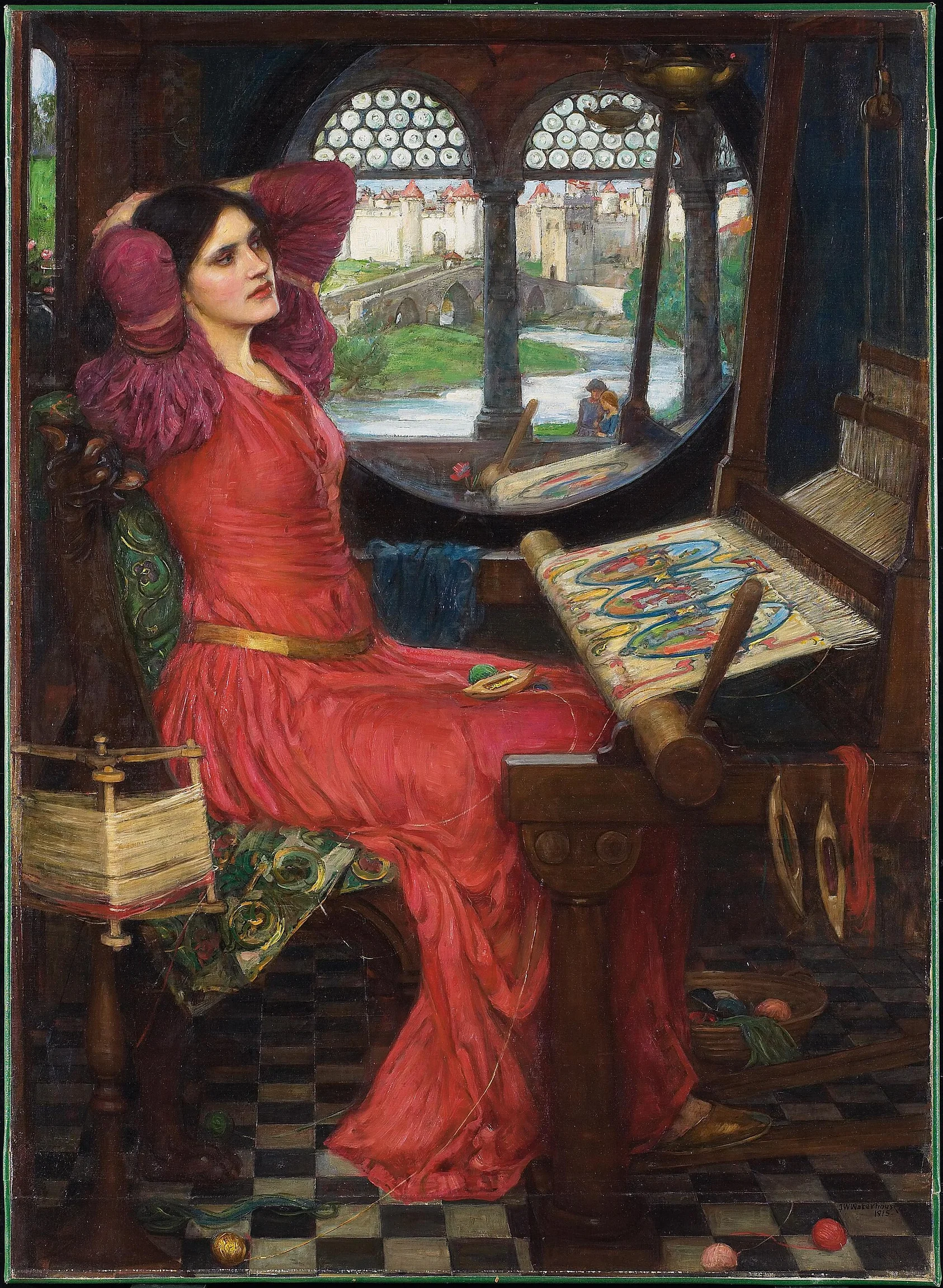
"I am half sick of shadows" said the Lady of Shalott, 1916. John William Waterhouse. Art Gallery of Ontario, Toronto.
Look closer
7 things to notice
 1
01
The complaint reaches her face
Her lips part beneath flushed cheeks, while her eyes look away from the loom. In the AGO's exhibition reading by Alain de Botton and John Armstrong, the picture concerns being occupied yet excluded from life. That reading has a visible point of contact here: the work is ready, but her attention has left it.
02
Two people have each other
A man and woman appear near the bottom of the mirror, close beside the river. Elizabeth Nelson identifies this as the sight of Tennyson's newly married lovers that prompts the Lady's complaint. Their small scale makes the distance plain. The pair share a place she can only see reflected.
03
Other lives become her work
Colored figures fill rounded compartments on the loom at right. Tennyson describes the Lady making images from the scenes her mirror supplies. The cloth therefore gives visible form to her daily task: turning events outside into an object inside. Blue curves enclose the small red figures on the cloth.
04
A stretch interrupts the rule
Both arms rise behind her head, lifting the purple sleeves away from the red bodice. Alison Fanous reads this stretch as frustration with confinement, comparing Waterhouse's figure with other women enclosed in Victorian paintings. The gesture uses the space immediately available to her. Her hands remain inside the room.
05
A small boat stays ashore
The wooden shuttle lies on her lap, pointed at both ends and carrying yellow thread. Its boatlike shape can recall the vessel she will board later in Tennyson's poem. Here it remains an ordinary working tool. The thread still connects her red dress to the unfinished cloth.
06
The floor makes room
Dark and pale tiles continue under the dress toward the chair. Elizabeth Nelson credits these measured floor divisions with making a believable, spacious interior for a legendary figure. The construction matters because the story is fantastic. Her long skirt occupies a floor that looks capable of bearing its weight.
07
A year survives in the corner
The small signature and date sit near the lower right, just above the foreground yarn. The AGO dates the painting to 1915; it was exhibited at the Royal Academy in 1916. Those two years sometimes become confused in listings. Waterhouse left the earlier one on the painted floor.
Our take
A break from work can be the moment when work stops being enough. The Lady has put her hands behind her head; the loom waits beside her, bright with pictures of other people's lives. Beyond her, a couple stands near the water. Even that view comes through a mirror. She has company only at a distance.
Waterhouse chose a moment before the disaster in Tennyson's poem. The Lady is still obeying the restriction that keeps her from looking directly toward Camelot. Elizabeth Nelson connects her dissatisfaction with the newly married lovers she has seen reflected. Nothing in the room has broken yet. The glass is whole, the thread continues across her red dress, and the little shuttle lies unused on her lap.
The painter's moment
1849–1917Painted it at 67Pre-Raphaelite-influenced British painting
By 1915, John William Waterhouse had been returning to this woman for nearly three decades. In The Lady of Shalott of 1888, he had painted her departure by boat; in 1894 he chose the moment when she looks toward Lancelot and the curse takes effect. This late version moves backward to the first spoken admission of dissatisfaction. Waterhouse was then seriously ill with cancer. A further project involving Ophelia remained unfinished. His long marriage to Esther Kenworthy, herself a painter, and his established place at the Royal Academy belonged to a working life approaching its end. He died in February 1917.
The present painting was signed in 1915 and exhibited in 1916, a distinction that explains the later date in some records. Its figure is surrounded by the practical equipment of weaving, while the large mirror supplies the poem's distant world. No secure identification of the model is needed to understand that arrangement. The picture later belonged to Frederick Cowan's household and passed to a great-niece, Mrs. Philip B. Jackson. She gave it to the Art Gallery of Ontario in 1971. The gift brought this late return to Tennyson into a public collection in Toronto, far from the London exhibitions where Waterhouse had built his career.
In its time
"I am half sick of shadows" said the Lady of Shalott was painted in 1916, when Waterhouse was 67. Where it stands on Art Through Time:
Its colors
Elsewhere in the world
- 1914The First World WarExpressionists and Dadaists answer the catastrophe.
- 1915Malevich shows the Black SquareThe Kyiv-born painter launches Suprematism in Petrograd.
- 1915The Armenian GenocideOttoman authorities kill around a million Armenians.
- 1917The Russian RevolutionThe Bolsheviks take power; the avant-garde briefly serves the new state.
- 1918Poland and the Baltics declare independenceUkraine declares too, but is overrun by the Red Army by 1921.
The facts
- Title
- "I am half sick of shadows" said the Lady of Shalott
- Artist
- John William Waterhouse (1849–1917)
- Date
- 1916
- Original medium
- Oil on canvas
- Style
- Pre-Raphaelite-influenced British painting
- Made in
- United Kingdom
- Collection
- Art Gallery of Ontario, Toronto
Living with it
The mood
A red dress fills the lower picture while a pale town appears inside a dark room. The mirror gives the image a second distance. Small working objects keep that imagined castle connected to an occupied chair and floor.
The palette
Ebony, walnut and bark belong to the room's wood and shadow. Madder names the red dress, the broad color that carries farthest; linen picks up the loom's pale threads and reflected masonry. Green in the distant landscape gives the mirror its separate light.
Who it finds
- For someone who has watched other people's journeys from a desk; the mirror brings the outside world to an unfinished task.
- For someone whose hands keep working after their interest has wandered; the shuttle has finally been set down.
- For someone who has returned to a familiar poem at another age; Waterhouse found an earlier moment late in his life.
See it in a room
Your photo is never uploaded, and it's gone when you leave.
At a distance, the dress and lifted arms establish the figure. A nearer view changes the scene: the apparent opening becomes a mirror, and the small lovers appear beside the river. Place the print where that second discovery is possible without furniture blocking the approach.
A reading room, bedroom or workroom suits its upright format and many small objects. A medium or large print lets the shuttle and woven pictures remain legible. Keep some clear wall around the frame; the tall loom, circular mirror and trailing dress already divide the picture into several distinct spaces.
How we make it
- True to the original
- Each file is color-matched to the museum original. If the color isn't right, we print it again, with our compliments.
- On canvas
- Fine-art canvas hand-stretched over a ¾″ solid-wood frame, with mirrored edges so nothing is lost.
- In our floating frame
- Our stretched canvas set in a slim floating frame, with a shadow gap so the painting seems to hover.
- As a framed print
- Archival pigment print on museum-grade cotton paper, in a solid-wood frame with UV-protective glazing.
- Ready to hang on arrival
- It arrives with the hanging hardware attached. No framer, no guesswork.
- Perfect on arrival
- If anything arrives damaged or not as you ordered, send us a photo within 7 days of delivery and we'll make it again, with our compliments.
In 1915, Waterhouse returned to the Lady before the mirror broke. Place her where the small reflected couple can be found.