The story · 3 min read
The second before she lets the boat go.
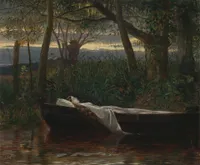
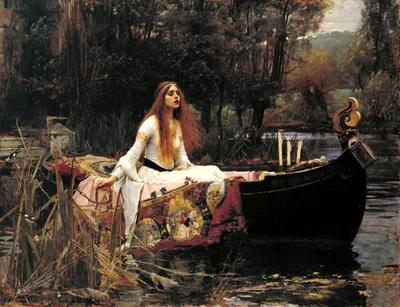
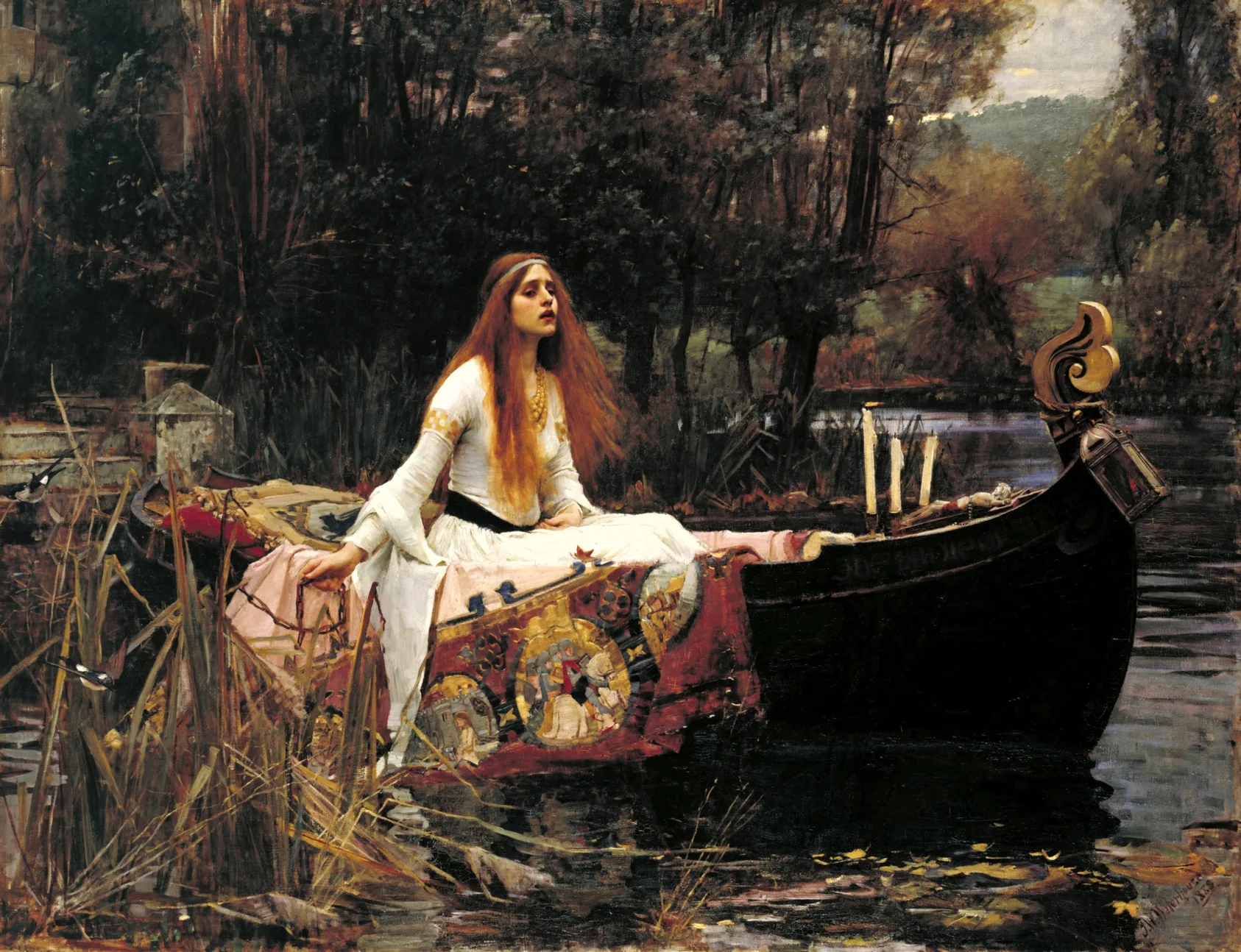
The Lady of Shalott, 1888. John William Waterhouse. Tate Britain.
Look closer
7 things to notice
 1
01
A face that already knows
Her eyes are fixed on something past the frame, and her lips are parted. There is no panic in her, only a terrible calm, as if she has already accepted what the river will do. In the poem she floats down to Camelot singing until the song stops; Waterhouse seems to paint the song just beginning.
02
The chain in her hand
Her left hand holds the chain that moors the boat, and she is about to let it go. In Tennyson's words: "She loosed the chain, and down she lay." The whole picture waits on that hand.
03
Three candles, a crucifix
Three candles stand in the bow, and two have gone out; Tate reads that as a sign that her life will soon end. Beside them lies a crucifix, which Tate reads as sacrifice.
04
Her whole world, over the side
The cloth spilling over the side is her own weaving. Tate describes it as the Lady herself and Lancelot among the knights: years of watching the world in a mirror, stitched by hand, now hanging inches above the river.
05
She signed her own boat
Along the dark side, near the bow, faint letters spell her name. Tennyson: "And round about the prow she wrote / The Lady of Shalott." As if she wanted Camelot to know exactly who was coming.
06
An omen in the reeds
At the far left, two black-and-white birds skim low over the reeds. Tate takes them for swallows, flying low, a sign that something ominous is happening. Even the birds seem to know.
07
The year is ending too
Yellow leaves drift on the black water in front of the boat. It is autumn, as it is in the poem: "The pale yellow woods were waning." The day, the year and her story are all closing at once.
Our take
Most paintings of a story show how it ends. Waterhouse paints the moment just before: the chain still in her hand, the boat not yet moving, two of the three candles already out. Nothing has happened, and everything is decided. That held breath is what this picture is about.
It is also a painting of choosing. In Tennyson's poem she has lived her whole life looking at the world in a mirror, weaving what she saw. She looked out once, at Lancelot, and this is what that look cost. Waterhouse doesn't paint her as afraid. Her lips are parted, as if the song the poem gives her last hours had already begun.
“And at the closing of the day / She loosed the chain, and down she lay; / The broad stream bore her far away, / The Lady of Shalott.”
Alfred Tennyson, The Lady of Shalott (1842)
The painter's moment
1849–1917Painted it at 39Pre-Raphaelite
Waterhouse was 39. He had married Esther Kenworthy five years before, and had spent the decade painting oracles, saints and sorceresses: Saint Eulalia in 1885, The Magic Circle in 1886, Mariamne in 1887. Born the year after the Pre-Raphaelite Brotherhood formed, he later took up its style and its subjects. This was the first time he painted the Lady of Shalott.
It was not the last. He came back to her in 1894, as she turns to look at Lancelot, and again in 1916, a year before he died, with her words from the poem as the title: "I am half sick of shadows." Henry Tate gave this first version to the nation in 1894, and it hangs in Tate Britain.
In its time
The Lady of Shalott was painted in 1888, when Waterhouse was 39. Where it stands on Art Through Time:
Its colors
Elsewhere in the world
- 1884The Berlin ConferenceEurope's powers divide Africa among themselves.
- 1887French Indochina is formedFrance rules Vietnam and Cambodia, and later Laos.
- 1888Brazil abolishes slaveryThe Golden Law makes Brazil the last country in the Americas to end it.
- 1890Wounded KneeU.S. soldiers kill some 250 Lakota men, women and children.
- 1894The Dreyfus AffairA Jewish officer is falsely convicted of treason; France, and its painters, split in two.
The facts
- Title
- The Lady of Shalott
- Artist
- John William Waterhouse (1849–1917)
- Date
- 1888
- Original medium
- Oil on canvas
- Style
- Pre-Raphaelite
- Made in
- United Kingdom
- Collection
- Tate Britain
Living with it
The mood
Quiet and autumnal, with an ache underneath. It doesn't make a room sad; it makes it still, like a river at dusk in the minute before something happens. A painting to sit near, not to walk past.
The palette
Almost all of it is the brown and black of a river at dusk. Two things break the dark: the ivory of her dress and the burgundy of the tapestry, and those are what you see from across a room.
Who it finds
- People who have outgrown a safe life. She leaves the tower knowing what it will cost; some people need to see that every morning.
- Anyone who has loved someone from a distance. Her whole story begins with watching a man ride past in a mirror.
- Readers who know how the story ends, and still hope every time that it won't.
See it in a room
Your photo is never uploaded, and it's gone when you leave.
It works from two distances. From across the room you see the shape of the story: a pale figure, a dark boat, the river. Come close and it gives you the small things: the candles, the chain, the letters on the boat.
Hang it where people stay rather than pass: a library, a reading chair, a bedroom, the turn of a stair. And give it size, enough that the candles and the chain can be read from where you sit.
How we make it
- True to the original
- Each file is color-matched to the museum original. If the color isn't right, we print it again, with our compliments.
- On canvas
- Fine-art canvas hand-stretched over a ¾″ solid-wood frame, with mirrored edges so nothing is lost.
- In our floating frame
- Our stretched canvas set in a slim floating frame, with a shadow gap so the painting seems to hover.
- As a framed print
- Archival pigment print on museum-grade cotton paper, in a solid-wood frame with UV-protective glazing.
- Ready to hang on arrival
- It arrives with the hanging hardware attached. No framer, no guesswork.
- Perfect on arrival
- If anything arrives damaged or not as you ordered, send us a photo within 7 days of delivery and we'll make it again, with our compliments.
Waterhouse painted her in 1888, and she has waited at the water's edge ever since. Give her a wall of her own.