The story · 4 min read
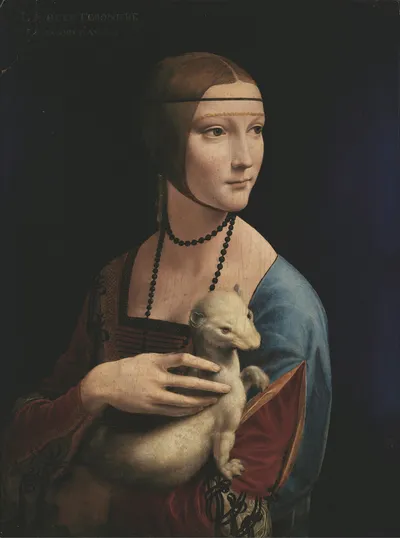
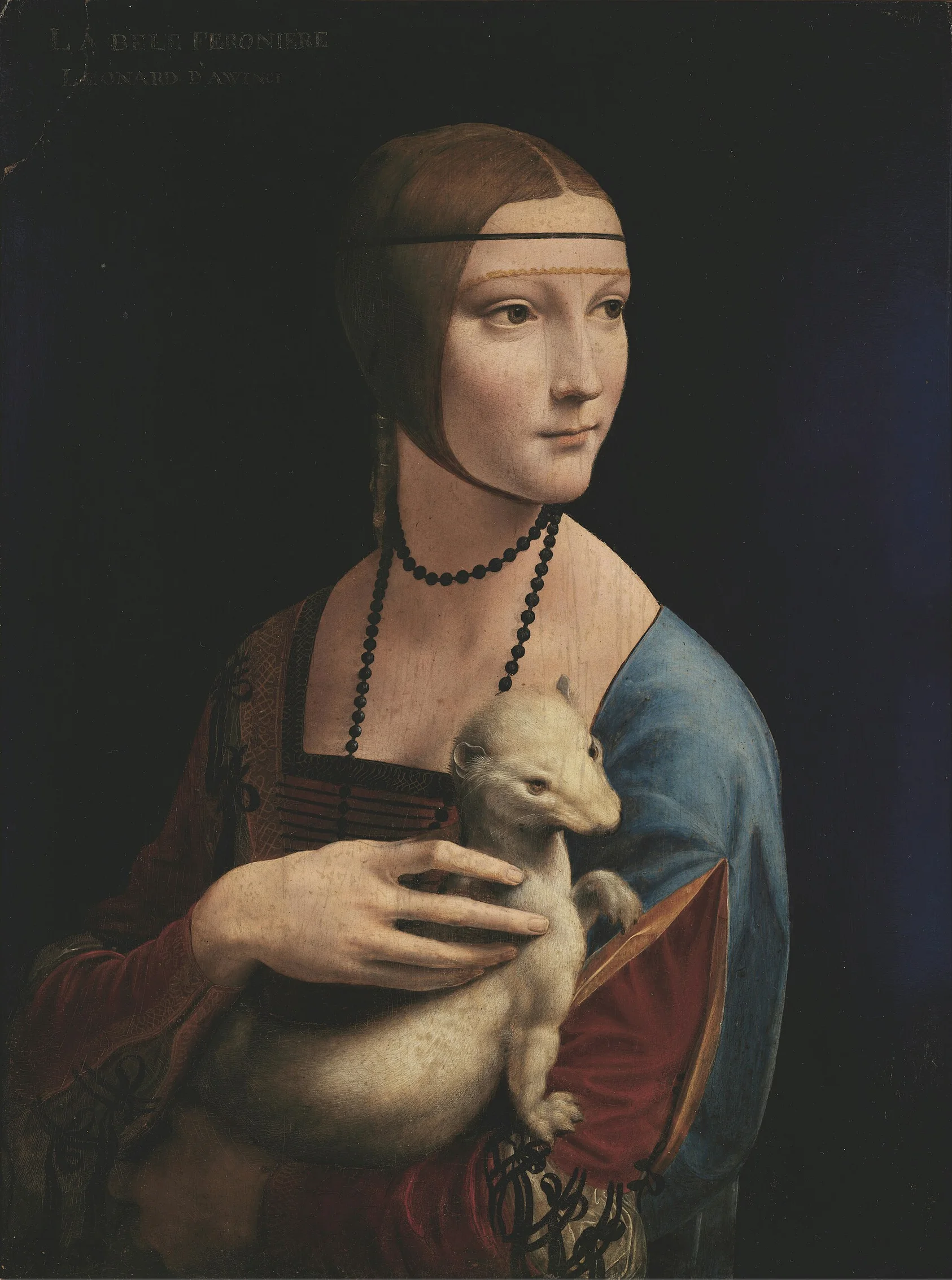
The woman and the animal have noticed someone we cannot see.
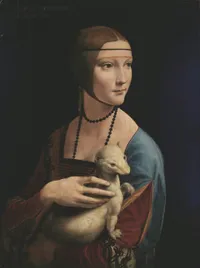
Lady with an Ermine, 1490. Leonardo da Vinci. Princes Czartoryski Museum, National Museum in Kraków.
Look closer
7 things to notice
 1
01
She is listening past us
Her eyes point right while the mouth stays closed, a small shadow defining the lower lip. The National Gallery describes her as listening and recalls Bernardo Bellincioni's poem praising Leonardo's portrait. Her attention gives the painted face an action. The response is still waiting behind those closed lips.
02
The animal carries another name
The ermine raises its pale head above her hand, dark eyes beside a narrow muzzle. The Kraków museum reads it as an allusion to Ludovico Sforza, awarded the Order of the Ermine in 1488. Cecilia's lover is absent as a person. His emblem occupies her arms.
03
The hand knows its work
Long fingers lie across the animal's body, tendons visible beneath pale skin. Museum authors Dorota Dec and Janusz Wałek emphasize Leonardo's knowledge of anatomy in making this figure convincing. The hand gives that knowledge a practical use. Each finger has a different distance to travel around the fur.
04
Fashion keeps the hair in place
Smooth brown hair runs close to her head beneath a thin band. The style is called a coazzone, with the hair arranged beside the face and a long braid behind. The braid is outside this view, but its careful preparation belongs to court dress. These smooth bands were an arrangement, not loose hair.
05
The label got her wrong
Faint lettering stretches across the upper-left darkness, naming La Belle Ferronnière. The museum's catalog explains that this later inscription records a mistaken identification. Letters and a contemporary poem helped reconnect the picture with Cecilia. The words remain on the panel even though the museum has corrected the name.
06
Someone darkened the room
Flat black surrounds the lit edge of her face. The Kraków museum dates a repainting of the background to the nineteenth century; Leonardo's setting originally had more variation in its light. The stark contrast we know is partly a later choice. The darkness beside her cheek has its own author.
07
White could mean more than fur
The animal's pale body curves downward across the red clothing. The National Gallery records purity and honor among the traditional meanings Leonardo associated with the ermine. That reading can coexist with the reference to Ludovico. A small white animal could carry several courtly compliments at once.
Our take
Two heads turn as if someone has entered. Cecilia's body faces across the picture, while her eyes and the ermine's nose point right. The shared direction suggests an interruption, with its cause outside the picture. The National Gallery reads her pose as listening. We can look closely at her face, but we have arrived outside the conversation.
The white animal may carry the name of someone powerful. The museum in Kraków connects it to Ludovico Sforza, Cecilia Gallerani's lover, who had received the Order of the Ermine. An apparently private gesture therefore has a public history: her hand surrounds an emblem associated with the man who ruled Milan. The animal remains alert beneath those long fingers, its small paw clear against the red sleeve.
The painter's moment
1452–1519Painted it at 38Renaissance
At the Milanese court, Leonardo da Vinci worked among people whose portraits, clothes and entertainments helped express their position. His first Milan period extended from the early 1480s to 1499. Around 1490 he painted Cecilia Gallerani, a young woman known for learning and poetry as well as beauty. The National Gallery describes his work with musicians and court entertainments during these years. This portrait belonged to that closely connected world. Ludovico Sforza supported the painter and was Cecilia's lover. The National Gallery sees the picture as an attempt to preserve a beauty that time would alter, giving a brief period of her life a lasting painted form.
Cecilia's position changed in 1491. Ludovico married Beatrice d'Este in January, and Cecilia gave birth to his son later that year. Mother and child subsequently left the court. She retained a portrait by Leonardo: in 1498 Isabella d'Este borrowed it, a transaction recorded in their correspondence. Those letters later helped scholars identify the woman in this panel. Its modern history carried it much farther from Milan. Bought in Italy around 1800 for the Czartoryski collection, it was confiscated during the German occupation of Poland in the Second World War. It now belongs to the National Museum in Kraków and is displayed in the Princes Czartoryski Museum.
In its time
Lady with an Ermine was painted in 1490, when Leonardo was 38. Its Italian title is Dama con l'ermelli. Where it stands on Art Through Time:
Its colors
Elsewhere in the world
- 1492Spain expels its JewsSephardic communities scatter to the Ottoman Empire, North Africa and the Netherlands.
- 1492Columbus reaches the CaribbeanTwo worlds collide; nothing stays the same.
- 1492The Ottomans welcome Spain's JewsSultan Bayezid II offers refuge to Sephardic exiles.
The facts
- Title
- Lady with an Ermine
- Artist
- Leonardo da Vinci (1452–1519)
- Date
- 1490
- Original medium
- Oil on walnut panel
- Style
- Renaissance
- Made in
- Italy
- Collection
- Princes Czartoryski Museum, National Museum in Kraków
Living with it
The mood
A pale face and a white animal make two areas of attention against deep darkness. Blue cloth adds a cooler edge at right, while red stays low in the picture. The figure seems occupied by something just outside the frame.
The palette
Slate and charcoal fill the ground; walnut and clay shape the clothing and shadows. Flax warms the face and fur. Blue cloth and muted red add smaller contrasts beyond the sampled palette. Across a room, the two pale heads are the first things to separate.
Who it finds
- For someone who remembers being drawn into a conversation across a room; Cecilia's attention has already gone ahead of her.
- For someone who has had a label attached to them that never fitted; the inscription above Cecilia preserves an old mistake.
- For someone whose animal notices a visitor first; these two heads share the same direction of attention.
See it in a room
Your photo is never uploaded, and it's gone when you leave.
At a distance, the repeated direction of the heads makes the portrait easy to read. Up close, the hand, fine hair bands and faint inscription give it different stories. The animal's body extends well below its face, so the lower half deserves as much room as the upper.
An upright space beside a desk or reading chair suits that movement between near and far. Choose a size that keeps the fingertips legible. Avoid tucking it into a dark recess where the clothing would disappear; a little even light helps the blue and red remain distinct from the black.
How we make it
- True to the original
- Each file is color-matched to the museum original. If the color isn't right, we print it again, with our compliments.
- On canvas
- Fine-art canvas hand-stretched over a ¾″ solid-wood frame, with mirrored edges so nothing is lost.
- In our floating frame
- Our stretched canvas set in a slim floating frame, with a shadow gap so the painting seems to hover.
- As a framed print
- Archival pigment print on museum-grade cotton paper, in a solid-wood frame with UV-protective glazing.
- Ready to hang on arrival
- It arrives with the hanging hardware attached. No framer, no guesswork.
- Perfect on arrival
- If anything arrives damaged or not as you ordered, send us a photo within 7 days of delivery and we'll make it again, with our compliments.
Around 1490, Leonardo gave an unseen arrival two attentive witnesses. Hang Cecilia and her ermine where the small hand and pale heads remain clear.