The story · 4 min read
Everyone recognizes her. Leonardo never sent her home.
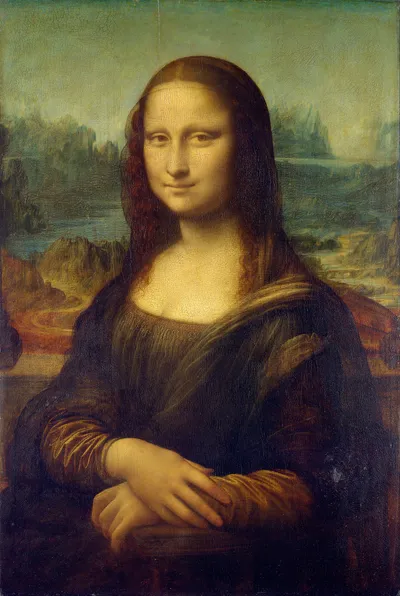
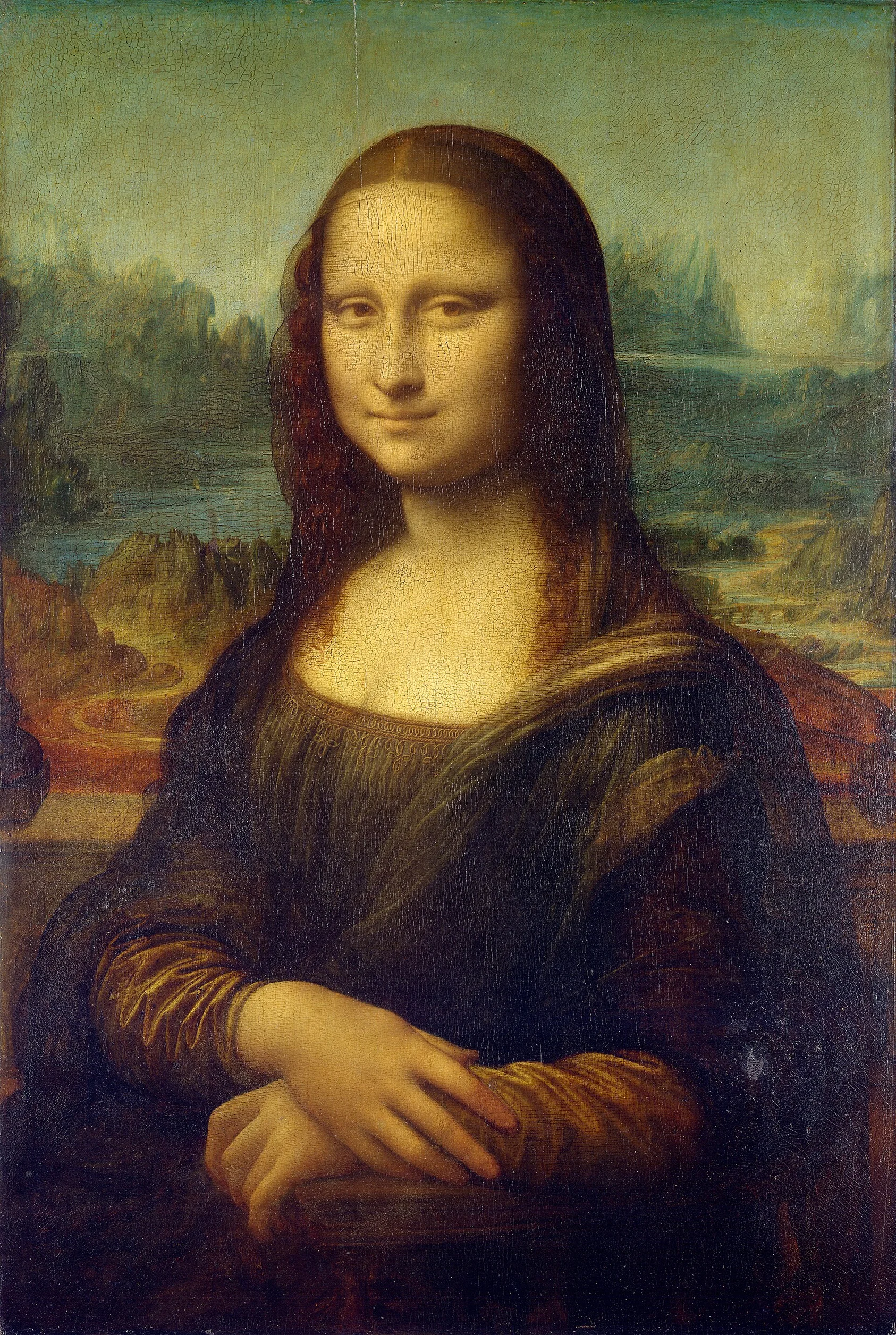
Mona Lisa, c. 1503. Leonardo da Vinci. Musée du Louvre, Paris.
Look closer
7 things to notice
 1
01
The smile changes when you look
The mouth sits inside soft shadow, its corners difficult to pin down. Harvard scientist Margaret Livingstone explains that its smile registers more strongly in peripheral vision than when we look straight at it. Try looking at the eyes, then back at the lips. The shadow stays soft at either corner of her mouth.
02
A hand makes the introduction
Her right hand lies across the left wrist, pale fingers above the chair arm. Beth Harris at Smarthistory explains how including the hands helped Leonardo make the portrait feel more like an encounter with a person. The body has room to act. She is seated close enough for us to notice her hands.
03
The dress was never plain
Fine loops of embroidery follow the neckline above gathered dark fabric. The Louvre identifies gold stitching and a transparent silk covering, part of an expensive outfit whose colors have darkened. Lisa was married to a silk merchant. Those small stitches belong to the world that paid for her portrait.
04
The green has a history
The distant rocks dissolve into greenish haze at left. The Louvre's technical account explains that aged varnish has yellowed the picture, shifting the sky's blue toward green. This color belongs partly to the painting's long life. The landscape we know has been seen through that yellow layer.
05
A road without an address
A narrow bridge crosses the water behind her shoulder, its arches small against the rocky ground. The Louvre describes the background as a fantasy landscape. Proposed real locations remain arguments, not an address supplied by Leonardo. The bridge gives us a human construction without telling us where Lisa is sitting.
06
The edge takes time to find
Hair and veil darken the right side of her face, with no hard border between skin and shadow. The Louvre calls the technique sfumato: thin paint layers soften the transitions. The effect depends on work that hides its own separate strokes. Her cheek emerges gradually from the brown.
07
She has a place to sit
A low parapet runs behind the sleeve, with a column base near the picture's edge. Harris identifies the setting as an open porch. The landscape lies beyond a piece of architecture, so Lisa occupies a room-like space between us and the mountains. The small base helps establish that threshold.
Our take
Recognition gets here before the woman does. We know the smile, the dark dress, the folded hands. Then the small things begin to unsettle that familiarity: the mouth has no firm edge, the road disappears into rock, and the chair points a different way from the face. This is Lisa Gherardini, wife of the Florentine merchant Francesco del Giocondo, according to the Louvre. The name is less mysterious than the expression.
Leonardo kept the portrait instead of delivering it, carrying it with him to France. That fact changes the encounter: a picture intended for a household became something its painter continued to work on. We cannot know what Lisa thought about it. We can see how little Leonardo needed to suggest a welcome: two hands together, a face above them, the corners of a mouth.
The painter's moment
1452–1519Painted it at 51Renaissance
By early 1503, Leonardo da Vinci was back in Florence after working as an engineer for Cesare Borgia. A portrait of a merchant's wife entered a life divided among painting, drawing and practical investigations. The Louvre dates this panel across 1503–1519, a longer span than the single year often attached to it. The broad range matters because Leonardo kept the work. It did not settle into the household for which it was probably begun. He could return to the face and clothing while other jobs, patrons and places changed around him. The museum considers it still unfinished when he died.
In 1516 Leonardo went to France to work under Francis I, taking the portrait with him. He died there in 1519. The Louvre considers a royal acquisition in 1518 very likely, while other accounts place it after his death; the exact transfer is less secure than its eventual place in the French royal collection. Centuries later, the panel acquired a different kind of history. In 1911, former Louvre worker Vincenzo Peruggia stole it. Recovery followed after he tried to sell it in Italy. Steven Zucker at Smarthistory explains how the theft helped magnify its fame: the private portrait had become international news.
In its time
Mona Lisa was painted around 1503, when Leonardo was 51. Where it stands on Art Through Time:
Its colors
Elsewhere in the world
- 1500Portugal reaches BrazilCabral's fleet claims the coast for Portugal.
- 1501The Safavid dynastyA golden age of Persian painting.
- 1508Michelangelo paints the Sistine ceilingRome becomes the capital of the High Renaissance.
The facts
- Title
- Mona Lisa
- Artist
- Leonardo da Vinci (1452–1519)
- Date
- c. 1503
- Original medium
- Oil on poplar panel
- Style
- Renaissance
- Made in
- Italy
- Collection
- Musée du Louvre, Paris
Living with it
The mood
A pale face and two hands interrupt a deep brown upright. Beyond them, green hills open a second distance. The image gives a room both a person close by and a landscape too far away to enter.
The palette
Plum and walnut deepen the dress and hair; bronze warms the sleeves. Olive spreads through the landscape, while gold belongs to the warm skin and distant light. The hands and face register first across a room, separated by dark fabric.
Who it finds
- For someone whose best photograph never quite caught their expression; Lisa's mouth changes with the place our eyes settle.
- For someone who has kept working on a small project for years; Leonardo carried this unfinished portrait from place to place.
- For someone who recognizes a face before remembering its name; this familiar image belongs to Lisa Gherardini.
See it in a room
Your photo is never uploaded, and it's gone when you leave.
From a doorway, the face and hands form two clear areas of light. Closer, the neckline, veil and bridge divide the picture into smaller discoveries. The surface in this reproduction has a visible network of age cracks, so a place where someone can approach it gives more than the familiar silhouette.
A study, bedroom or narrow living-room wall suits the upright shape. Keep enough space around the print for the landscape to remain part of the encounter. A moderate size works well near a chair; a larger one needs a clear view back to the hands at the bottom.
How we make it
- True to the original
- Each file is color-matched to the museum original. If the color isn't right, we print it again, with our compliments.
- On canvas
- Fine-art canvas hand-stretched over a ¾″ solid-wood frame, with mirrored edges so nothing is lost.
- In our floating frame
- Our stretched canvas set in a slim floating frame, with a shadow gap so the painting seems to hover.
- As a framed print
- Archival pigment print on museum-grade cotton paper, in a solid-wood frame with UV-protective glazing.
- Ready to hang on arrival
- It arrives with the hanging hardware attached. No framer, no guesswork.
- Perfect on arrival
- If anything arrives damaged or not as you ordered, send us a photo within 7 days of delivery and we'll make it again, with our compliments.
Begun around 1503, Leonardo's portrait keeps its welcome unfinished. Give the face, the hands and the distant bridge space to be seen together.