The story · 4 min read
A boy falls out of the sky. The working day continues.
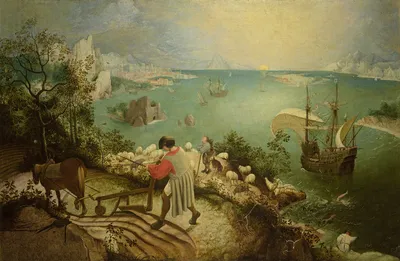
Landscape with the Fall of Icarus, Undated (1525–1569). Pieter Brueghel the Elder. Royal Museums of Fine Arts of Belgium, Brussels.
Look closer
7 things to notice
 1
01
The title is almost gone
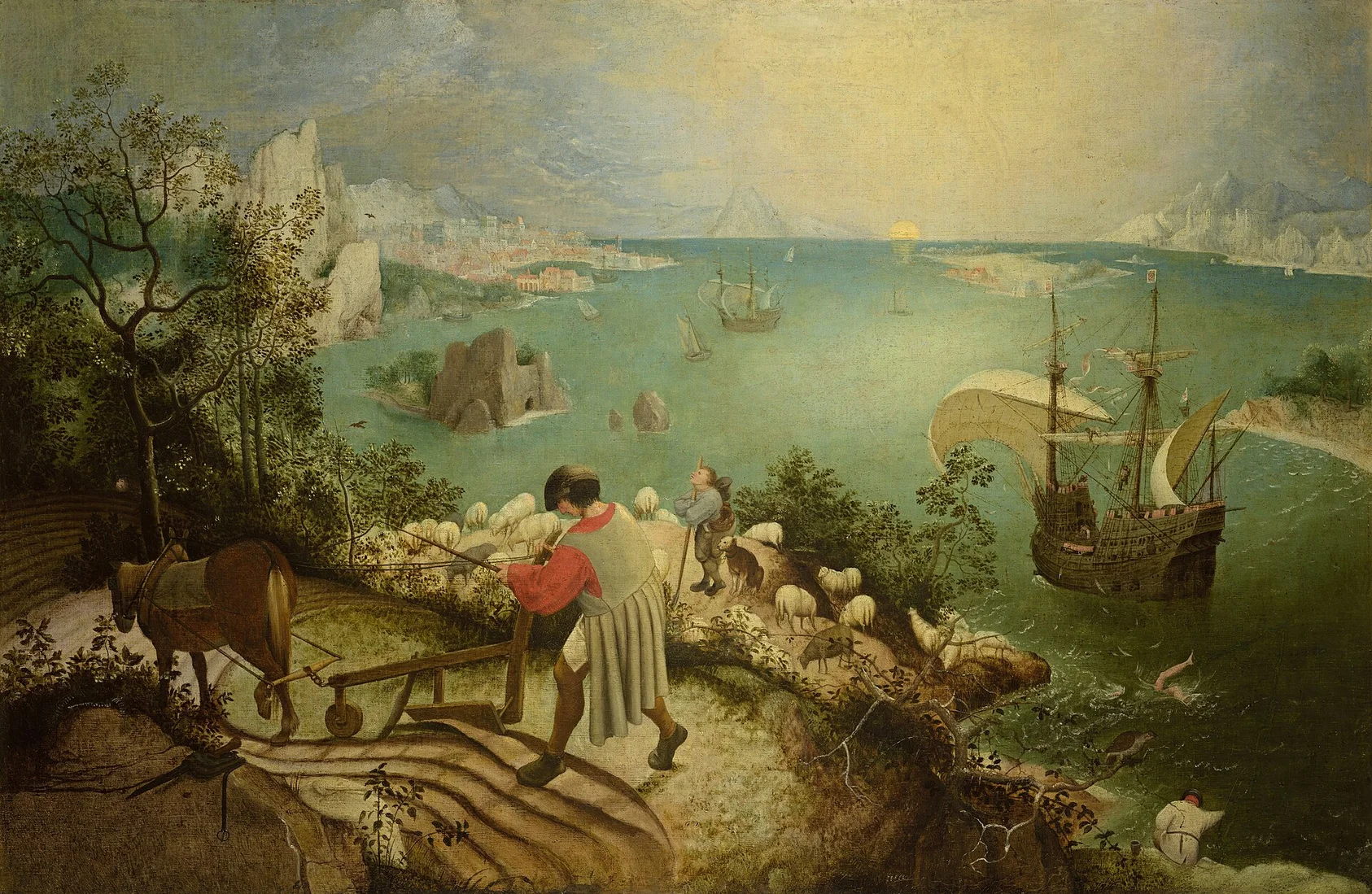
Two pale legs break the water below the large ship. In Ovid's account, the sun softens the wax securing Icarus's feathers after he disregards his father's warning. The fall is already over when this picture finds him. What remains visible is small enough to miss on a first look.
02
The day's work keeps its place
The plowman guides his horse along the brown furrows, a red sleeve marking his arm. Auden's poem makes his continuing labor central to its account of unnoticed suffering. The picture does not tell us what the man has heard. It gives his next furrow more space than Icarus's last movement.
03
He looks where someone is missing
The shepherd's face points into the sky above his sheep. The Royal Museums of Fine Arts of Belgium notes that another version includes Daedalus in flight, giving that gaze a visible destination. This version has no father in the air. The upturned face preserves a question the empty sky cannot answer.
04
The nearest witness is occupied
The fisherman crouches at the lower right, his pale back toward us and his line in the water. Ovid includes an angler among those who marvel at the flying pair. Here he attends to his own task instead. The story's witness has become another person facing the sea.
05
A small bird remembers another fall
A brown partridge stands on a branch above the fisherman. Ovid tells how Daedalus, jealous of his gifted nephew, pushed him from a height; the goddess Pallas saved the boy by changing him into this bird. The museum connects the detail to that earlier episode. Another endangered child survives in the branches.
06
The ship has somewhere to go
The large vessel occupies the water above Icarus, with full sails and an elaborate web of rigging. Auden imagined it continuing toward its destination despite the fall nearby. That is a poet's interpretation, not a report from the crew. The painted sails remain full beside the small patch of disturbed water.
07
The sun raises a doubt
The yellow sun sits low on the horizon, far from the fallen boy. The museum identifies this position as one of the painting's puzzles and reports suggestions of later alteration. No settled reconstruction resolves it. The light that causes the disaster in Ovid appears here as a small, distant disk.
Our take
The title asks us to find someone the landscape almost hides. A plowman occupies the foreground, ships cross the green water, and a town waits under distant mountains. Only at the right edge of that busy world do two legs appear above a splash. Icarus is disappearing while we admire the view.
Ovid's story gives him wings made by his father, Daedalus, and a warning about flying too high. The painting reduces the fatal result to a detail. W. H. Auden later read this landscape as a world continuing with its own affairs during someone else's disaster. That influential reading belongs to the poem he wrote about the picture, not a recovered statement from its maker. The plowman's red sleeve remains far larger than the drowning boy.
The painter's moment
1525–1569Northern Renaissance; disputed attribution, after a design by Pieter Bruegel the Elder
The design is associated with Pieter Bruegel the Elder, but the hand that painted this surviving canvas remains disputed. Around the mid-1550s, Bruegel was back in Antwerp after traveling in Italy. He had joined the city's painters' guild in 1551, then journeyed as far south as Reggio Calabria and worked in Rome. By 1555 his landscape designs were being issued as prints by Hieronymus Cock. That period supplies a plausible setting for the broad imagined coast, and a lost original has often been placed around 1558. It does not supply a secure date or author for the object now in Brussels.
The painting surfaced on the market in 1912 and entered the Royal Museums of Fine Arts of Belgium that year, acquired from London's Sackville Gallery. It has neither a signature nor a date. Damage, repeated interventions and disputed technical evidence make its history unusually difficult to untangle. Some specialists regard it as a copy after a lost Bruegel; the museum leaves the attribution qualified. In April 2026 it announced a further technical investigation with the Royal Institute for Cultural Heritage. The authorship is still a research question. The museum has scheduled the results for an exhibition in 2028, rather than announcing a conclusion in advance.
In its time
No date is recorded for Landscape with the Fall of Icarus; Brueghel lived from 1525 to 1569. Where it stands on Art Through Time:
Its colors
The facts
- Title
- Landscape with the Fall of Icarus
- Artist
- Pieter Brueghel the Elder (1525–1569)
- Date
- Undated (1525–1569)
- Original medium
- Painting
- Style
- Northern Renaissance; disputed attribution, after a design by Pieter Bruegel the Elder
- Collection
- Royal Museums of Fine Arts of Belgium, Brussels
Living with it
The mood
A wide green bay opens beyond a brown hillside, giving the room several distances at once. The first impression is full of ordinary activity. A closer encounter finds a small emergency near the edge of the water.
The palette
Bark and olive mark the foreground earth and trees; moss and sage carry the coast into the green sea. Straw belongs to the pale sky and sails. Across a room, the bay's broad green area arrives before the red sleeve or the small white splash.
Who it finds
- For someone who has received terrible news while ordinary work continued nearby; the scale of the landscape can feel painfully familiar.
- For someone who always finds the smallest figure in a crowded picture; Icarus asks for that habit of attention.
- For someone who has changed their mind after learning a painting's title; the green bay becomes a different place once the legs are found.
See it in a room
Your photo is never uploaded, and it's gone when you leave.
The panorama needs enough width for the working figures and ships to remain distinct. At a distance, the picture becomes a coastal landscape; near the frame, the bird and drowning legs change what that landscape contains. A position beside a frequently used path allows both encounters.
A study or a long living-room wall suits the horizontal shape. Choose a larger print when possible, because the title's subject is deliberately small. Avoid placing it so high that the lower-right water is hard to inspect. The image's moral difficulty depends on seeing the detail, not only enjoying the distant bay.
How we make it
- True to the original
- Each file is color-matched to the museum original. If the color isn't right, we print it again, with our compliments.
- On canvas
- Fine-art canvas hand-stretched over a ¾″ solid-wood frame, with mirrored edges so nothing is lost.
- In our floating frame
- Our stretched canvas set in a slim floating frame, with a shadow gap so the painting seems to hover.
- As a framed print
- Archival pigment print on museum-grade cotton paper, in a solid-wood frame with UV-protective glazing.
- Ready to hang on arrival
- It arrives with the hanging hardware attached. No framer, no guesswork.
- Perfect on arrival
- If anything arrives damaged or not as you ordered, send us a photo within 7 days of delivery and we'll make it again, with our compliments.
This undated landscape, linked to a design often placed around 1558, rewards a low enough position for the small figure in the water.