The story · 4 min read
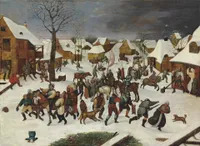
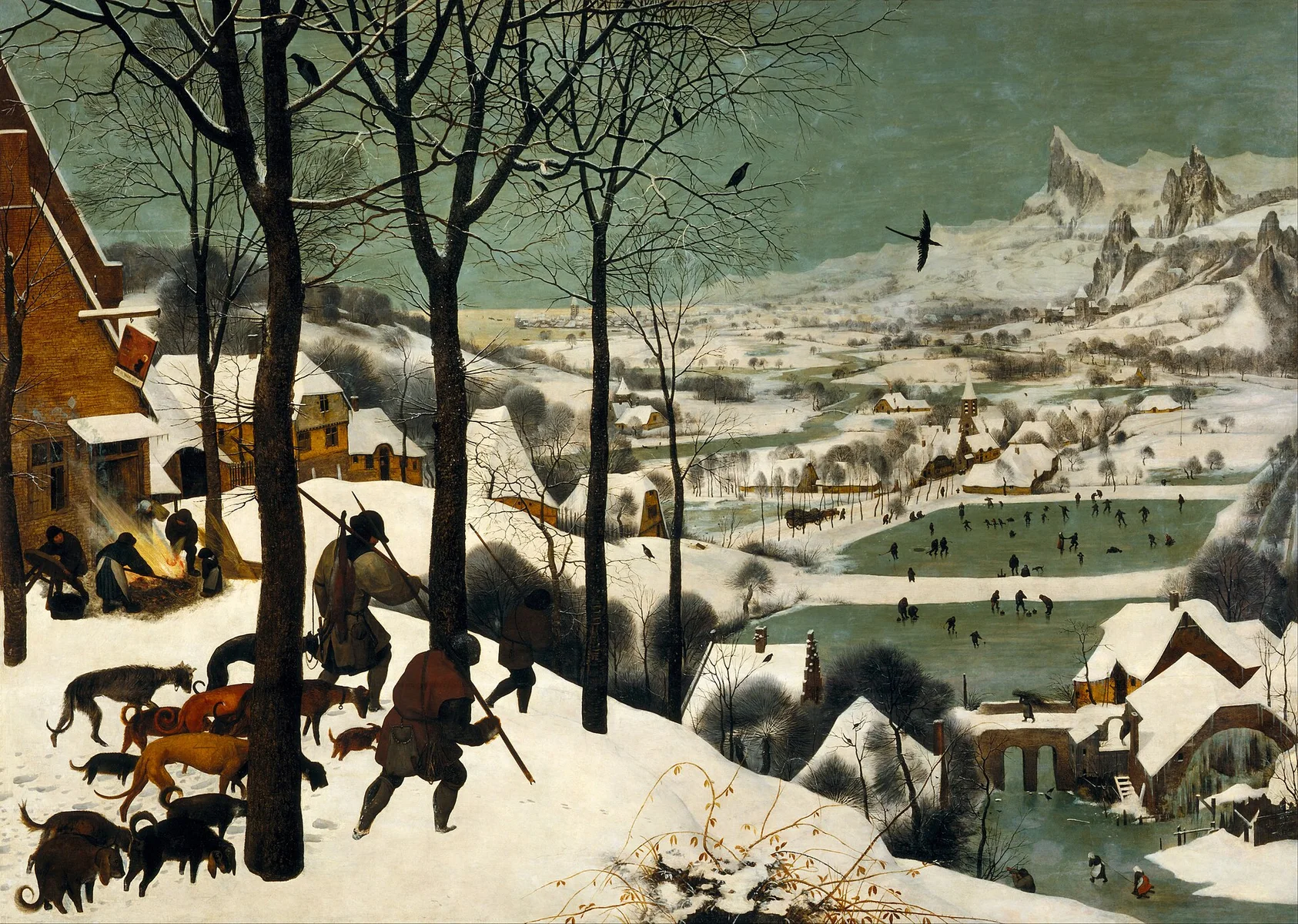
Three hunters bring back one fox. Below them, the village goes on playing.
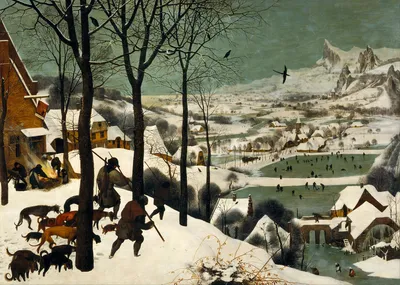
The Hunters in the Snow, 1565. Pieter Brueghel the Elder. Kunsthistorisches Museum, Vienna.
Look closer
7 things to notice
 1
01
So little to carry back
Three hunters descend the left-hand slope, their heads low, a russet fox hanging behind the man nearest the left tree. The museum identifies it as their single catch; David Boffa reads their posture as the weight of an unsuccessful hunt. Their poles make long lines across the snow. The fox takes up so little space.
02
Even the dogs want home
The foreground dogs crowd the snow at lower left, dark muzzles down, long ears beside their cheeks. Boffa notices that their posture repeats the hunters' discouragement. You know the heaviness of the last few steps after a long walk. Home seems to be pulling at these lowered heads.
03
Warmth has work to do
A fire flares beside the inn, yellow at its centre, with workers close around the flames. They are preparing to singe a pig, a job Boffa links to older pictures of December. The small blaze has a purpose beyond warming fingers. Someone must get the food ready.
04
The cold gives something back
Small figures cross the upper pond, black strokes against green ice, some upright and others low to the surface. Boffa identifies skating among the activities on the ponds. At this distance, a person takes only a few marks to paint. A pair of legs is enough to make the ice feel busy.
05
A place above the errands
A black bird grips a thin branch near the upper centre, its body sharp against the grey-green sky. Boffa compares our high view of the valley to the view of birds in these foreground trees. For a few seconds we share that distance. The branch needs no road down.
06
Winter stops the wheel
Icicles fringe the mill at lower right, white points beside the wheel and the dark channel underneath. Cäcilia Bischoff, writing for the museum, singles out the frozen wheel as one of Bruegel's signs of winter. Cold has reached the machinery too. The water has teeth along its edge.
07
Home beneath an invented mountain
Snow caps the crags at upper right, steep pale faces above a cluster of buildings. Bischoff explains that Bruegel joined Alpine mountains to Flemish architecture; the landscape was constructed. Its scale makes the roofs look small enough to cover with a hand. Even here, people have found room for home.
Our take
One fox is a small return for three men and this many dogs. The hunters come downhill through the snow, heads low, their long poles cutting across the tree trunks. Below them, people skate on the ponds. A yellow fire burns beside the houses; tiny figures scatter over green-grey ice. Bruegel gives the unsuccessful hunt a whole village to come back to. The day has gone badly, but it has not gone badly for everyone.
This winter was made for a wealthy man's home. The merchant Niclaes Jongelinck ordered it as part of a series of seasons for his house in Antwerp, and he owned at least sixteen paintings by Bruegel. Looking at the returning men from that comfortable distance, we still have to follow them down. The roofs are close. The last stretch of snow lies between the dogs and home.
The painter's moment
1525–1569Painted it at 40Flemish Mannerism
Two years before this winter, Pieter Bruegel the Elder married Mayken Coecke in Brussels and settled there. In 1565 he painted the seasonal series for Niclaes Jongelinck, a wealthy merchant in Antwerp, the trading city to the north. Six pictures would carry the year through a house. The patron already had an appetite for Bruegel's work: his collection contained at least sixteen of the painter's pictures. Here the cold and the work of getting through it became something to look at indoors. The distance between the buyer and the hunters is part of our encounter with the painting, too. We watch from shelter.
Bruegel painted this scene in oil on wood. The series took its starting point from calendar pictures, with their recurring seasonal tasks, but Jacob Wisse of Yeshiva University argues that the changing landscape itself became the main subject. In this panel the people are small enough for snow, ice and bare trees to govern almost everything around them. Five of the six seasonal paintings survive; this one belongs to the Kunsthistorisches Museum in Vienna. Seen on its own, it still sends the eye through several kinds of day, from the poor hunt to the work beside the fire and the games below. The same cold covers them all.
In its time
The Hunters in the Snow was painted in 1565, when Brueghel was 40. Where it stands on Art Through Time:
Its colors
Elsewhere in the world
- 1568Cochin's Paradesi Synagogue is builtKerala's Jews have lived under Hindu kings' protection for centuries.
- 1571Manila is foundedSpain's galleons link Asia and the Americas.
The facts
- Title
- The Hunters in the Snow
- Artist
- Pieter Brueghel the Elder (1525–1569)
- Date
- 1565
- Original medium
- Oil on panel
- Style
- Flemish Mannerism
- Collection
- Kunsthistorisches Museum, Vienna
Living with it
The mood
A high window onto a village in winter. The black trunks stand close to the room; beyond them, the ponds and roofs recede until people become small marks. It gives a long view to a place where someone sits.
The palette
Grey-green fills the sky and ice, while flax and ivory run through the snow. Olive shadows gather among the roofs; walnut darkens trunks, coats and dogs. Across a room, the pale snow is the broad light, divided by those nearly black trees.
Who it finds
- For someone who has come home tired while other people were still playing outside; the hunters know that last downhill stretch.
- For someone who remembers a whole neighbourhood gathering when water froze; the small figures give the pond back its company.
- For someone who has watched familiar roofs disappear under snow; here the paths remain, thin lines connecting one house to another.
See it in a room
Your photo is never uploaded, and it's gone when you leave.
At a distance, the dark trunks and the sloping white ground do the work. The eye follows the hill into the valley before picking out a person. Close by, the fire, the lowered dogs' heads and the skaters each make a separate scene. The picture repays a chair within looking distance.
Choose a study, a living room or a broad landing with room to step back. A generous horizontal print gives the ponds and the mountain settlement space to remain legible. Keep the surrounding objects few, so the small errands inside the picture have somewhere to emerge.
How we make it
- True to the original
- Each file is color-matched to the museum original. If the color isn't right, we print it again, with our compliments.
- On canvas
- Fine-art canvas hand-stretched over a ¾″ solid-wood frame, with mirrored edges so nothing is lost.
- In our floating frame
- Our stretched canvas set in a slim floating frame, with a shadow gap so the painting seems to hover.
- As a framed print
- Archival pigment print on museum-grade cotton paper, in a solid-wood frame with UV-protective glazing.
- Ready to hang on arrival
- It arrives with the hanging hardware attached. No framer, no guesswork.
- Perfect on arrival
- If anything arrives damaged or not as you ordered, send us a photo within 7 days of delivery and we'll make it again, with our compliments.
Bruegel's winter of 1565 leaves room for labour and play beneath the same sky. Hang it where its small lives can be found.