The story · 4 min read
The light belongs to the prisoner; everyone else controls where she goes.
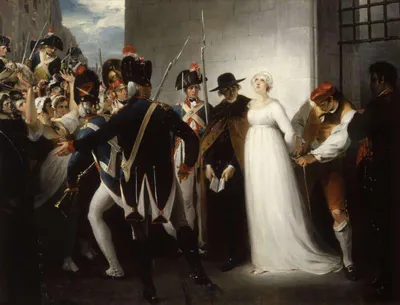
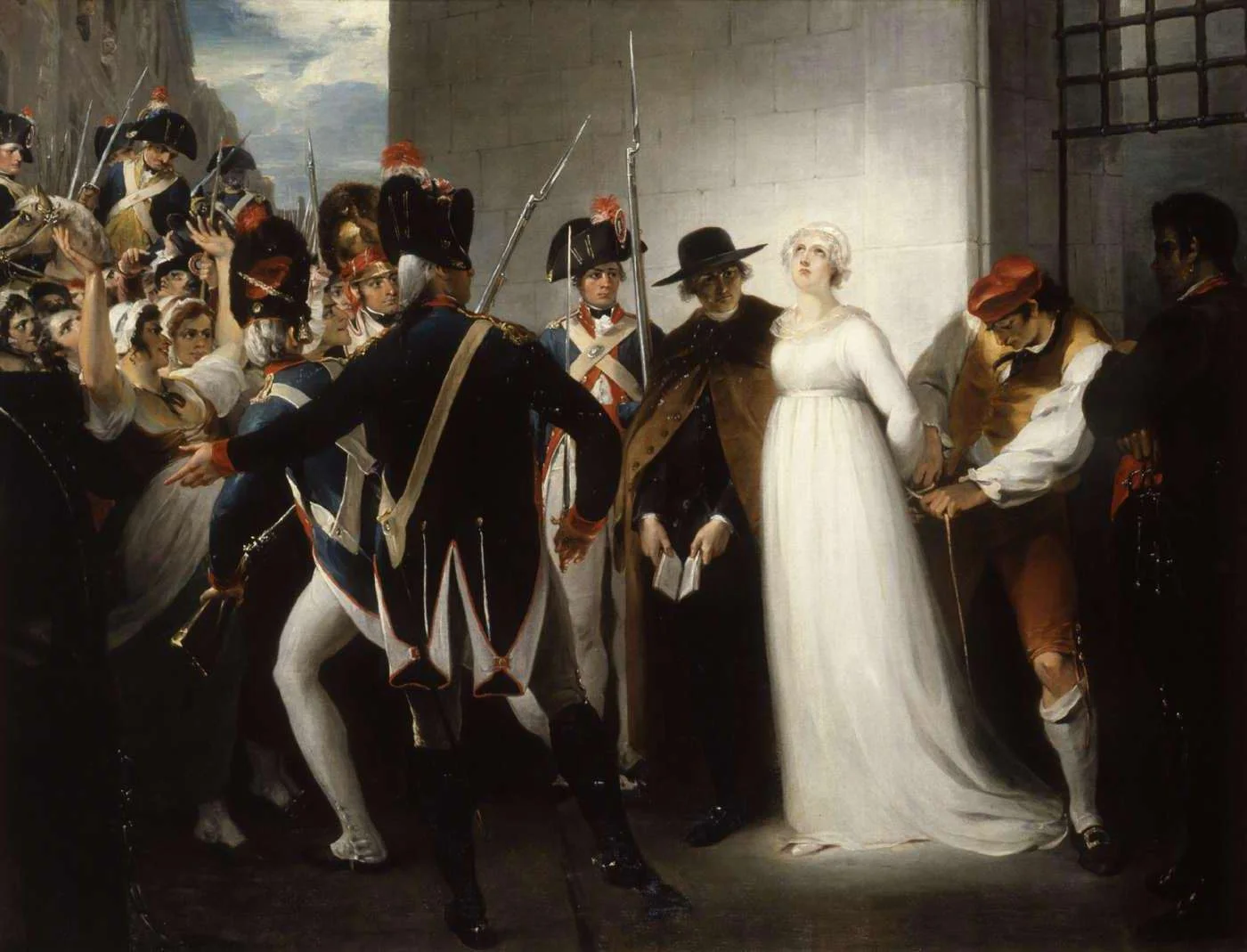
Marie Antoinette being taken to her Execution, October 16, 1793, 1794. William Hamilton. Musée de la Révolution française – Domaine de Vizille, Isère.
Look closer
7 things to notice
 1
01
Her eyes leave the crowd
Marie Antoinette's eyes look upward beneath a small white cap. Historian Pascal Dupuy reads the expression as prayer and the lighting as part of Hamilton's royalist sympathy. The face belongs to the picture's argument as well as its subject. Pale skin meets the cap's narrow edge.
02
The next movement is decided
The executioner's hands work at the queen's wrists, with a cord descending toward the floor. Dupuy identifies the binding as preparation for her journey to the scaffold. Hamilton places this practical action beside the brilliant dress. The small knot occupies the boundary between white sleeve and brown clothing.
03
White carries an argument
The long white dress widens toward the floor, almost uninterrupted by dark color. The museum describes Hamilton's figure as deliberately lengthened to give her grace and make her a sympathetic victim. That reading belongs to the artist's treatment, not a verdict on her trial. The hem lies in the light.
04
A book without a reader
A small book opens between the hands of the dark-clothed priest. Dupuy identifies him as a constitutional priest whose confession the queen refused, while noting his oddly Anglican-looking costume. Hamilton puts him close without making the pair meet. His fingers remain on the pale pages.
05
These arms can move
A woman raises both bare arms above the left-hand gathering. The museum compares her unrestricted gesture with the prisoner's bound hands, making bodily movement part of Hamilton's opposing groups. The difference is visible before the identities are known. Her open palm appears among the soldiers' hats.
06
A back blocks the passage
A soldier faces away from us, his dark coat and outstretched arm cutting across the gathering. Dupuy describes the soldiers as restraining the hostile onlookers. Their barrier surrounds the prisoner while separating her from the crowd. A pale belt crosses the broad blue back.
07
The prison remains behind her
Iron bars divide the high window above the dark doorway. The museum identifies the setting as the Conciergerie, where the queen had been confined before her execution. Hamilton's Marie Antoinette execution scene begins at that threshold. The grid remains fixed above the people leaving below.
Our take
White cloth takes nearly all the light. Hamilton's Marie Antoinette execution scene stops before the cart journey, as her hands are bound outside the Conciergerie prison on 16 October 1793. Soldiers and onlookers surround her, but her face looks above them. The former queen has no command over the next movement. The painting gives her command of its center.
Hamilton painted the scene in England the following year, while Britain and the French Republic were at war. The museum reads his elongated figure and brilliant dress as an appeal for sympathy. This is a carefully arranged account of the event, shaped for people across the Channel. A woman's bare arms rise above the left-hand crowd; beside the queen, a length of cord hangs down.
The painter's moment
1751–1801Painted it at 43History painting
By 1794, William Hamilton had spent years making dramatic scenes readable in a single image. He began with architectural drawing, then painted theatrical portraits and episodes from plays. He became a Royal Academician in 1789 and worked for the illustrated Shakespeare, Bible and English history projects of major London publishers. His French subject was recent news rather than a distant episode from a book. Marie Antoinette had been executed the previous October, months after Louis XVI. Across the Channel, war and competing accounts of the French Revolution gave images of the former queen an audience already prepared to interpret them.
Hamilton made a broad oil painting, nearly two meters wide, with the prisoner surrounded by figures whose gestures direct attention toward her. Dupuy places it within a market for sympathetic royal images and notes that engravings soon carried the composition further. A different surviving record is David's small pen-and-brown-ink drawing of the queen on her way to execution, now in the Louvre. Its sheet is less than fifteen centimeters high. The difference in scale alone changes the encounter: one small figure on paper, one illuminated figure among many on canvas. Hamilton's painting now belongs to the Musée de la Révolution française at Vizille, near Grenoble, where it records a British response to the event.
In its time
Marie Antoinette being taken to her Execution, October 16, 1793 was painted in 1794, when Hamilton was 43. Its French title is Marie-Antoinette quittant la conciergerie, le 16octobre 1793. Where it stands on Art Through Time:
Its colors
Elsewhere in the world
- 1788Colonization of Australia beginsConvicts, Australia's first Jews among them, land on Gadigal country; Aboriginal nations face devastation.
- 1789The French RevolutionPainters take sides; history painting turns political.
- 1791France makes its Jews full citizensThe first country in Europe to grant Jews equal rights.
- 1791The Pale of SettlementRussia confines its Jews to its western borderlands.
- 1795Poland is erased from the mapRussia, Prussia and Austria complete the partitions.
The facts
- Title
- Marie Antoinette being taken to her Execution, October 16, 1793
- Artist
- William Hamilton (1751–1801)
- Date
- 1794
- Original medium
- Oil on canvas
- Style
- History painting
- Collection
- Musée de la Révolution française – Domaine de Vizille, Isère
Living with it
The mood
One column of white separates from a surrounding field of dark coats and stone. The raised arms at left make a second, smaller center of movement. Across a room, the contrast remains clear before the faces or the cord become readable.
The palette
Ebony and walnut occupy the doorway, uniforms and lower shadows. Bark warms the executioner's clothing, while stone lightens the masonry behind the queen. Ivory belongs most strongly to her dress; it is the first color to separate across a room.
Who it finds
- For someone who has watched a public event become competing pictures; Hamilton's light makes one account immediately visible.
- For someone who remembers waiting while others decided the next step; the cord marks how little movement remains.
- For someone who notices what a crowd allows one person to do; raised arms surround a woman with bound hands.
See it in a room
Your photo is never uploaded, and it's gone when you leave.
From a distant seat, the white figure establishes the center immediately. Close up, the binding cord and the priest's book explain different kinds of restraint around her. The entire left side matters too: the soldier's back and the raised arms establish the gathering she must pass through.
A study or a room used for reading gives this historical scene a place for sustained attention. Choose a width that keeps the queen's face and the binding hands distinct at the normal viewing distance. Avoid a position where a lamp or tall object covers the lower dress; its unbroken length is part of Hamilton's arrangement.
How we make it
- True to the original
- Each file is color-matched to the museum original. If the color isn't right, we print it again, with our compliments.
- On canvas
- Fine-art canvas hand-stretched over a ¾″ solid-wood frame, with mirrored edges so nothing is lost.
- In our floating frame
- Our stretched canvas set in a slim floating frame, with a shadow gap so the painting seems to hover.
- As a framed print
- Archival pigment print on museum-grade cotton paper, in a solid-wood frame with UV-protective glazing.
- Ready to hang on arrival
- It arrives with the hanging hardware attached. No framer, no guesswork.
- Perfect on arrival
- If anything arrives damaged or not as you ordered, send us a photo within 7 days of delivery and we'll make it again, with our compliments.
Hamilton's 1794 canvas gives the condemned queen its brightest light. Place the broad scene where the cord beside her dress remains visible.