The story · 4 min read
A name on the list is enough to empty a chair.
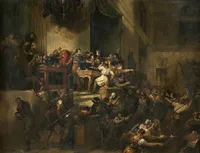
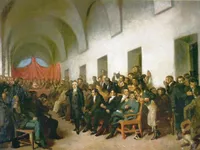
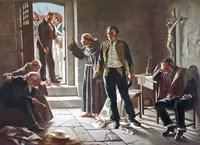
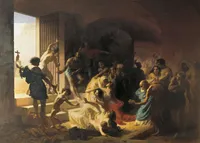
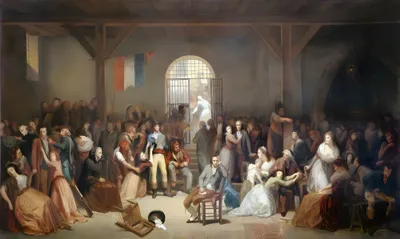
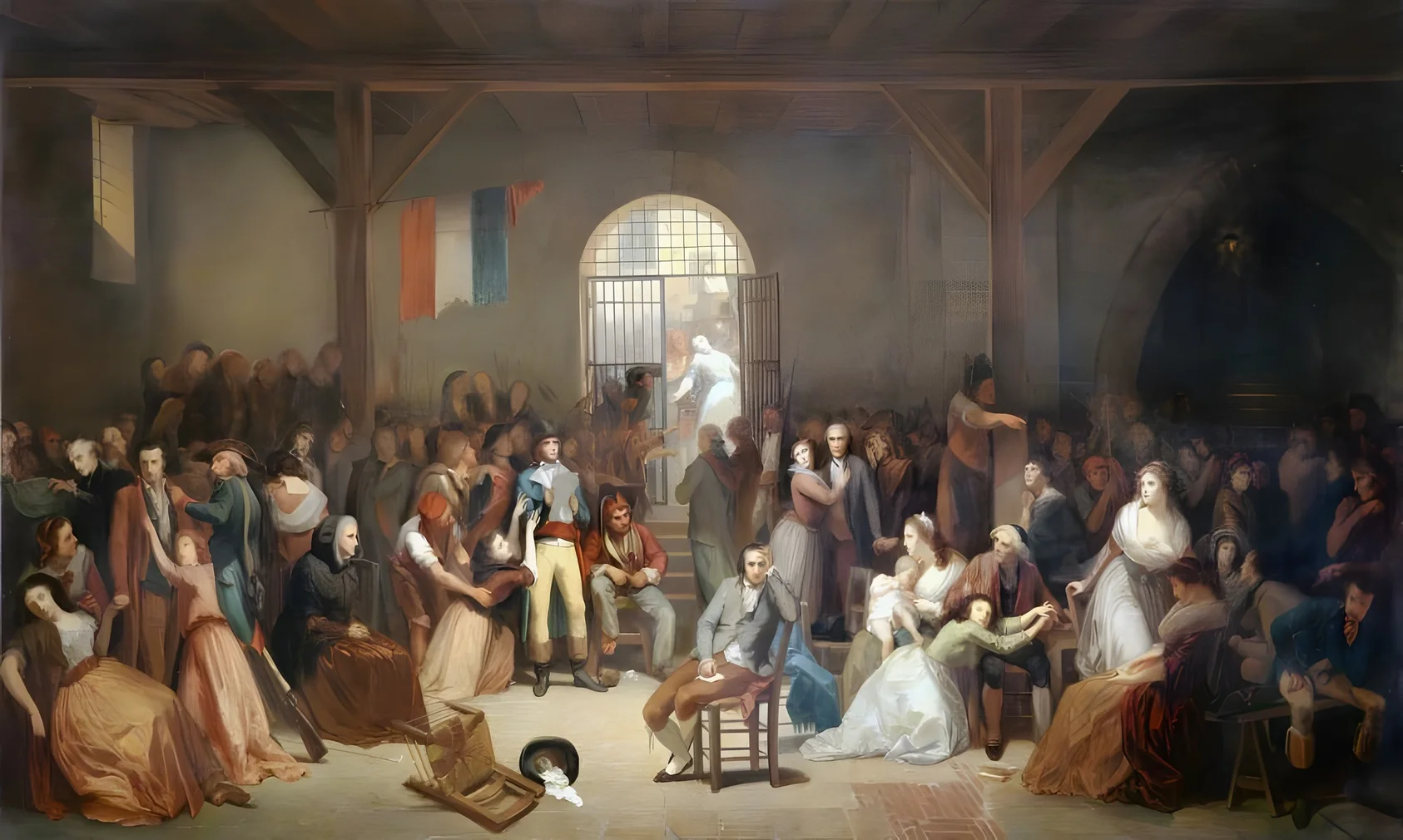
Roll Call of the Last Victims of the Terror, Undated (1815–1892). Charles Louis Müller. Walker Art Gallery, National Museums Liverpool.
Look closer
7 things to notice
 1
01
The poet keeps his paper
Chénier sits in a gray coat, his head supported by one hand and a sheet in the other. The Musée de la Révolution française traces his likeness to Joseph-Benoît Suvée's prison portrait. A remembered face gives the imagined gathering its center. The sheet lies white against his brown trousers.
02
The light leads outside
A woman in white passes through the barred doorway at the back. Jérémie Benoît identifies her as the princess of Chimay and reads the opening's brightness as death, with continued life inside the darker room. The exit in this Reign of Terror painting offers no safety. Her pale dress meets the open gate.
03
One reader decides who listens
The standing official in blue reads from a large sheet, his white neckcloth clear above it. Müller's exhibition catalogue supplied lists of the condemned taken from the Moniteur. Names entered the picture through a document as well as through faces. The reader's paper covers the middle of his coat.
04
A child enters the invented room
The woman in white carries a small child against her upper body. The Musée de la Révolution française notes that children this young would not have been present among these prisoners. Müller makes separation visible through a family group he constructed. The baby's bare arm crosses the pale fabric.
05
Her name brings her upright
A woman rises at the right, her white neckline bright above a gray dress. Museum interpretation identifies her as the princess of Monaco, answering the call. Her body has begun the movement that the seated prisoners still await. One hand remains beside the chair.
06
The floor remembers a disturbance
A chair lies on its back beside a black hat and loose white cloth. The Musée de la Révolution française notes how these discarded objects establish the foreground's depth. They also leave a place where a person was sitting. The chair's underside faces the open room.
07
The colors belong to the jailers
Red, white and blue cloth hangs above the prisoners on the rear wall. The museum describes Müller as opposed to republican politics. His arrangement puts the Revolution's colors inside a scene of its victims waiting to die. The hanging cloth ends well above their heads.
Our take
The open door is the most frightening part of the room. In this Reign of Terror painting, light enters through the same opening by which prisoners leave for execution. A reader has the list; everyone else must wait to hear it. The seated man at the center is the poet André Chénier. His paper is still in his hand.
This undated Walker Art Gallery version repeats a composition Müller exhibited in 1850. Its room gathers people condemned on different days, making a single scene from separate deaths. The Musée de la Révolution française points out that the small children also belong to the painter's invention. Beside Chénier, a woman has a baby against her chest. Beneath them, an overturned chair has left a little more empty floor.
The painter's moment
1815–1892History painting
When Charles Louis Müller exhibited the original composition in 1850, the French Revolution was returning to books as well as pictures. New histories had appeared in 1847, and another revolution had established a republic in 1848. Müller looked back to the prisoners condemned in July 1794. He had trained with Gros, whose studio continued David's teaching, and had studied in Rome. The exhibition catalogue printed names from contemporary lists, giving the invented gathering a documentary foundation. Chénier, however, became its center through a later account: Alfred de Vigny's Stello, published in 1832. A novelist helped determine which prisoner would occupy the empty space.
Müller's monumental canvas, now at the Musée de la Révolution française in Vizille, measures more than eight meters across. The Walker picture belongs to the composition's smaller versions; its own date and maker's relationship to Müller remain unresolved in the accessible records. It should not simply inherit the large painting's 1850 date. The museum's account also questions the setting traditionally called Saint-Lazare, identifying an invented Conciergerie interior instead. Neither room can be treated as a measured record. Portraits, published names and a literary hero give the scene its people, while the painter arranges their last minutes around a single bright door.
In its time
No date is recorded for Roll Call of the Last Victims of the Terror; Müller lived from 1815 to 1892. Where it stands on Art Through Time:
Its colors
The facts
- Title
- Roll Call of the Last Victims of the Terror
- Artist
- Charles Louis Müller (1815–1892)
- Date
- Undated (1815–1892)
- Original medium
- Oil on canvas
- Style
- History painting
- Made in
- France
- Collection
- Walker Art Gallery, National Museums Liverpool
Living with it
The mood
The dark ceiling occupies nearly half the image, making the seated figures feel low and close together. Pale clothes break up the brown room. From a distance, the doorway remains a narrow patch of brightness above the prisoners.
The palette
Walnut and bark fill the ceiling and crowded edges, while clay warms the walls and floor. Ebony gathers in coats and the deep arch at right. Linen marks the door and pale clothing, drawing the eye toward the seated people.
Who it finds
- For someone who has waited through a list of names; the official's sheet divides one person's time from another's.
- For someone who has kept a loved one's handwriting; a small white paper remains beside the poet's hand.
- For someone who has read history through individual lives; the broad dark room resolves into separate faces.
See it in a room
Your photo is never uploaded, and it's gone when you leave.
Across a room, the pale center appears surrounded by a broad dark enclosure. Come closer and the separate faces, the reader's sheet and the fallen chair emerge. The subject asks for time with individual people; a position beside a chair or desk allows those smaller passages to remain within view.
A study or a substantial living room wall gives the wide interior enough space. Choose a size at which the central paper and the mother's child are distinct without approaching right up to the surface. Keep the area below uncluttered, so the painted floor and overturned furniture remain part of the image.
How we make it
- True to the original
- Each file is color-matched to the museum original. If the color isn't right, we print it again, with our compliments.
- On canvas
- Fine-art canvas hand-stretched over a ¾″ solid-wood frame, with mirrored edges so nothing is lost.
- In our floating frame
- Our stretched canvas set in a slim floating frame, with a shadow gap so the painting seems to hover.
- As a framed print
- Archival pigment print on museum-grade cotton paper, in a solid-wood frame with UV-protective glazing.
- Ready to hang on arrival
- It arrives with the hanging hardware attached. No framer, no guesswork.
- Perfect on arrival
- If anything arrives damaged or not as you ordered, send us a photo within 7 days of delivery and we'll make it again, with our compliments.
In this imagined prison of July 1794, the door is open and the prisoners wait. Give the wide room space for each face.