The story · 3 min read
The room agrees almost completely; one seated man keeps his hands to himself.
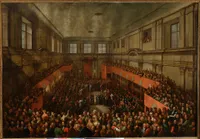
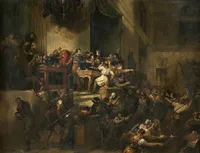
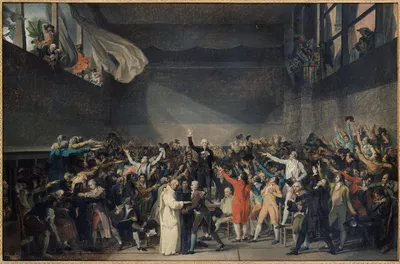
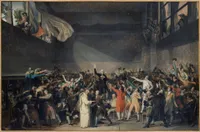
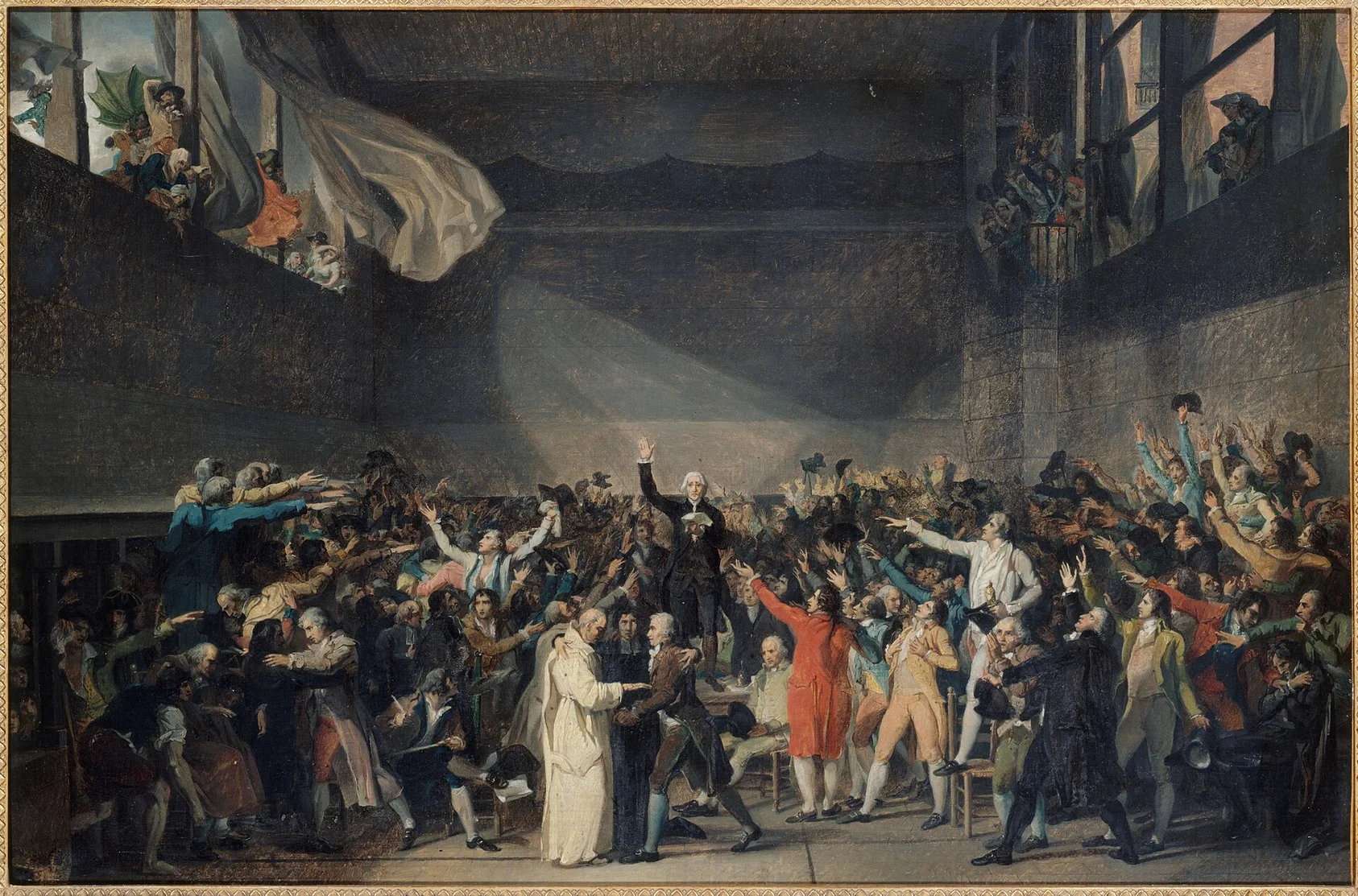
Tennis Court Oath, Undated (1748–1825). Jacques-Louis David. Musée Carnavalet – Histoire de Paris.
Look closer
7 things to notice
 1
01
A table becomes a platform
Bailly stands in black above the surrounding heads, one hand raised beside the paper. Carnavalet identifies him as the chairman reading the oath. The borrowed furniture gives his words a visible center without a throne or lectern. His dark coat rises above the pale faces below.
02
Two churches in one embrace
Three clergymen meet below the speaker, their different clothes close together. Carnavalet reads the group as religious union across the Catholic-Protestant divide: a monk, a parish priest and a Protestant minister. They give the assembly's promise a smaller human form. A white sleeve crosses the dark clothing between them.
03
One refusal stays in view
A seated man keeps his arms across his chest at the right edge. Carnavalet names him as Martin-Dauch, the lone deputy who declined the oath, and notes that his opinion was respected. Agreement has a visible exception. His compact posture remains below the surrounding arms.
04
Someone must write it down
A seated figure writes below the mass of upraised hands. The collection record identifies him as Bertrand Barère. In a composition built around public gestures, his smaller action gives the meeting another kind of record. His paper occupies a pale patch among the dark coats.
05
The future is still together
A man brings both hands to his chest near the right foreground. The museum identifies Robespierre here, among people whose later political paths would diverge. The Tennis Court Oath painting keeps them within one agreement. His hands make a small inward gesture amid the outward arms.
06
The public gets a window
Small faces appear along the high window ledge at left. David's composition includes the public above the deputies; Carnavalet describes the whole arrangement as theatrical. These spectators occupy the edge of that staged room. Their heads form a second, smaller audience against the light.
07
The weather enters the meeting
A long curtain sweeps inward from the upper window, pale against the high wall. Carnavalet's teaching account offers two readings of the wind: an old order ending or renewal arriving. Neither requires a literal weather report. The loose cloth crosses the orderly architecture.
Our take
One man at the far right refuses the gesture. Around him, the Tennis Court Oath painting gathers raised arms toward Jean-Sylvain Bailly, standing on a table. On 20 June 1789, deputies at Versailles promised to remain together until France had a constitution. Joseph Martin-Dauch would not join them. The composition preserves his refusal inside its great image of agreement.
This canvas at the Musée Carnavalet follows David's design; the museum dates it after 1791 and identifies David as the maker of the model. His own enormous painting remained unfinished as money failed and former allies became enemies. The smaller image gives the whole assembly a finished room. High above the deputies, spectators look through windows and a curtain flies inward.
The painter's moment
1748–1825Neoclassical history painting, after Jacques-Louis David
In 1790, Jacques-Louis David took on an event he had not witnessed. The deputies' meeting at Versailles, the royal town west of Paris, had happened the previous June. A national subscription supported by the Jacobin Club was meant to finance a monumental painting. David exhibited a drawing at the Salon of 1791 and arranged sittings in the former Feuillants convent. He had built an earlier oath around ancient Romans; this one required the faces of living politicians. Enough money did not arrive from subscribers, and the National Assembly agreed to public funding. The picture depended on a unity that was already becoming difficult to sustain.
By 1793 David was himself a deputy, and some of the figures in his design had become politically unacceptable. Mirabeau's secret dealings with the king had come to light after his death. The large canvas was abandoned and survives at Versailles. This smaller oil painting belongs to a different object history. Carnavalet's current catalog calls it a work after 1791 with David responsible for the model, while older museum material used a firmer attribution. Its precise maker remains unresolved. Acquired in 1884, it preserves the assembly in a finished composition, with the raised arms, the three clergymen and the dissenter all still in their appointed places.
In its time
No date is recorded for Tennis Court Oath; David lived from 1748 to 1825. Its French title is Serment du Jeu de paume, le 20 juin 1789. Where it stands on Art Through Time:
Its colors
The facts
- Title
- Tennis Court Oath
- Artist
- Jacques-Louis David (1748–1825)
- Date
- Undated (1748–1825)
- Original medium
- Oil
- Style
- Neoclassical history painting, after Jacques-Louis David
- Made in
- France
- Collection
- Musée Carnavalet – Histoire de Paris
Living with it
The mood
The upper walls leave a large quiet space over a dense band of people. Raised hands and the central black coat organize the crowd from a distance. The open windows keep this enclosed meeting connected to people outside the room.
The palette
Charcoal, slate and ebony collect in coats and the deep recesses of the room. Bark and sand warm the walls and the small faces. Across a room, the pale architecture occupies most of the image while the people form a dark lower band.
Who it finds
- For someone who has sat through a meeting that changed a shared future; a borrowed table becomes the center.
- For someone who has declined a unanimous-looking decision; Martin-Dauch still occupies a place inside the room.
- For someone who has kept minutes while others spoke; Barère's paper gives public agreement a smaller, lasting task.
See it in a room
Your photo is never uploaded, and it's gone when you leave.
Across a room, the assembly reads first as a low horizontal gathering beneath tall walls. Move closer and the individual gestures separate: a writer, three clergymen, the one seated dissenter. Position the picture where a viewer can approach its lower edge without stepping around furniture or looking over a row of objects.
A study or shared dining space can accommodate the wide interior. The many small figures reward a size larger than a desk picture, with room to stand back and then examine a face. Leave the high windows within the frame's clear sightline; their spectators extend the meeting beyond the people on the floor.
How we make it
- True to the original
- Each file is color-matched to the museum original. If the color isn't right, we print it again, with our compliments.
- On canvas
- Fine-art canvas hand-stretched over a ¾″ solid-wood frame, with mirrored edges so nothing is lost.
- In our floating frame
- Our stretched canvas set in a slim floating frame, with a shadow gap so the painting seems to hover.
- As a framed print
- Archival pigment print on museum-grade cotton paper, in a solid-wood frame with UV-protective glazing.
- Ready to hang on arrival
- It arrives with the hanging hardware attached. No framer, no guesswork.
- Perfect on arrival
- If anything arrives damaged or not as you ordered, send us a photo within 7 days of delivery and we'll make it again, with our compliments.
This canvas after 1791 preserves a room full of promises. Hang it wide enough to find the man who refused one.