The story · 4 min read
The dress stays white only until you look at its colors.
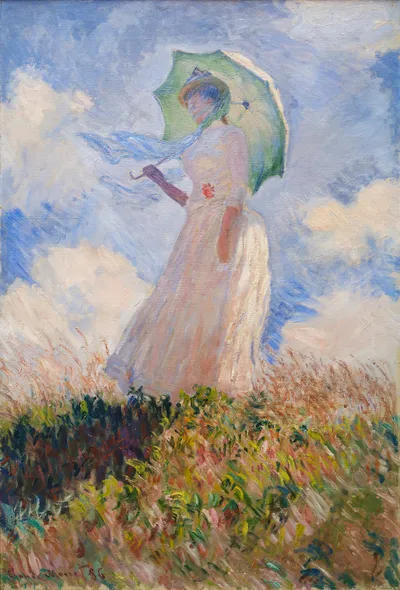
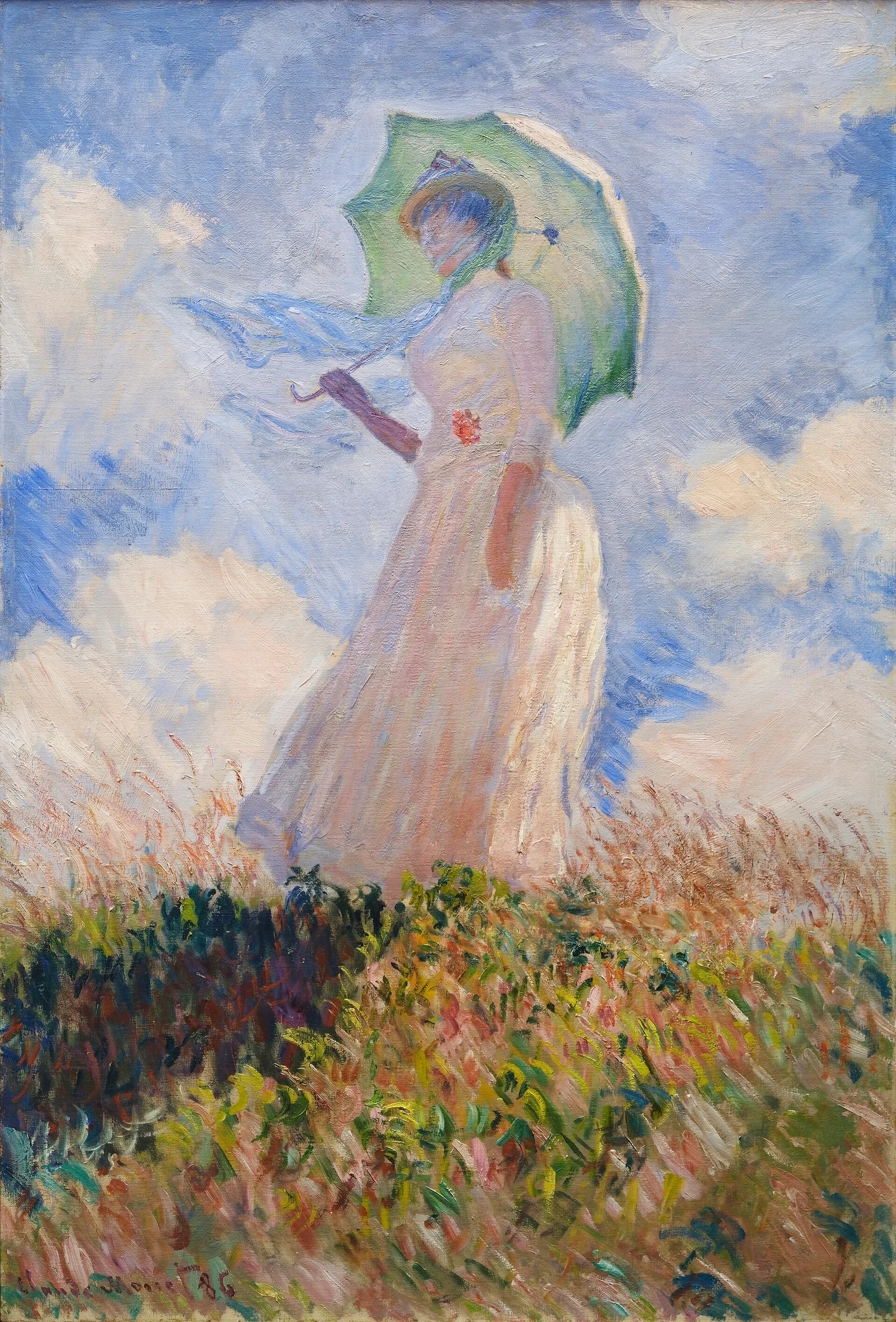
Woman with a Parasol, facing left, 1886. Claude Monet. Musée d'Orsay, Paris.
Look closer
7 things to notice
 1
01
A familiar model under the shade
Suzanne's face is partly obscured by blue shadow beneath the hat. The Metropolitan Museum identifies her as Monet's preferred model in the years after his first wife Camille died. This is a young woman from his own household. Yet the shaded face receives fewer distinct marks than the fabric around it.
02
The green belongs underneath
The parasol's right edge curves around a green underside, with a pale strip along its sunlit rim. Dominique Lobstein describes the parasols in these studies as white with green linings. That small material fact helps explain the changing colors. The protective canopy has light on one side and shade on the other.
03
The breeze interrupts the sitting
The blue veil extends leftward from the neck into the pale sky. Lobstein describes Suzanne opposing the wind in the two studies and connects the broken brushwork with that effect. A model can keep her position while loose cloth moves. The veil's separate blue marks make the interruption visible.
04
White needed several other colors
Pink and blue strokes run down the long skirt beside a narrow band of yellow light. Lobstein links these colored shadows with Monet's renewed study of figures in landscape. The dress supplied a pale surface on which those changes could register. Its brightest edge remains beside the bluer shadow.
05
A family outing changed the viewpoint
The hem meets a ridge of grass high against the sky. According to Germaine Hoschedé's recollection, retold by Lobstein, Monet found the raised viewpoint while securing a boat below his family on the bank. The account concerns the idea for the studies. Here, a thin grassy edge establishes our lower position.
06
Her family knew the painter
A small red flower marks the waist of Suzanne's pale dress. The Henner museum identifies her parents as Alice and Ernest Hoschedé, a textile merchant and art collector who supported Impressionist painters. She came from a family already connected to Monet's work. The red accent gives her light clothing one sharp point of color.
07
His son gave it away
Monet's signature and the abbreviated date 86 appear among the grasses at the lower left. The Orsay record traces the picture through his son Michel, who donated it to the French state in 1927. It remained in the family before entering a public collection. The painted name is almost lost among the stems.
Our take
Wind makes the veil clearer than the face. Blue strokes trail from Suzanne's hat across the sky, while her face disappears beneath the parasol's shade. The long dress looks white from a distance. Closer, its surface divides into pink, yellow and blue. She stands above us on a bank, with little ground between her hem and the clouds.
The model was Suzanne Hoschedé, a daughter of Monet's companion Alice. He painted two large parasol studies in 1886, one facing each way. Dominique Lobstein connects their raised viewpoint with a family memory: Monet looking up from a boat as the others climbed the bank. A familiar person became a chance to study a figure outdoors. The same changing light crosses her dress and the grass at her feet.
The painter's moment
1840–1926Painted it at 46Impressionism
In 1886, Claude Monet had lived in Giverny for three years. The village in the Seine valley west of Paris gave him space for work and a large household: his two sons and Alice Hoschedé's six children. His first wife, Camille, had died in 1879. Alice would not become his wife until 1892, but their families were already sharing daily life. Suzanne, Alice's daughter, became a frequent model during these years. The two parasol paintings grew from that proximity. He could return to a person he knew while trying different directions, positions and effects of outdoor light.
The work's museum title calls it a study of a figure in the open air. Its companion reverses Suzanne's direction, making the pair an extended attempt rather than one isolated glimpse. Later that year Monet left for Belle-Île, off the coast of Brittany, where he stayed from September into November. The Atlantic rocks and rapidly changing weather challenged methods he had developed along the Channel coast. He was still looking for subjects that required him to adjust. Both parasol studies remained in the family; Michel Monet gave this one to the state in 1927. After years at the Louvre and the Jeu de Paume, it entered the Musée d'Orsay in 1986.
In its time
Woman with a Parasol, facing left was painted in 1886, when Monet was 46. Its French title is la femme a l'ombrelle. Where it stands on Art Through Time:
Its colors
Elsewhere in the world
- 1884The Berlin ConferenceEurope's powers divide Africa among themselves.
- 1885Leopold II takes the CongoHis forced-labor regime costs millions of lives.
- 1885The Indian National Congress is foundedThe movement for self-rule takes shape.
- 1887French Indochina is formedFrance rules Vietnam and Cambodia, and later Laos.
- 1888Brazil abolishes slaveryThe Golden Law makes Brazil the last country in the Americas to end it.
The facts
- Title
- Woman with a Parasol, facing left
- Artist
- Claude Monet (1840–1926)
- Date
- 1886
- Original medium
- Oil on canvas
- Style
- Impressionism
- Made in
- France
- Collection
- Musée d'Orsay, Paris
Living with it
The mood
The pale sky occupies most of the rectangle, with one tall figure above a strip of busy grass. Blue and cream carry across a room before the face becomes visible. The long dress gives the light colors a clear vertical shape.
The palette
Chalk and linen describe the sunlit clouds and pale dress; periwinkle follows the blue shadows and sky. Bronze and olive gather in the grassy foreground. The eye first finds the light dress against blue, then the green underside of the parasol.
Who it finds
- For someone who has tried to keep still outdoors while the wind disturbed their clothes; Suzanne's veil refuses to share her pose.
- For someone who has become part of a household made from two families; Suzanne's place in Monet's work grew from that daily life.
- For someone who remembers a familiar person seen from an unfamiliar angle; the low bank changes the scale of a simple outing.
See it in a room
Your photo is never uploaded, and it's gone when you leave.
From farther away, the parasol and dress join into a single upright figure. Close to the surface, separate strokes make the veil, colored shadows and grasses more evident. A medium or large vertical print lets the shaded face remain a small, deliberate part of the whole image.
A living room, bedroom or landing with even daylight suits the pale range. Leave some clear space beside the frame so the blue veil has room within the composition to register. Light wood and plain linen nearby echo the painting's warm notes without multiplying its busy foreground. Avoid a position where glare washes out the distinctions between cream and blue.
How we make it
- True to the original
- Each file is color-matched to the museum original. If the color isn't right, we print it again, with our compliments.
- On canvas
- Fine-art canvas hand-stretched over a ¾″ solid-wood frame, with mirrored edges so nothing is lost.
- In our floating frame
- Our stretched canvas set in a slim floating frame, with a shadow gap so the painting seems to hover.
- As a framed print
- Archival pigment print on museum-grade cotton paper, in a solid-wood frame with UV-protective glazing.
- Ready to hang on arrival
- It arrives with the hanging hardware attached. No framer, no guesswork.
- Perfect on arrival
- If anything arrives damaged or not as you ordered, send us a photo within 7 days of delivery and we'll make it again, with our compliments.
Monet's study of 1886 gives Suzanne a sky full of moving light. Hang the tall image where its blue shadows remain distinct.