The story · 4 min read
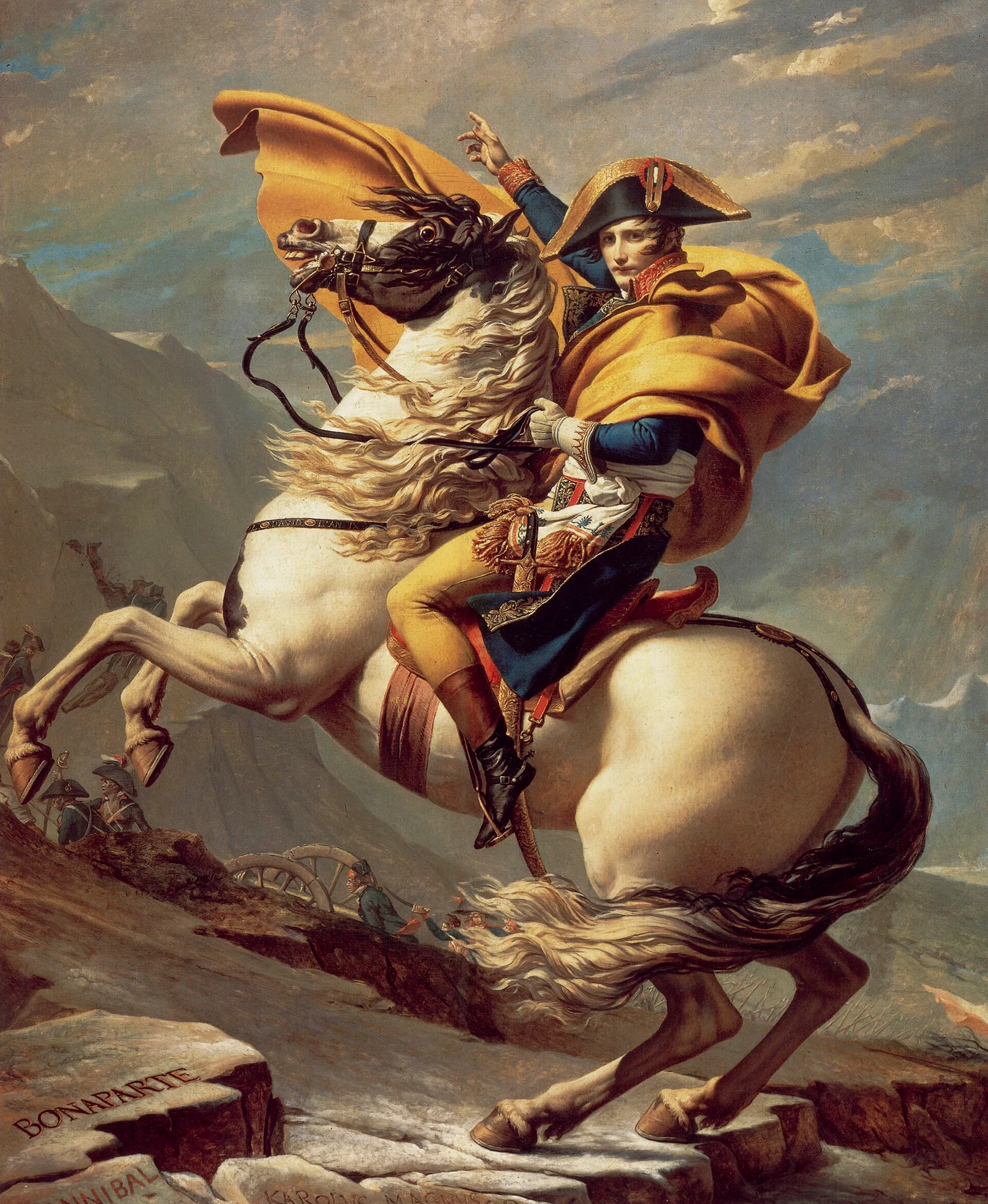
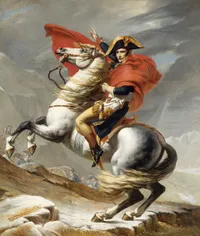
The horse struggles with the mountain; the rider seems untouched by it.
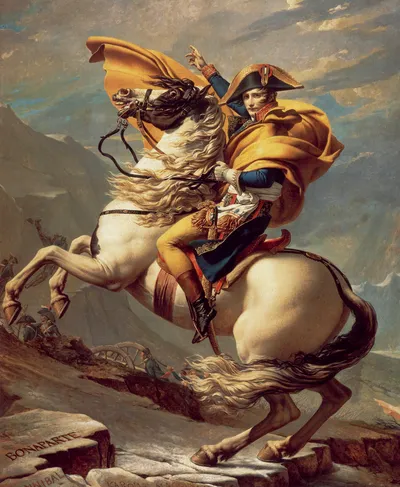
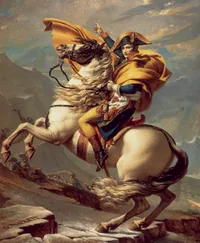
Napoleon Crossing the Alps, 1800. Jacques-Louis David. Musée national des châteaux de Malmaison et de Bois-Préau, Rueil-Malmaison.
Look closer
7 things to notice
 1
01
He did not sit for this
Bonaparte's face looks outward below the broad hat, with dark hair along one cheek. David had begun a portrait of him in 1797, but received no new sittings for the Alpine picture. The Open University describes this as an image of public authority rather than a simple record of appearance. The closed lips remain level above the collar.
02
The order comes toward us
The bare hand points upward above an embroidered cuff, its fingers separated against the sky. The Open University's reading extends the gesture beyond an instruction to the troops: it also addresses the viewer. The hand asks for movement while its owner stays composed. One finger indicates the way above the horse.
03
A mule would tell another story
The horse's mouth opens around the bit, with its eye prominent above the dark cheek. Bonaparte crossed the pass on a mule; the rearing animal belongs to David's construction of the event. The rider's still expression gains force beside this visible effort. Teeth show between the horse's parted lips.
04
His name joins older crossings
BONAPARTE runs diagonally across the foreground rock. The composition also names Hannibal and Charlemagne, earlier commanders who crossed the Alps, linking the new leader to a long military history. In the supplied image, the lowest inscriptions are partly cut by the edge. Bonaparte's name occupies the clearest stone above them.
05
Someone still has to haul it
A cannon wheel and small soldiers follow the slope below the horse. The Open University connects the artillery party and its tricolor with the French nation, giving the elevated rider a collective identity. Their work remains visible at a much smaller scale. The wheel sits low against the rocky ground.
06
The borrowed uniform was real
A gloved hand closes around the reins beside the blue sleeve and embroidered cuff. David could borrow the uniform and hat Bonaparte wore at Marengo, even though the sitter did not return to pose. Particular clothing helped support the invented ride. The pale glove makes a compact shape among the dark straps.
07
This cloak identifies a version
Yellow cloth sweeps around the shoulder and opens into a broad curve at right. The Fondation Napoléon identifies the yellow cloak and dappled horse as marks of the Malmaison version; other versions alter these colors. The composition was repeated without remaining identical. Here the brightest cloth sits directly beside the face.
Our take
The horse has an open mouth; Napoleon's is closed. In Napoleon Crossing the Alps, animal, cloak and cloud all move around a rider whose face remains composed. The event belongs to May 1800, when the First Consul crossed the Great Saint Bernard Pass during his Italian campaign. He actually traveled on a mule. David gives the journey a different kind of authority.
A Spanish king commissioned the portrait for a room of military leaders in Madrid. The image had a place to fill before it had a horse. Unable to obtain new sittings from Bonaparte, David used his own son to model the posture on a ladder. A studio arrangement became a mountain passage. Below the rider, men haul their equipment up the narrow slope.
The painter's moment
1748–1825Painted it at 52Neoclassicism
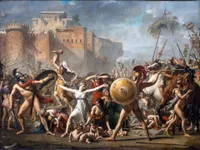
Jacques-Louis David had passed through two imprisonments in 1794 and 1795 before finding a new public for his work. In 1799, his Intervention of the Sabine Women offered an ancient scene of women stopping a battle. He exhibited it himself and charged admission. The studio became a place where a large historical picture could earn money outside the usual Salon arrangement. A commission from Charles IV of Spain then brought him a living military subject. The king wanted Bonaparte among the great captains represented in his Madrid palace. David's new painting would place a contemporary ruler within that company.
The Malmaison version of Napoleon Crossing the Alps was made in 1800–1801; the Fondation Napoléon places its execution between September and January. David showed it in the same studio setting as the Sabine Women. Bonaparte saw the result and ordered repetitions for prominent buildings, making the composition serve more than its first royal destination. This Spanish canvas later traveled through another member of the family: Joseph Bonaparte took it from Madrid to the United States. A bequest from his descendant Eugénie Bonaparte brought it to Malmaison, west of Paris, in 1949–1950. Five principal versions survive, their different horses and cloaks preserving the history of separate commissions.
In its time
Napoleon Crossing the Alps was painted in 1800, when David was 52. Its French title is Bonaparte franchissant les Alpes au Grand-Saint-Bernard. Where it stands on Art Through Time:
Its colors
Elsewhere in the world
- 1795Poland is erased from the mapRussia, Prussia and Austria complete the partitions.
- 1804Haiti declares independenceThe first nation founded by people who freed themselves from slavery.
The facts
- Title
- Napoleon Crossing the Alps
- Artist
- Jacques-Louis David (1748–1825)
- Date
- 1800
- Original medium
- Oil on canvas
- Style
- Neoclassicism
- Made in
- France
- Collection
- Musée national des châteaux de Malmaison et de Bois-Préau, Rueil-Malmaison
Living with it
The mood
A yellow cloak crosses the upper part of a tall rectangle, above a pale horse and a low band of stone. The picture gives a room an upward direction. The small marching figures keep the ascent attached to physical work.
The palette
Bronze and russet shape the rocks, clothing and shadows; mahogany deepens the horse's face and the cloak's creases. Sand and wheat light the horse and yellow fabric. Across a room, the pale body and bright cloak separate before the small blue uniform does.
Who it finds
- For someone who has seen a polished account leave out the difficult work; the artillery crew still has a mountain to climb.
- For someone who recognizes how a uniform changes a person's public role; borrowed clothes help build this commanding figure.
- For someone who remembers the practical details behind a grand photograph; a studio ladder lies behind the painted ascent.
See it in a room
Your photo is never uploaded, and it's gone when you leave.
From a doorway, horse and rider form one large rising shape. Closer, the small soldiers, the reins and the letters in the rock complicate that first impression. The lower part needs a clear sightline; furniture placed across it would remove the labor and inscriptions that qualify the commanding pose.
A study or a high-ceilinged living room gives the vertical composition enough space. Choose a size that allows the horse's head and the rider's face to remain distinct from the usual viewing position. Leave a little distance for the whole ascent, and a nearby route for examining the people below.
How we make it
- True to the original
- Each file is color-matched to the museum original. If the color isn't right, we print it again, with our compliments.
- On canvas
- Fine-art canvas hand-stretched over a ¾″ solid-wood frame, with mirrored edges so nothing is lost.
- In our floating frame
- Our stretched canvas set in a slim floating frame, with a shadow gap so the painting seems to hover.
- As a framed print
- Archival pigment print on museum-grade cotton paper, in a solid-wood frame with UV-protective glazing.
- Ready to hang on arrival
- It arrives with the hanging hardware attached. No framer, no guesswork.
- Perfect on arrival
- If anything arrives damaged or not as you ordered, send us a photo within 7 days of delivery and we'll make it again, with our compliments.
David's 1800–1801 rider rises above the working army. Hang the whole ascent where the small cannon wheel remains part of the view.
.jpg&w=200)