The story · 4 min read
Three men swear together; the women already know what victory will cost.
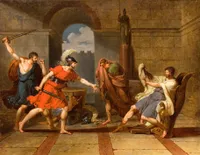
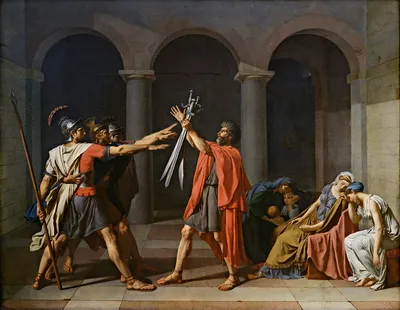
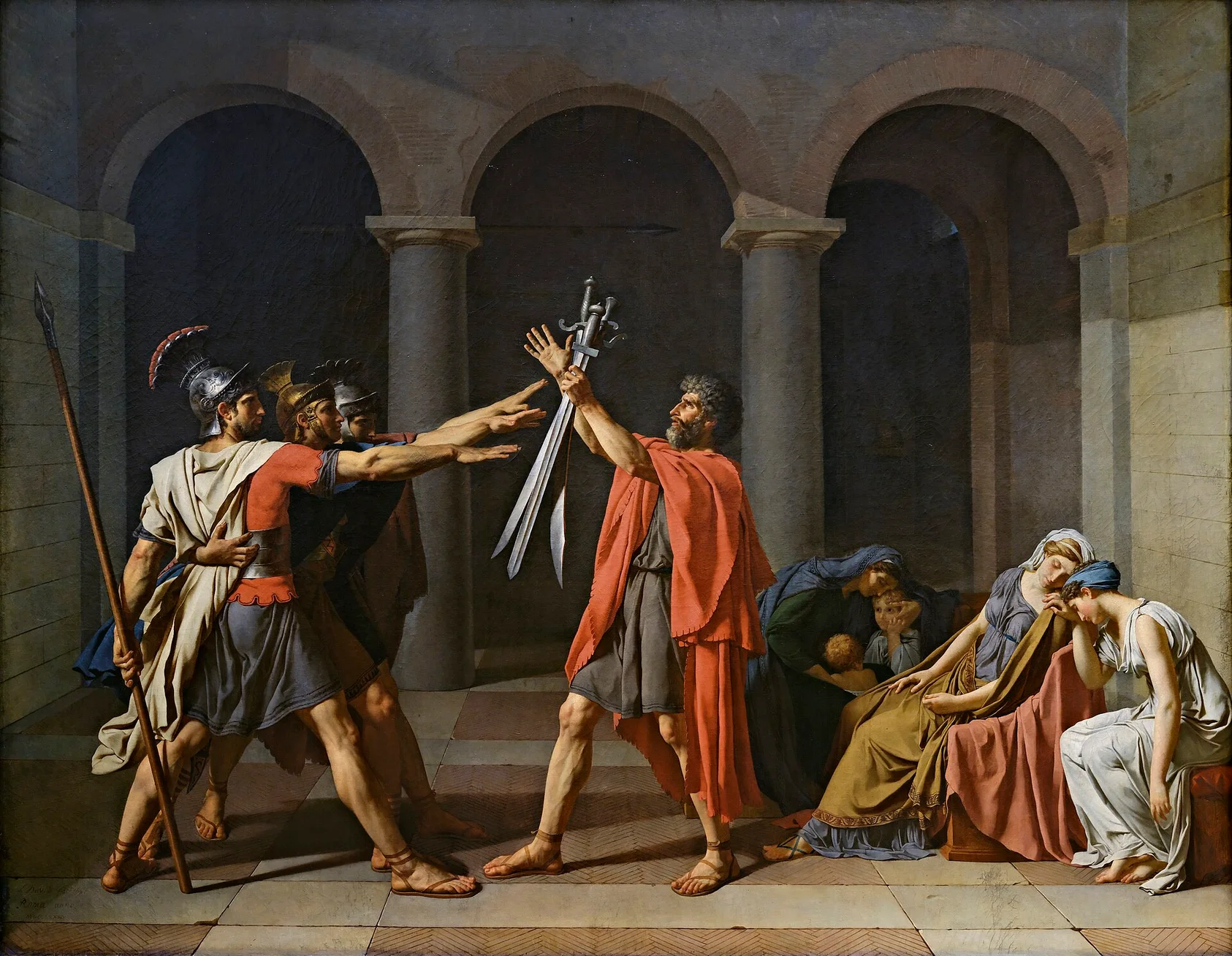
The Oath of the Horatii, 1784. Jacques-Louis David. Musée du Louvre, Department of Paintings, Paris.
Look closer
7 things to notice
 1
01
The promise came from David
Three blades meet above the father's hand, bright against the dark doorway. The Louvre identifies the oath as David's addition to the ancient story. The painting makes that invented ceremony the point toward which the men's bodies converge. A family decision acquires the shape of steel.
02
Only one brother comes home
Three profiles face the swords, each partly hidden behind the next. In the Roman legend, only one of these brothers survives the contest with the Curiatii. David places them together before that separation. The nearest man's eye follows the same direction as the faces behind him.
03
The father gives the weapons
The older man's chin rises above his red cloak, toward the blades he offers. The Louvre reads the ceremony as an example of commitment overriding family feeling. The father participates in that commitment, though his own sons will fight. Light picks out his forehead and open mouth.
04
Either victory brings a loss
The women sit shoulder to shoulder, their heads low above pale and brown clothing. The Louvre names the competing ties: Camilla is promised to a Curiatius, while Sabina has married a Horatius. Their family crosses the battle line. White fabric gathers around the nearer woman's knees.
05
A smaller life beside the oath
Two children sit close to an older woman, partly sheltered by her dark covering. The work's account identifies this group as the brothers' children and their nurse. Their scale changes the family scene: the men have dependents as well as a city. A small face appears beside the dark fabric.
06
Stone gives each group its place
A plain column separates the first two arches, its capital broad and unadorned. The Louvre describes the Doric architecture and three-part arrangement as central to the picture's Neoclassical order. The building gives each human group a separate bay. The column continues down between the extended arms.
07
The date leaves a question
Small lettering marks the stone at lower left, including a Roman-numeral date for 1784. The Louvre retains that date in its heading but places completion in July 1785 in its detailed history. The Oath of the Horatii carries both parts of its making. The earlier year remains on the stone.
Our take
Before anyone fights, the room has divided. In The Oath of the Horatii, three Roman brothers face their father's swords while the women sit apart. Their enemies belong to the same extended family. One woman has a husband among the Roman champions; another is engaged to a man on the opposing side. No outcome can leave this household whole.
The oath itself was David's invention. Livy's Roman history and Corneille's play supplied the family conflict, but neither supplied this ceremony. A royal commission gave him room to make it. The Louvre reads the resulting picture as a lesson in duty intended for Louis XVI's subjects, later adopted by revolutionaries. Before those later meanings, the father waits with three blades in his hand.
The painter's moment
1748–1825Painted it at 36Neoclassicism
A royal deadline had already passed when Jacques-Louis David went back to Rome in 1784. Louis XVI's administration had commissioned a picture of the victorious Horatius for the Salon of 1783. David delayed it while finishing his admission picture for the Royal Academy. Then he obtained permission to work in Italy, changed the chosen episode and widened the planned square canvas. The commission gave him an ancient hero; the finished design gave that hero a family. Studies had explored other moments, including Camilla's death at her brother's hands after the battle. The Met's account of one drawing traces how female grief remained important even as David chose an earlier scene.
The inscription says 1784, but the Louvre's detailed history places most of the painting in the first half of 1785, with completion in July. David opened his Roman studio to visitors in August before sending the canvas to Paris. It arrived for the closing weeks of the Salon in September. The picture measured more than four meters across, wider than the king's original specification. David subsequently kept it in his studio and made a smaller repetition. Its public life crossed into the French Revolution, including another Salon appearance in 1791. A picture made for the king could now be seen under a different political sky.
In its time
The Oath of the Horatii was painted in 1784, when David was 36. Its French title is Le serment des Horaces. Where it stands on Art Through Time:
Its colors
Elsewhere in the world
- 1780The rebellion of Túpac Amaru IIAn Andean uprising against colonial abuse is crushed; its leader is executed.
- 1781Academy of San Carlos foundedAcademic training arrives in Mexico City.
- 1788Colonization of Australia beginsConvicts, Australia's first Jews among them, land on Gadigal country; Aboriginal nations face devastation.
- 1789The French RevolutionPainters take sides; history painting turns political.
The facts
- Title
- The Oath of the Horatii
- Artist
- Jacques-Louis David (1748–1825)
- Date
- 1784
- Original medium
- Oil on canvas
- Style
- Neoclassicism
- Made in
- France
- Collection
- Musée du Louvre, Department of Paintings, Paris
Living with it
The mood
Three arches establish a broad, orderly room inside the room. The raised arms occupy one side; seated figures lower the other. From a distance the swords make a narrow bright center, while the women remain a separate pool of light.
The palette
Walnut and bark run through the columns, floor and clothing, with ebony inside the arches. Bronze warms the father's red cloak and the men's skin. Sand gathers around the women; across a room, their pale clothing answers the bright blades.
Who it finds
- For someone whose family has belonged to opposing sides of an argument; the women must live with either result.
- For someone who remembers a promise made in company; three brothers share one gesture before their paths separate.
- For someone who has watched children absorb an adult decision; two small figures remain beside the nurse.
See it in a room
Your photo is never uploaded, and it's gone when you leave.
The three arches remain legible across a living room, each containing a different arrangement of bodies. At closer range, the shared profiles and the women’s touching shoulders complicate that architectural order. Keep the right side visible from the main seat; the story depends on the people outside the oath as much as those taking it.
A wide wall in a study or dining room suits the horizontal composition. Choose enough width for the small children to remain discoverable at close range. A table below can echo the low stone floor, provided its objects do not interrupt the women at the picture's right edge.
How we make it
- True to the original
- Each file is color-matched to the museum original. If the color isn't right, we print it again, with our compliments.
- On canvas
- Fine-art canvas hand-stretched over a ¾″ solid-wood frame, with mirrored edges so nothing is lost.
- In our floating frame
- Our stretched canvas set in a slim floating frame, with a shadow gap so the painting seems to hover.
- As a framed print
- Archival pigment print on museum-grade cotton paper, in a solid-wood frame with UV-protective glazing.
- Ready to hang on arrival
- It arrives with the hanging hardware attached. No framer, no guesswork.
- Perfect on arrival
- If anything arrives damaged or not as you ordered, send us a photo within 7 days of delivery and we'll make it again, with our compliments.
Completed in 1785, David's family waits on either side of three swords. Give the whole room enough width for both sides to remain visible.