The story · 4 min read
The sentence was his; the grief belongs to everyone in the room.
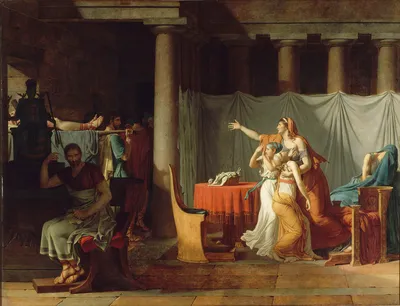
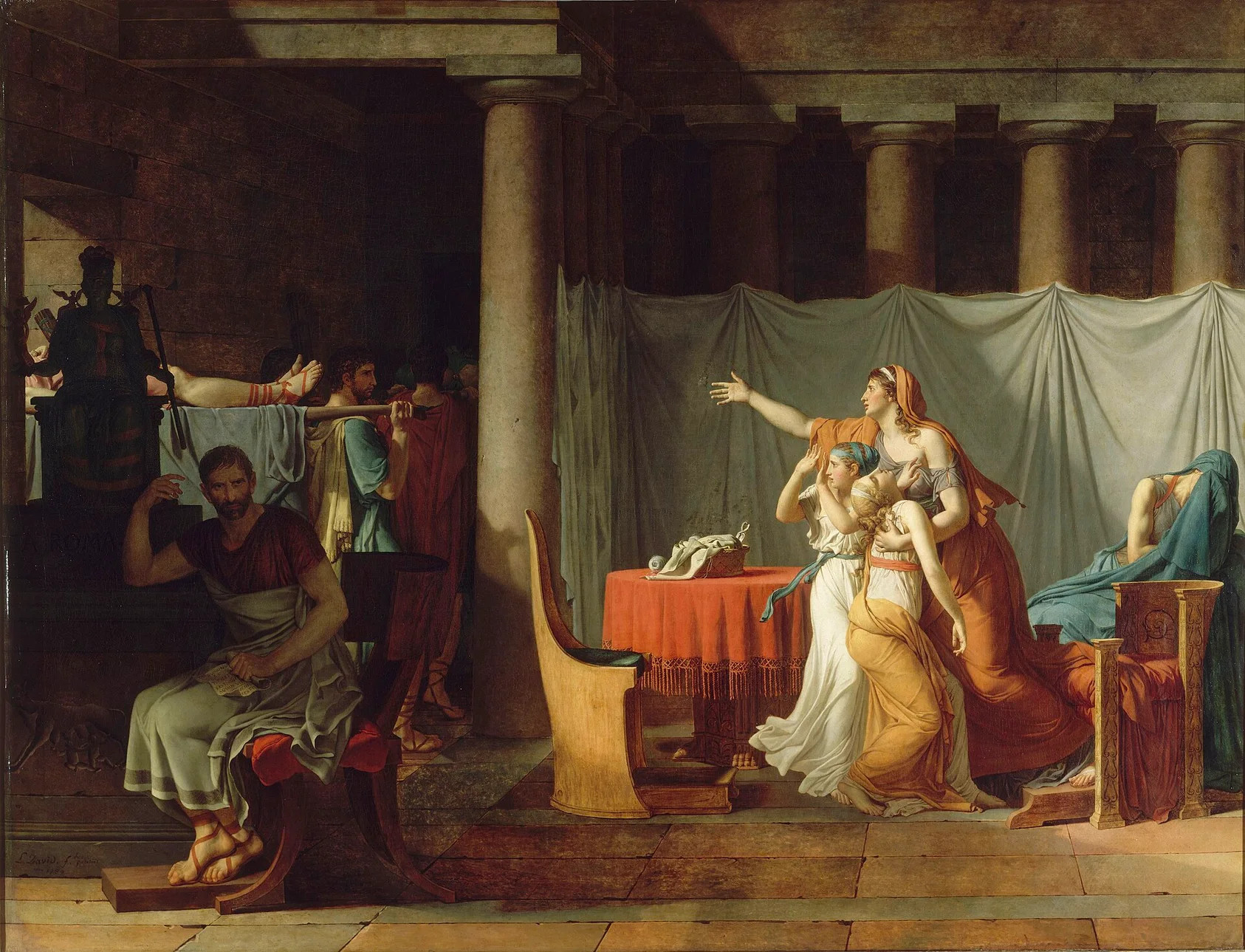
The Lictors Bring to Brutus the Bodies of His Sons, 1789. Jacques-Louis David. Musée du Louvre, Department of Paintings, Paris.
Look closer
7 things to notice
 1
01
He has already given the order
Brutus's face occupies the shadow below the returning bodies, with one hand raised beside it. Bätschmann reads the picture as a difficult conflict between public responsibility and human feeling, rather than a simple model of virtue. The father has no further command to give here. His eyes face out of the darkness.
02
The sons return without a voice
Bare lower legs extend from the litter behind the statue. Stéphane Lojkine identifies the sons as Titus and Tiberius, condemned for a plot supporting the exiled Tarquin. David invented this return to the house after the execution. Red sandal straps cross the pale ankles.
03
Her arm cannot bring them back
The mother's arm stretches toward the litter while her daughters gather against her. The Louvre describes their gestures as grief and incomprehension at the arriving bodies. The family has another response to the sentence besides the father's silence. Her open hand ends in the empty space above the table.
04
The interrupted work stays ready
A basket, pale fabric and scissors sit on the bright red tablecloth. David's imagined homecoming places the Roman story among household things rather than on an execution ground. The small tools need no further symbolic identity to mark a task interrupted. The scissors remain upright beside the cloth.
05
One person cannot watch
A seated woman covers her face with blue-green cloth at the far right. The composition's account identifies her as a servant, adding another member of the household to the grief. She occupies the edge of the family scene without looking toward the litter. Her bare arm remains visible below the covering.
06
The feet contradict the stillness
Brutus's feet cross tightly below the long pale garment. The Louvre reads their contracted position as a sign of pain beneath his seated composure. In the Brutus painting, David gives a small bodily detail the force of an admission. Sandal straps cross the tense toes.
07
Rome sits inside the house
A dark statue rises behind Brutus, with a long staff beside its body. The Louvre identifies it as a figure symbolizing Rome. The public cause for which he condemned his sons has a physical place beside his chair. The statue's edge interrupts the light from the doorway.
Our take
The father sits where the light barely goes. In this Brutus painting, David brings the bodies of two sons into a household whose head has ordered their deaths. Lucius Junius Brutus, a founder of the Roman Republic, condemned them for plotting to restore the monarchy. Their mother sees the returning bodies across the room. He faces away from them.
Louis XVI's administration commissioned the painting, originally asking for a different Roman subject. David changed it before the French Revolution began and exhibited the result in 1789. Art historian Oskar Bätschmann cautions against treating its first reception as a straightforward revolutionary sensation. The conflict is already difficult at the scale of one family. Between the parents, sewing things remain on a red-covered table.
The painter's moment
1748–1825Painted it at 41Neoclassicism
In May 1786, Jacques-Louis David received a royal commission for a scene in which Coriolanus was stopped by his family. During 1787 he substituted Brutus and his dead sons. The change kept Roman history and family conflict, but made the household face the result of a father's decision. David was working toward a public Salon picture long before the Bastille fell in July 1789. The completed canvas arrived at the exhibition in September, after its August opening. Its date belongs to the Revolution's first year, while its commission belongs to the monarchy's established program of historical painting.
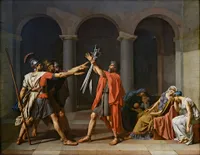
The often-repeated story of an explosive political reception needs care. Bätschmann finds the early criticism concerned with composition, light and shadow, and questions the evidence for a revolutionary sensation in 1789. He places a more explicit political reception in 1790, when performers recreated the painting at the end of a production of Voltaire's Brutus. By then David was becoming more actively involved in revolutionary artistic politics. He exhibited the painting again in 1791 and kept it with The Oath of the Horatii in his Louvre studio. Both works later went to the Luxembourg palace before entering the Louvre's galleries in 1826. The bodies still arrive through the same narrow opening beside the seated father.
In its time
The Lictors Bring to Brutus the Bodies of His Sons was painted in 1789, when David was 41. Where it stands on Art Through Time:
Its colors
Elsewhere in the world
- 1788Colonization of Australia beginsConvicts, Australia's first Jews among them, land on Gadigal country; Aboriginal nations face devastation.
- 1789The French RevolutionPainters take sides; history painting turns political.
- 1791France makes its Jews full citizensThe first country in Europe to grant Jews equal rights.
- 1791The Pale of SettlementRussia confines its Jews to its western borderlands.
- 1795Poland is erased from the mapRussia, Prussia and Austria complete the partitions.
The facts
- Title
- The Lictors Bring to Brutus the Bodies of His Sons
- Artist
- Jacques-Louis David (1748–1825)
- Date
- 1789
- Original medium
- Oil on canvas
- Style
- Neoclassicism
- Made in
- France
- Collection
- Musée du Louvre, Department of Paintings, Paris
Living with it
The mood
A dark seated figure occupies one end of the room, a brightly lit family the other. Between them, a red tablecloth makes a broad warm center. The architecture remains orderly while the people respond to the arrival in different ways.
The palette
Mahogany and bark deepen the father's side, while walnut and bronze run through the columns, chairs and table. Wheat lights skin and the daughters' clothing. Across a room, the red cloth and pale family group separate from the shadow around Brutus.
Who it finds
- For someone who has made a decision others had to live with; the father and mother occupy separate light.
- For someone who remembers work left unfinished by bad news; the sewing basket remains ready on the table.
- For someone who recognizes strain in a person's posture before their words; the father's feet tell another story.
See it in a room
Your photo is never uploaded, and it's gone when you leave.
From a distant seat, the room divides into dark and light, with the red table between them. A closer look finds the sewing basket and the father's crossed feet, small details that complicate the broad arrangement. Keep both edges visible; the covered face at right belongs to the household too.
A wide wall in a study gives the opposing groups enough separation to be read. Choose a size that preserves the small arriving feet at left without requiring the viewer to stand against the frame. Low furniture can sit beneath the image, leaving the painted floor and the father's sandals in clear view.
How we make it
- True to the original
- Each file is color-matched to the museum original. If the color isn't right, we print it again, with our compliments.
- On canvas
- Fine-art canvas hand-stretched over a ¾″ solid-wood frame, with mirrored edges so nothing is lost.
- In our floating frame
- Our stretched canvas set in a slim floating frame, with a shadow gap so the painting seems to hover.
- As a framed print
- Archival pigment print on museum-grade cotton paper, in a solid-wood frame with UV-protective glazing.
- Ready to hang on arrival
- It arrives with the hanging hardware attached. No framer, no guesswork.
- Perfect on arrival
- If anything arrives damaged or not as you ordered, send us a photo within 7 days of delivery and we'll make it again, with our compliments.
David's 1789 household receives the consequence of one man's sentence. Hang the wide room where its dark father and illuminated family can both be studied.