The story · 4 min read
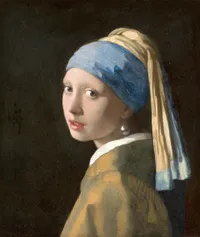
She turned around, and she is still about to speak.
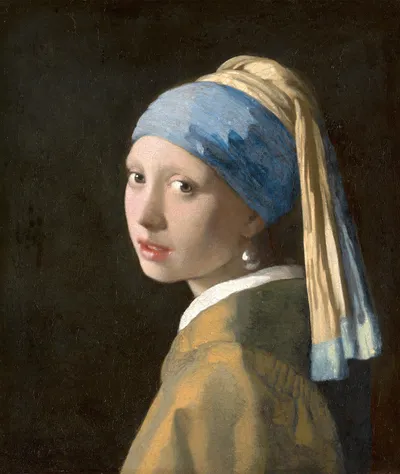
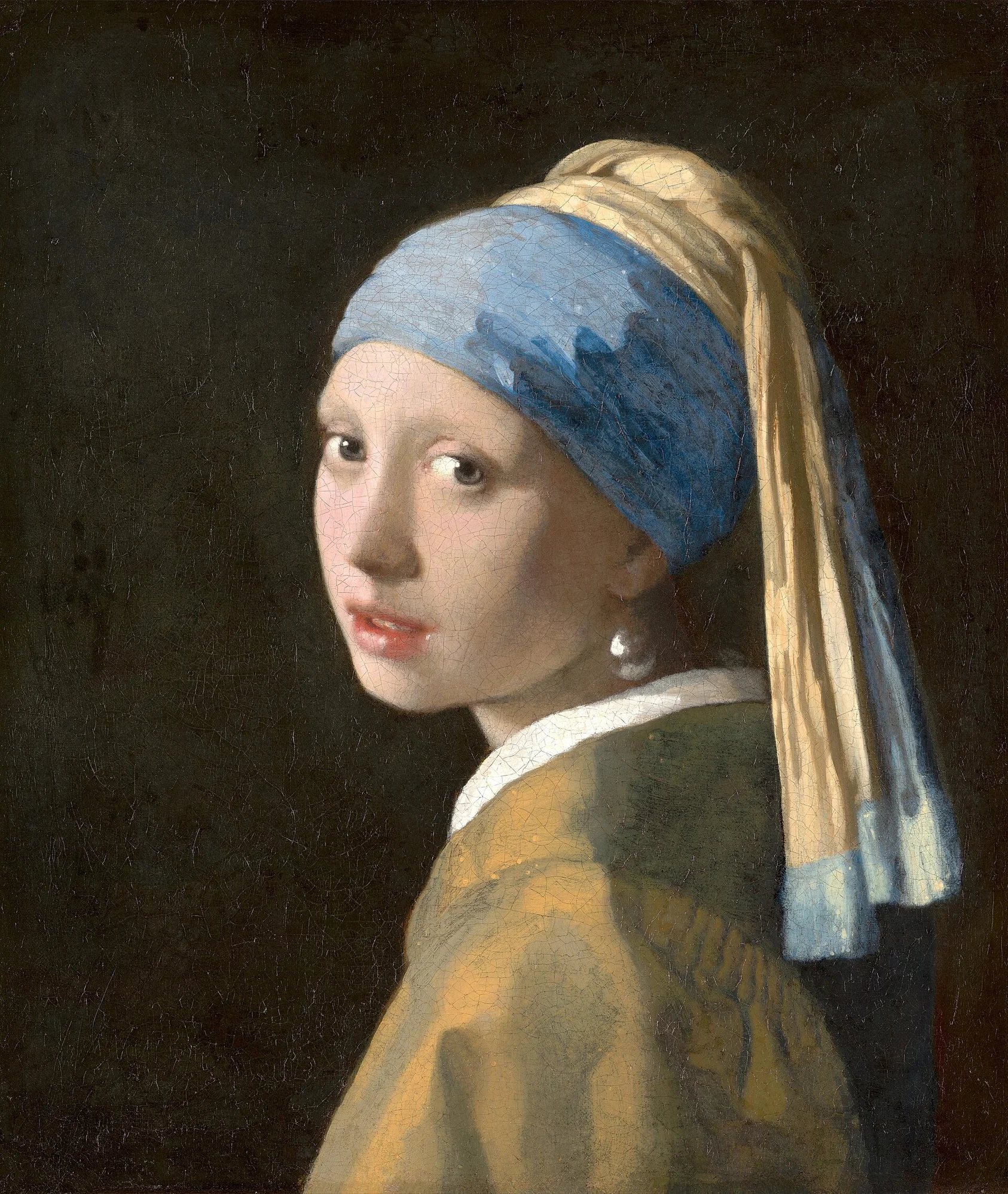
Girl with a Pearl Earring, 1665. Johannes Vermeer. Mauritshuis.
Look closer
7 things to notice
 1
01
Caught mid-turn
She turns back over her left shoulder, lit from the left, her far cheek sinking into soft shadow. The 1994 restoration made her gaze toward the viewer feel more intimate. Who she is, nobody knows: the writers Jean-Louis Vaudoyer and Lawrence Weschler believed she was Vermeer's eldest daughter, Maria, while others see a Sibyl, a biblical figure, or no one real at all.
02
Someone real looked back
Two wide grey-brown eyes look sideways at us, each holding one small point of white light. The 2018 study found fine eyelashes around them, and from that study's findings researchers concluded that Vermeer had a living sitter in front of him, in an actual room, rather than an imagined ideal.
03
The word she never says
Her lips are parted just enough to show a glint of teeth, and two small touches of white make them glisten. It is the least settled part of the face, as if she has drawn a breath to speak and Vermeer stopped the clock before she could.
04
The pearl that may not be there
Look closely and the earring is almost nothing: a bright highlight above, a faint reflection of the white collar below, with no outline and no hook to hold it to her ear. It has been called an illusion, and in 2014 the Dutch astrophysicist Vincent Icke argued that it looks more like polished tin than a pearl. The jewel the painting is named for seems to be made mostly of light.
05
A fortune in blue
Her face and the cloth are painted with a short list of pigments, and natural ultramarine is one of them: an extremely expensive pigment made from lapis lazuli, which Vermeer used more lavishly than any other painter of his century. Here the blue is laid on in loose, visible strokes, pale where it catches the light and deep in the folds, as if the costliest color he owned belonged on her.
06
Dressed for somewhere far away
A long tail of pale yellow cloth falls from the turban to her shoulder. The exotic dress and the oriental turban seem to make her a stranger from far away, and for a long time the painting was simply called Girl with a Turban. The art historian Andrew Graham-Dixon reads the clothes differently: he believes she is Magdalena van Ruijven, the 12-year-old daughter of Vermeer's chief patron, and that the biblical-style clothing may mean the painting marked her baptism into her family's Remonstrant church.
07
She was never alone in the dark
The dark behind her looks empty. The 2018 study found that Vermeer painted a green curtain there, with diagonal folds on the right, and that two pigments in its green glaze, indigo and weld, have faded over time. The room has slipped away around her, as if to leave her face alone in the night.
Our take
She has just turned around. Girl with a Pearl Earring is Vermeer's study of a head, a tronie, not a portrait of anyone in particular, and that may be why it feels so personal: her eyes find us over her shoulder, and her lips part as if she were about to say our name. Nobody knows who she was. She has not said a word, and we feel we have always known her.
It is also a painting of what isn't there. The pearl that gave it its name has no outline and no hook; it has been called an illusion, a highlight and a reflection that the eye turns into a jewel. Look long enough and the whole picture works that way, as if Vermeer painted not a girl but the second you notice someone looking back.
The painter's moment
1632–1675Painted it at 33Dutch Golden Age
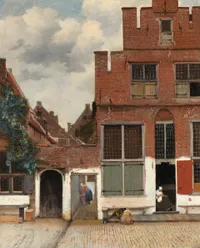
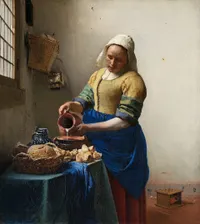
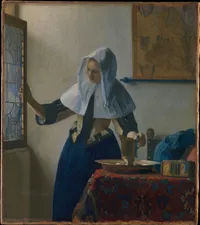
Johannes Vermeer was about 33. He painted in the front room on the second floor of his mother-in-law's house in Delft, and he worked slowly, probably finishing about three commissioned paintings a year. Delft's painters' guild elected him its head in 1662 and re-elected him in 1663, the same year that the French traveller Balthasar de Monconys came to visit and Vermeer had no paintings to show him. Pearls run all through his work, appearing in 21 of his paintings, among them Woman with a Pearl Necklace. Here he took away almost the whole room and kept only the face. He signed it "IVMeer" but did not date it, so about 1665 is an estimate. Around the same years he painted another head study, Study of a Young Woman, now in the Metropolitan Museum of Art.
Its first recorded owner was Pieter van Ruijven, the Delft patron whose buying kept Vermeer afloat, who had it until 1674. Jacob Dissius owned it from 1682 to 1695. In 1881 it came up at an auction in The Hague with its paint coming loose, and Arnoldus Andries des Tombe bought it for two guilders plus thirty cents in fees. He had no heirs, and in 1902 he left it to the Mauritshuis in his will. During the Nazi occupation it was hidden for two years in a bombproof bunker under the museum, then in the St. Pietersberg caves near Maastricht. After years of touring the world, it came back in 2014 to stay.
In its time
Girl with a Pearl Earring was painted in 1665, when Vermeer was 33. Its Dutch title is Meisje met de parel. Where it stands on Art Through Time:
Its colors
The facts
- Title
- Girl with a Pearl Earring
- Artist
- Johannes Vermeer (1632–1675)
- Date
- 1665
- Original medium
- Oil on canvas
- Style
- Dutch Golden Age
- Made in
- Netherlands
- Collection
- Mauritshuis
Living with it
The mood
Intimate, and quietly charged. It doesn't decorate a room so much as put someone in it: a face that turns toward whoever walks in. Rooms with her in them feel a little less empty, even at night.
The palette
Read as a whole, it is almost all dark and earth: the night behind her, the olive shadows of her jacket, the ochre of her skin. The blue band and the yellow cloth are too small to move those averages, and they are exactly what the eye goes to first.
Who it finds
- Anyone who still remembers a face they glimpsed once, long after forgetting where.
- People who are at peace not knowing. Nobody knows who she is, and some would rather keep the question than be given an answer.
- Anyone who has been looked at, just once, as if they were the only person in the room.
See it in a room
Your photo is never uploaded, and it's gone when you leave.
From across a room it comes down to three things: a pale face in the dark, a flash of blue and yellow, and one white point at her ear. Up close it gives you the rest: the catchlights in her eyes, the wet light on her lips, the tiny dots of paint along her shoulder, and the earring that turns into a highlight and a reflection when you look for it.
Hang it where someone arrives: an entrance, a landing, the wall you face from a desk or a bed, so that she is turning toward you each time. The original is small, 44.5 by 39 cm, and a print near that size keeps it close and private; go larger only if she will be seen from across the room, so her face can still meet you there.
How we make it
- True to the original
- Each file is color-matched to the museum original. If the color isn't right, we print it again, with our compliments.
- On canvas
- Fine-art canvas hand-stretched over a ¾″ solid-wood frame, with mirrored edges so nothing is lost.
- In our floating frame
- Our stretched canvas set in a slim floating frame, with a shadow gap so the painting seems to hover.
- As a framed print
- Archival pigment print on museum-grade cotton paper, in a solid-wood frame with UV-protective glazing.
- Ready to hang on arrival
- It arrives with the hanging hardware attached. No framer, no guesswork.
- Perfect on arrival
- If anything arrives damaged or not as you ordered, send us a photo within 7 days of delivery and we'll make it again, with our compliments.
Vermeer caught her turning around 1665, and she is still about to speak. Give her someone to look at.