The story · 4 min read
The murder is real; the innocence has been carefully painted.
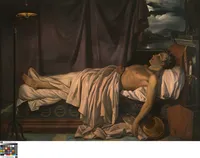
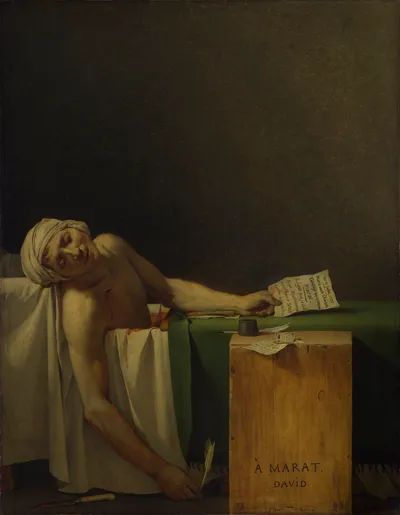
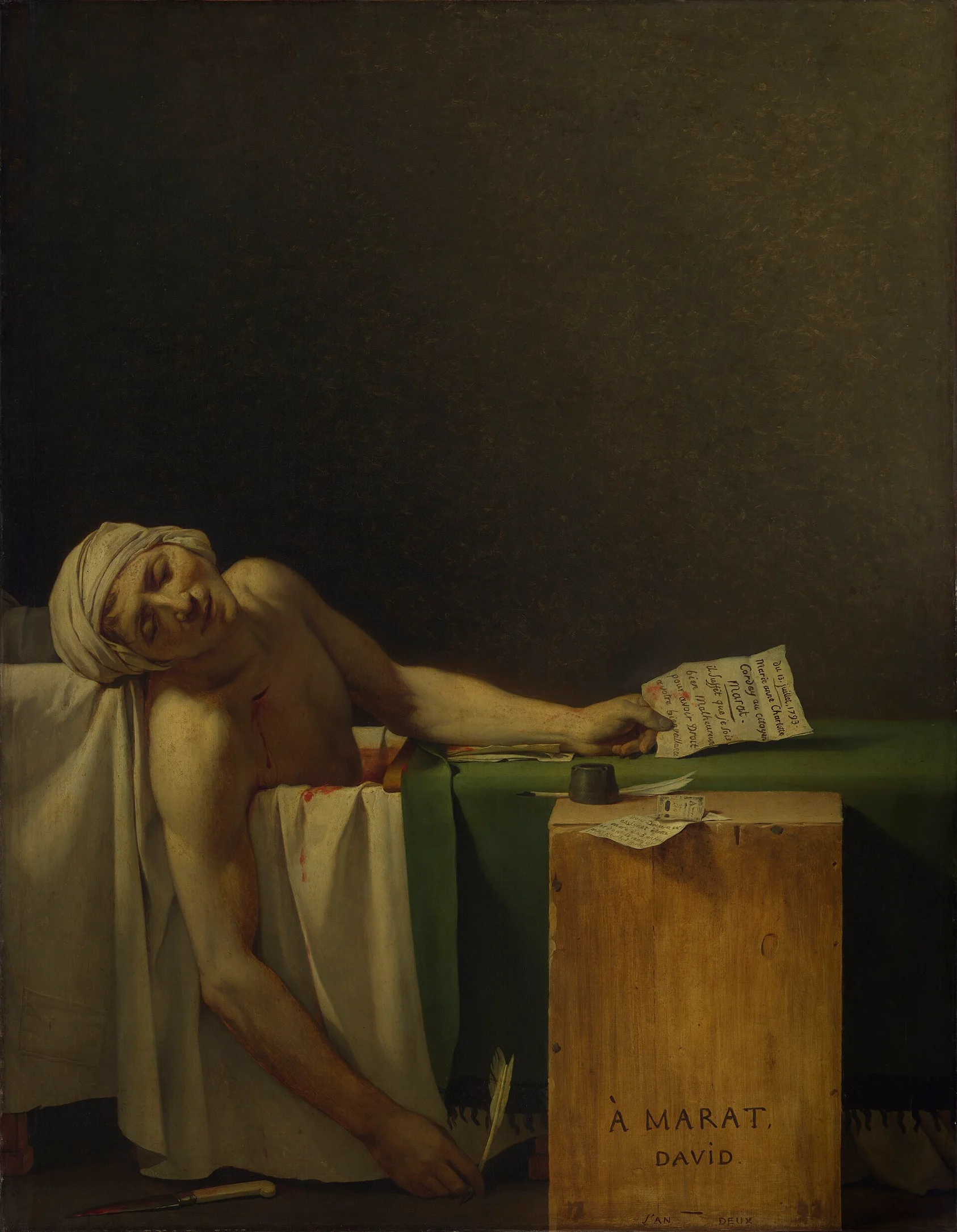
The Death of Marat, 1793. Jacques-Louis David. Royal Museums of Fine Arts of Belgium, Brussels.
Look closer
7 things to notice
 1
01
The illness leaves no mark
Marat's face hangs beneath a pale cloth wrapped around his head. Beth Harris points out that David gives no visible sign of the skin disease that had driven him to spend hours in the bath. The painter has made the face smoother than the living man's suffering allowed. His eyes are closed.
02
The letter has been rewritten
The paper in his left hand names Charlotte Corday and carries the date of the murder. David changed her wording, making the appeal concentrate on misery and kindness, as the Web Gallery of Art's comparison explains. The painting supplies its own evidence of Marat's generosity. The writing faces outward for us to read.
03
A writer's hand goes still
The lowered right hand has almost reached the floor, with a quill still between its fingers. Versailles identifies the pen with Marat's work as a journalist. Steven Zucker also compares the body's pose with a Pietà, the mourning of the dead Christ. A tool of political work remains beside the slack fingers.
04
The painter puts his name below
The front of the wooden box bears a dedication to Marat, followed by David's name and the republican date, Year Two. The museum records all three parts of the inscription. A plain piece of furniture becomes the place where the painter addresses the dead. His name is smaller than Marat's.
05
The bath became a workplace
A white cloth covers the bath's rim beside Marat's body, with green fabric over the writing surface nearby. The museum explains that bathing relieved the pain of his skin condition. He worked while receiving that relief. The stained linen marks the edge of a place that served two daily needs.
06
The killer remains outside the frame
A knife lies at the lower left, its handle light against the floor. Corday used a knife to kill Marat, but David excludes her figure. Curator Frederik Leen reads that removal of surrounding people and ordinary circumstances as part of the painting's heroic construction. The pale handle points toward the bath.
07
The darkness took several directions
The upper right contains a broad, uneven field of brown-black paint. Catherine Defeyt and her colleagues found that David made this background with broken strokes running in different directions, using earth pigments and carbon black. It is worked paint rather than an untouched void. Faint lighter passages interrupt the darkness.
Our take
The pen remains in his hand after the work has stopped. Marat lies dead in the bath, one arm dropping toward the floor, the other still extended with a letter. A small wound and stained cloth establish the violence. Above him, nearly half the canvas contains no person or object. David has left the dead man alone.
He was painting a friend and political ally, killed by Charlotte Corday on July 13, 1793. The picture asks us to mourn Marat as a generous servant of the Revolution, although his journalism had also urged ruthless political action. David altered the wording of Corday's letter to emphasize an appeal to his kindness. This is a memorial built from choices. The note faces us clearly, while the knife lies low in shadow.
The painter's moment
1748–1825Painted it at 45Neoclassicism
In the summer of 1793, Jacques-Louis David was inside the machinery of the French Revolution. He sat in the National Convention and had voted for Louis XVI's execution. Marat was both a friend and a political ally. When Charlotte Corday killed the journalist in his Paris bath on July 13, the Convention's request for a memorial came the next day. David was being asked to give a public form to a death that mattered personally to him. The commission also offered the revolutionary government a martyr. Painter, mourner and political participant occupied the same position before this canvas.
He announced the picture's completion in October, about three months after the assassination, and gave it to the Convention in November. It hung beside his memorial to the murdered deputy Le Peletier, near the assembly's president. That official place did not last. After Robespierre's fall in 1794, David himself was imprisoned; a second arrest followed in 1795. The two memorial pictures were removed from the assembly that February and returned to him later in the year. Marat's canvas eventually passed through David's family and entered the Royal Museums of Fine Arts of Belgium in 1893, under a grandson's bequest. The painter's political fortunes had changed much sooner.
In its time
The Death of Marat was painted in 1793, when David was 45. Its French title is La Mort de Marat. Where it stands on Art Through Time:
Its colors
Elsewhere in the world
- 1788Colonization of Australia beginsConvicts, Australia's first Jews among them, land on Gadigal country; Aboriginal nations face devastation.
- 1789The French RevolutionPainters take sides; history painting turns political.
- 1791France makes its Jews full citizensThe first country in Europe to grant Jews equal rights.
- 1791The Pale of SettlementRussia confines its Jews to its western borderlands.
- 1795Poland is erased from the mapRussia, Prussia and Austria complete the partitions.
The facts
- Title
- The Death of Marat
- Artist
- Jacques-Louis David (1748–1825)
- Date
- 1793
- Original medium
- Oil on canvas
- Style
- Neoclassicism
- Made in
- France
- Collection
- Royal Museums of Fine Arts of Belgium, Brussels
Living with it
The mood
A pale body and a wooden box occupy the lower part of a large dark field. The image gives a wall a severe division between light and shadow. Its few objects remain legible at a distance, with the letter drawing attention closer.
The palette
Walnut, bark and charcoal account for the broad background and the deepest corners. Bronze and ochre appear in the wooden box and warm skin passages. The white linen, browned by the image's overall warmth, makes the strongest light shape against those dark colors.
Who it finds
- For someone who has reconsidered a public hero after learning the fuller history; David's choices remain visible in the smooth face and letter.
- For someone who has inherited a letter after its writer died; the surviving paper here carries a deliberately constructed account.
- For someone who has watched a friend's memory become a public cause; the dedication records both affection and political allegiance.
See it in a room
Your photo is never uploaded, and it's gone when you leave.
Across a room, the body, linen and box form a low arrangement beneath the empty upper field. Close up, the letter and dedication make the image's political purpose more specific. An adequately sized print matters here because the writing is part of what David asks us to examine.
A study or reading room gives the work a place where its history can accompany looking. Even light will preserve the background's uneven surface and the objects near the floor. A narrow frame suits the plain box inside the picture. Choose the position with the subject in mind: this is an image of an actual murder and a deliberately shaped public memorial.
How we make it
- True to the original
- Each file is color-matched to the museum original. If the color isn't right, we print it again, with our compliments.
- On canvas
- Fine-art canvas hand-stretched over a ¾″ solid-wood frame, with mirrored edges so nothing is lost.
- In our floating frame
- Our stretched canvas set in a slim floating frame, with a shadow gap so the painting seems to hover.
- As a framed print
- Archival pigment print on museum-grade cotton paper, in a solid-wood frame with UV-protective glazing.
- Ready to hang on arrival
- It arrives with the hanging hardware attached. No framer, no guesswork.
- Perfect on arrival
- If anything arrives damaged or not as you ordered, send us a photo within 7 days of delivery and we'll make it again, with our compliments.
David painted Marat's interrupted work in 1793. Place the full dark rectangle where the letter and dedication can be examined at close range.