The story · 4 min read
One person stops; the same evening lets the others go on.
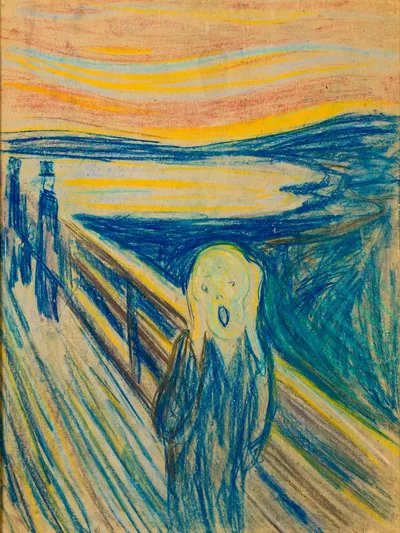
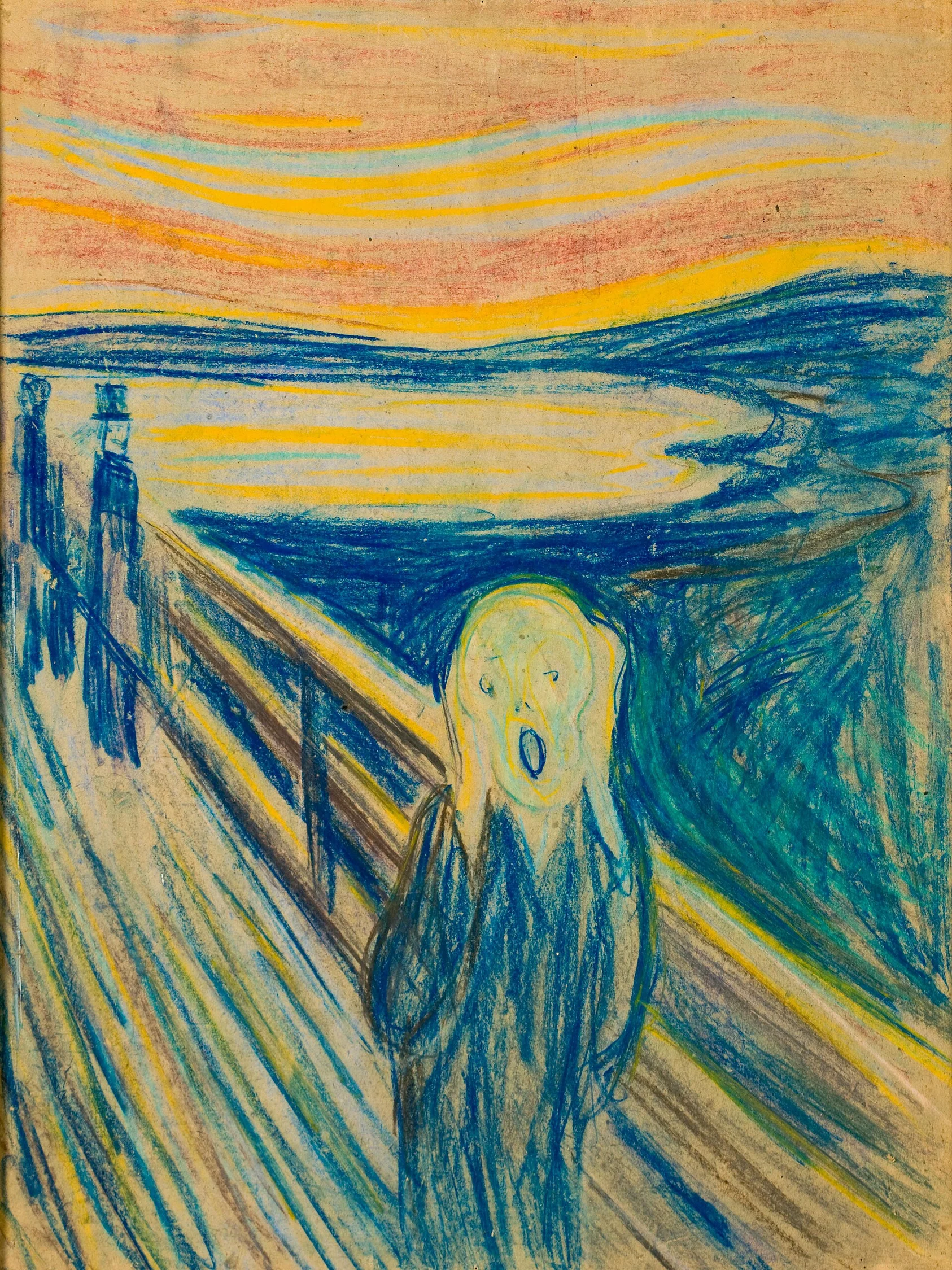
The Scream, 1893. Edvard Munch. MUNCH (Munchmuseet), Oslo.
Look closer
7 things to notice
 1
01
No one person owns this face
The central head has an oval mouth and little more than curved marks for eyes. MUNCH describes the protagonist as having no fixed gender, ethnicity or social identity. That openness helps explain why so many people recognize a feeling here. The face supplies an expression without supplying a name.
02
The hands leave a question open
A long pale hand follows the right side of the head. Curator Ute Kuhleman Falck asks whether the figure is making a scream or responding to one. Munch's text places a scream in the surrounding natural world. The gesture can be read as an attempt to shut something out.
03
The companions keep their distance
Two dark hats sit above narrow blue shoulders at the far left. Falck reads the companions as people who continue without sharing the foreground figure's experience. Their presence makes the event unequal: the same walk has produced different reactions. The small hat brims remain level above the slanting road.
04
The sky began in a notebook
Yellow, pale blue and reddish bands cross the upper sky. In Nice in the winter of 1892, Munch wrote a prose poem recalling a sunset walk and clouds that seemed aflame. Falck traces the image back to that text. Here the remembered sky is divided into long colored lines.
05
A real fjord became unfamiliar
The blue shoreline curves around a pale area of water at the right. MUNCH locates the remembered walk above Oslofjord. Art historian Noelle Paulson reads the picture as a remembered sensation rather than a straightforward record of a view. The distant shore has the same unsettled curves as the figure's outline.
06
The road keeps its straight lines
The brown railing cuts diagonally across the blue landscape left of the figure. Paulson contrasts this rigid structure with the curving forms of body, land and sky. The road offers a clear route through a scene whose other shapes will not stay straight. Its parallel rails continue behind the figure.
07
Another picture was on the back
Blue crayon lines leave the tan support exposed through the lower body. The museum records a version of Vampire on the reverse of this cardboard. Before 1950 the board was split and the two images mounted separately on fiberboard. This spare-looking surface once belonged to two finished pictures.
Our take
The mouth is open, but the picture cannot tell us where the sound begins. A pale figure faces us with both hands beside its head. Two people remain farther along the road, upright and separate from the curves of water and sky. The rail leads toward them. The foreground figure cannot seem to follow.
Munch had written about this experience before making the image: a walk with friends, a changed sunset and the sensation of a scream moving through nature. The version here is his 1893 crayon drawing, with the cardboard visible between the marks. Its yellow sky and blue lines are less densely worked than the better-known painted version. Curator Ute Kuhleman Falck keeps the central question open: someone may be screaming, or reacting to a scream. The hands remain beside the ears.
The painter's moment
1863–1944Painted it at 30Symbolism; precursor to Expressionism
In 1892, Edvard Munch arrived in Berlin to exhibit with the city's artists' association. His pictures divided its members so sharply that the show closed after one week. He treated the scandal as useful publicity in a letter to his aunt Karen. It followed several difficult years: his father had died in 1889 while Munch was studying in France, and memories of loss had become part of his work. Berlin offered a new circle around the writers August Strindberg and Stanisław Przybyszewski. In their discussions, the inward subjects he pursued could find company even when his exhibitions met hostility.
During 1892 he made Despair, a precursor to The Scream, and wrote the account of a walk that would accompany the developing image. In 1893 the motif took its familiar form. This crayon drawing is one of four main color versions, and one of the two Munch kept. He made a lithograph in 1895, allowing the composition to circulate in another medium. The drawing now belongs to MUNCH in Oslo. The same sheet of cardboard once carried Vampire on the other side; separating those images before 1950 changed the object itself. The familiar face has a material history beyond its many reproductions.
In its time
The Scream was painted in 1893, when Munch was 30. Where it stands on Art Through Time:
Its colors
Elsewhere in the world
- 1890Wounded KneeU.S. soldiers kill some 250 Lakota men, women and children.
- 1893Hawaiʻi's queen is overthrownU.S.-backed businessmen depose Liliʻuokalani; annexation follows in 1898.
- 1893New Zealand women win the voteThe first self-governing country to grant it.
- 1894The Dreyfus AffairA Jewish officer is falsely convicted of treason; France, and its painters, split in two.
- 1896The Battle of AdwaEthiopia defeats Italy and stays independent.
The facts
- Title
- The Scream
- Artist
- Edvard Munch (1863–1944)
- Date
- 1893
- Original medium
- Painting
- Style
- Symbolism; precursor to Expressionism
- Made in
- Norway
- Collection
- MUNCH (Munchmuseet), Oslo
Living with it
The mood
Yellow and tan occupy the broad upper sky, while blue curves gather around one pale face. The diagonal railing gives the wall a strong slant. Compared with the painted versions, this drawing leaves more bare surface between its colored marks.
The palette
Ochre and flax belong to the exposed warm support and the sky's yellow bands. Sage and jade appear where lighter green-blue marks cross those areas; teal defines the figure, companions and shoreline. The pale head remains the clearest shape inside the blue lower half.
Who it finds
- For someone who has stopped during an ordinary walk because everything suddenly felt different; Munch made an image from that remembered interruption.
- For someone whose companions did not notice what overwhelmed them; the two distant figures continue inside the same scene.
- For someone who knew this face through reproductions before seeing the drawing; the bare cardboard gives the familiar gesture another texture.
See it in a room
Your photo is never uploaded, and it's gone when you leave.
Across a room, the head, open mouth and diagonal rail register immediately. At closer range, the drawing's grain and incomplete coverage distinguish this version from a painted surface. A medium print allows the small distant figures and the gaps between crayon marks to remain visible.
A study or a room where images receive close attention gives its familiar subject space to become specific again. Plain surrounding surfaces help the tan and blue retain their differences. Avoid placing it among many competing faces or patterns; the central head already commands attention. A narrow frame suits the drawn lines and keeps the broad sky within a clear boundary.
How we make it
- True to the original
- Each file is color-matched to the museum original. If the color isn't right, we print it again, with our compliments.
- On canvas
- Fine-art canvas hand-stretched over a ¾″ solid-wood frame, with mirrored edges so nothing is lost.
- In our floating frame
- Our stretched canvas set in a slim floating frame, with a shadow gap so the painting seems to hover.
- As a framed print
- Archival pigment print on museum-grade cotton paper, in a solid-wood frame with UV-protective glazing.
- Ready to hang on arrival
- It arrives with the hanging hardware attached. No framer, no guesswork.
- Perfect on arrival
- If anything arrives damaged or not as you ordered, send us a photo within 7 days of delivery and we'll make it again, with our compliments.
Munch's crayon Scream of 1893 leaves warm cardboard between blue lines. Give this particular version space for its pale sky and distant companions.