The story · 4 min read
A whole sky in motion, painted from behind a barred window.
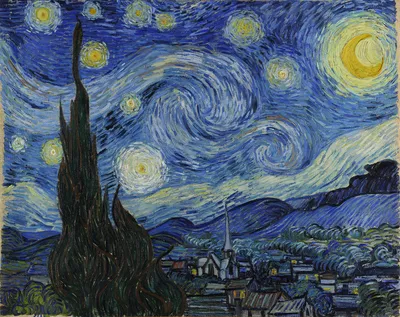
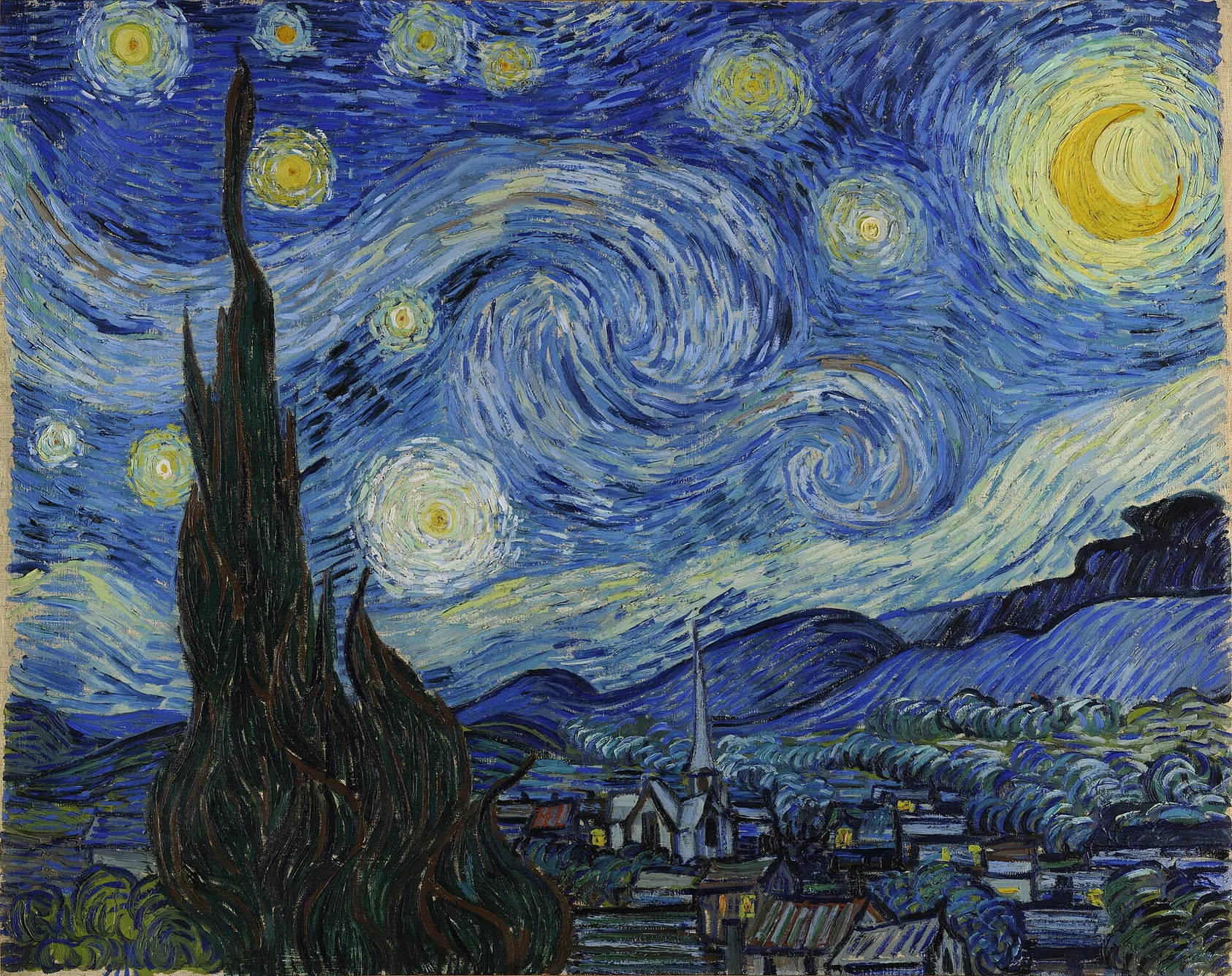
The Starry Night, 1889. Vincent van Gogh. The Museum of Modern Art.
Look closer
7 things to notice
 1
01
A flame that wants the sky
The cypress rises from the bottom edge almost to the top of the canvas, dark green and brown, shaped like a flame. Van Gogh made it larger than life and brought it close to the front of the picture. The art historian Vojtech Jirat-Wasiutynski reads the cypresses as natural obelisks, linking heaven and earth.
02
Not a star at all
Just right of the cypress, the brightest light in the sky sits inside rings of pale strokes. It is not a star but the planet Venus, the morning star. In early June 1889 he wrote that he had watched it from his window before sunrise, and that it looked very big.
03
A dream, or the end of the world
Along the top left, small yellow stars each turn inside rings of pale blue and green. The art historian Sven Loevgren linked the stars to the eleven stars of Joseph's dream in Genesis, and Meyer Schapiro read a hidden reference to the Book of Revelation. Van Gogh himself said the painting was not a return to romantic or religious ideas.
04
The sky breaks like a wave
Across the middle of the sky, pale blue, white and cream strokes curl over like a wave about to break. The art historian Albert Boime read it as a spiral galaxy or a comet, and the Harvard astronomer Charles A. Whitney thought it could be wind, recalling the mistral of Provence. The critic Robert Hughes compared the whirl of stars to Hokusai's Great Wave.
05
The moon he wanted
At the top right, a thick orange-yellow crescent burns inside a wide halo of circling strokes. When he painted it, the real moon was waning gibbous, not a crescent, as if he gave the sky the moon it needed rather than the one it had. For the moon and stars he used a rare pigment, Indian yellow, together with zinc yellow.
06
A steeple from somewhere else
Above the rooftops, a thin white-and-blue spire points up into the hills and the sky. The village is the only part of the picture he could not see from his room; he invented it. The art historian Ronald Pickvance thought the steeple looks more Dutch than Provençal, as if home had found its way into the view.
07
Someone is already up
Down in the village, a few windows hold small squares of yellow lamplight, one beside the red-roofed cottage near the cypress. It is the hour just before sunrise. While the sky churns overhead, someone below seems to have lit a lamp and started the day, unaware of it all.
Our take
The canvas is 73.7 cm tall, about the height of a kitchen table, and Van Gogh put a whole sky in motion inside it. It is the view east from his window at the asylum in Saint-Rémy, just before sunrise in June 1889. The stars turn, the sky rolls over like surf, and a cypress climbs out of the dark as if to join them. Below the hills the village is asleep, and above them nothing is.
It feels like a painting about looking, and not being able to stop. He painted the view from that barred window at least 21 times, and only this once at night. Even then he painted it by daylight, in his ground-floor studio, from a morning star he had watched and a village he invented. He called it a 'failure', and what is moving in that sky has been read as a galaxy, a comet and the wind.
The painter's moment
1853–1890Painted it at 36Post-Impressionism
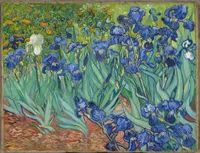
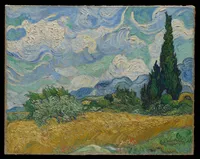
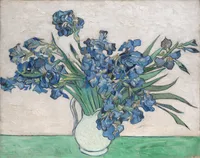
Vincent van Gogh was about 36. On the evening of 23 December 1888, after an argument, he went to his room, seemed to hear voices, and cut his ear. The next day his younger brother Theo, who paid his way and had written to him for years, proposed to Jo Bonger. On 8 May 1889 a Protestant clergyman, Frédéric Salles, took Vincent to the Saint-Paul-de-Mausole asylum at Saint-Rémy-de-Provence, where he had two rooms with barred windows and used one of them as a studio. That month he painted Irises, now in the J. Paul Getty Museum, and Green Wheat Field with Cypress, the first painting he made outdoors at the asylum. Around 23 May he wrote to Theo about the view through the iron bars of his window.
The Starry Night was finished by about 18 June, when he wrote to Theo that he had a new study of a starry sky. Less than a month later, in July, the mistral set off his first breakdown at the asylum. He held the painting back at first, then sent it to Theo in Paris on 28 September with nine or ten other paintings. On 22 October Theo wrote that Vincent's search for style took away the real feeling of things, and in late November Vincent called the painting a 'failure' in a letter to Émile Bernard. The Museum of Modern Art in New York has owned it since 1941, acquired through the Lillie P. Bliss Bequest.
In its time
The Starry Night was painted in 1889, when Van Gogh was 36. Its Dutch title is Sterrennacht. Where it stands on Art Through Time:
Its colors
Elsewhere in the world
- 1884The Berlin ConferenceEurope's powers divide Africa among themselves.
- 1887French Indochina is formedFrance rules Vietnam and Cambodia, and later Laos.
- 1888Brazil abolishes slaveryThe Golden Law makes Brazil the last country in the Americas to end it.
- 1890Wounded KneeU.S. soldiers kill some 250 Lakota men, women and children.
- 1894The Dreyfus AffairA Jewish officer is falsely convicted of treason; France, and its painters, split in two.
The facts
- Title
- The Starry Night
- Artist
- Vincent van Gogh (1853–1890)
- Date
- 1889
- Original medium
- Oil on canvas
- Style
- Post-Impressionism
- Made in
- Netherlands
- Collection
- The Museum of Modern Art
Living with it
The mood
Restless and wide awake, the way a clear night is when you can't sleep. It doesn't quiet a room; it gives the room a sky and something to keep coming back to. It reads a little differently every time you look up.
The palette
Nearly all of it is blue, from slate to deep indigo, and pigment analysis finds ultramarine and cobalt blue in the sky. The cypress is the darkest thing in it and the pale sage of the halos carries the light, but what you see from across a room is the small, hot yellow of the moon and stars.
Who it finds
- Anyone who has lived through a hard season with one window to look out of. He saw this view through iron bars, and made this out of it.
- Anyone who has made the same thing again and again, trying to get it right. He painted this window at least 21 times, and still called this one a failure.
- People who would rather keep a question than settle it: a galaxy, the wind, a wave, Joseph's dream, Revelation. The painting has never said which.
See it in a room
Your photo is never uploaded, and it's gone when you leave.
From across a room it reads as movement: one dark flame on the left, a sky rolling from side to side, the moon burning in the corner. Come close and it turns into strokes: the rings around each star, the thin steeple, the few yellow windows of a village that is still asleep.
Hang it where people look up: above a sofa or a bed, at the end of a hall, in a study where the lamp is still on at 2 a.m. And give it the largest size the wall allows. The original is only 73.7 cm tall, and a sky this big needs at least that much room to turn.
How we make it
- True to the original
- Each file is color-matched to the museum original. If the color isn't right, we print it again, with our compliments.
- On canvas
- Fine-art canvas hand-stretched over a ¾″ solid-wood frame, with mirrored edges so nothing is lost.
- In our floating frame
- Our stretched canvas set in a slim floating frame, with a shadow gap so the painting seems to hover.
- As a framed print
- Archival pigment print on museum-grade cotton paper, in a solid-wood frame with UV-protective glazing.
- Ready to hang on arrival
- It arrives with the hanging hardware attached. No framer, no guesswork.
- Perfect on arrival
- If anything arrives damaged or not as you ordered, send us a photo within 7 days of delivery and we'll make it again, with our compliments.
Van Gogh watched this sky through iron bars in June 1889, and it has not stopped moving since. Give it room to turn.